Column | Why Indian consumer law holds doctors accountable, not lawyers
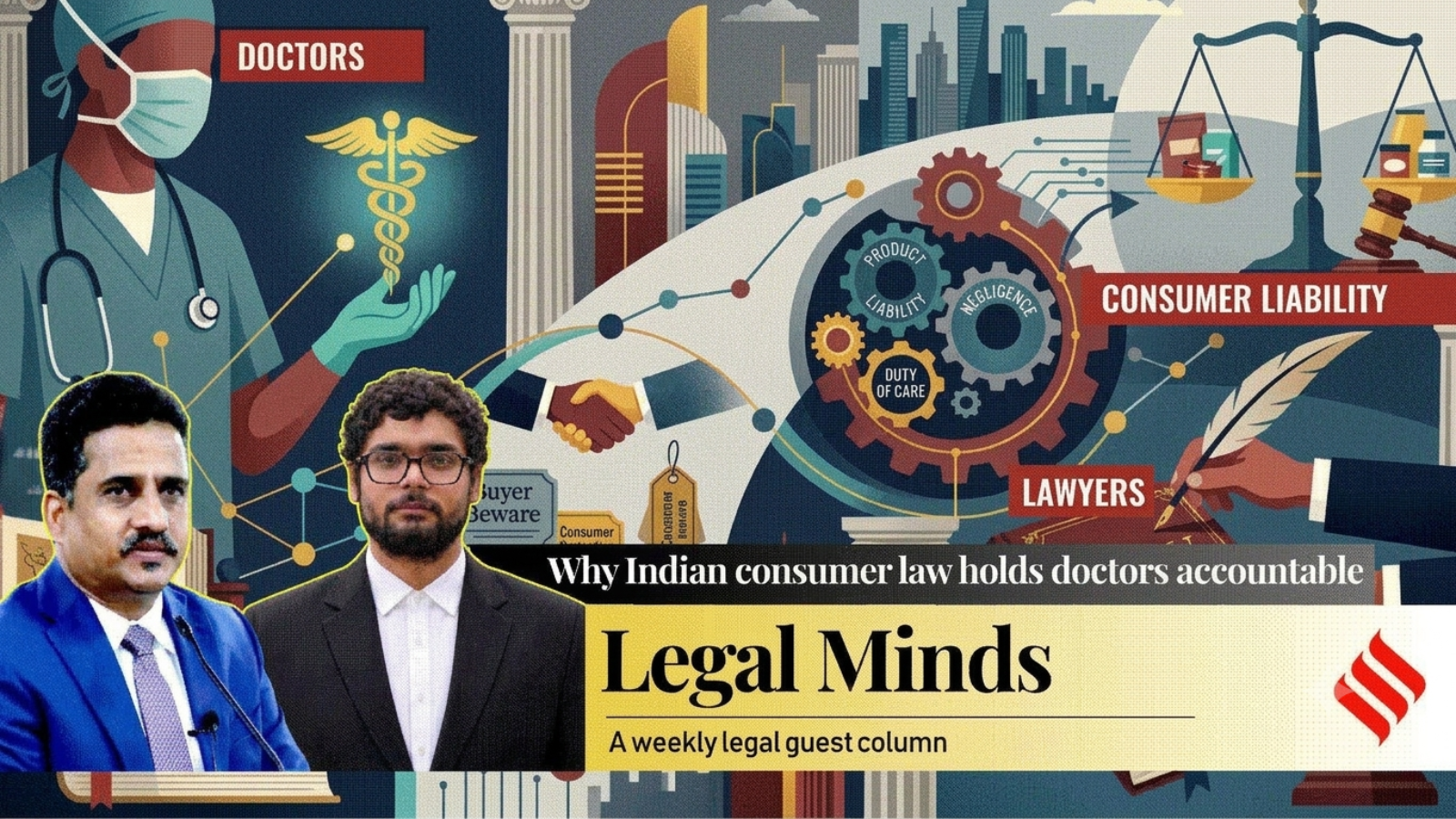
Written by Prof. (Dr) Ashok Ramappa Patil and Sumit Kumar Singh
The Supreme Court‘s refusal to hear the curative petition in open court in the Medico Legal Society of India v. Bar of Indian Lawyers & Ors. on September 9, 2026, places medical practitioners back in a familiar controversy. Doctors who render certain medical services remain liable under consumer protection laws, while lawyers’ services are exempt from such liability.
To properly comprehend this “variance”, it is essential to look back at previous cases defining professional negligence, which admitted medical treatment within the ambit of consumer protection law while exempting lawyers from its jurisdiction.
The curative petition is an exceptional post-review remedy available before the Supreme Court, established in Rupa Ashok Hurra v. Ashok Hurra (2002).
While Article 137 of the Constitution makes it clear that “the Supreme Court shall have power to review any judgment pronounced or order made by it”, curative jurisdiction comes into play once the ordinary process has been exhausted and its use is limited to situations that involve ‘gross miscarriage of justice’ or ‘abuse of process’. It, therefore, does not constitute a second appeal or an ordinary second review of the case.
A five-judge bench comprising Justices Vikram Nath, B V Nagarathna, M M Sundresh, Prashant Kumar Mishra, and K V Viswanathan ruled that the petition did not meet the threshold set out in Rupa Ashok Hurra (2002).
Procedurally, the matter arose from a review petition of 2025 in a civil appeal of 2009. The Court, however, did not go into the merits of the case. Thus, this procedural finality sharpens, once again, the substantive question of what professional services Parliament intended consumers to be able to sue over for incompetence.
Story continues below this ad
Accountability for professionals predates consumer protection laws for many years. In one of the formative Supreme Court cases of Dr Laxman Balkrishna Joshi v. Dr Trimbak Bapu Godbole (1968), the young patient sustained a fracture of the femur and later succumbed to his injuries.
The Court found the defendant liable, emphasising the concept of ‘duty of care’. Specifically, it ruled on the obligation to decide whether to operate, to make decisions about the methods of treatment, and to carry out the procedure in practice.
The medical practitioner was expected to possess reasonable skill, knowledge, and diligence. Although the case rested on the principles of civil negligence, it formulated the idea of the duty of care that would later be relied upon in consumer cases.
Consumer law put on trial
The Consumer Protection Act, 1986, was put on trial with questions regarding the applicability of the said Act and whether the consequent relief could be accessed through its special forum by the patients or not. An early affirmation came from the Andhra Pradesh High Court in Dr A.S. Chandra v. Union of India (1992).
Story continues below this ad
The court decided that the services rendered by the private medical practitioners, the hospitals, and the nursing homes for consideration would fall within the ambit of the Act. The ruling’s significance was institutional, as the existence of the medical profession does not, by itself, preclude the application of the statutory remedy provided for unsatisfactory service.
The National Consumer Disputes Redressal Commission took the same position in Cosmopolitan Hospitals v. Vasantha P. Nair (1992), holding that paid medical service is considered a “service” under the provisions of the Act and the unsatisfactory service would give rise to a consumer remedy. It rejected the argument that physician-patient relationships fall outside contracts for personal service.
This position was contested in Dr C S Subramanian v. Kumarasamy (1994), the Madras High Court held that medical diagnosis and treatment, including surgical treatment, do not fall under the Act while distinguishing paramedical services, which could still attract consumer jurisdiction.
The Court expressed concern about subjecting complex professional judgment to summary adjudication and about the possible consequences this might have for medical practice. This disagreement matters because topical debate over professional independence and the suitability of consumer forums was already central to these formative litigations.
Story continues below this ad
In Indian Medical Association v. V.P. Shantha (1995), the Supreme Court settled the controversy by ruling that medical consultation, diagnosis, and treatment provided for consideration fall within the definition of “service”.
The Court applied the broader view and reversed the Madras High Court Judgement, holding that the questions of professional and disciplinary accountability were irrelevant to the analysis. In distinguishing ordinary medical treatment from the employment contract, it ruled that there was no relationship of the latter type between the parties.
V.P. Shantha was not without qualifications. It held that institutions from which the services were received without consideration would fall outside the scope of the Act and that where some patients pay for the services while others receive them free of charge, the latter could still benefit from the provisions. It indicated that payment for insurance and corporate-funded treatment should be considered the same as gratuitous medical services.
Accountability still requires appropriate safeguards. In Jacob Mathew v. State of Punjab (2005), arising from the prosecution of a doctor accused of a patient’s death, the Court differentiated between civil negligence and criminal negligence, holding that the latter demands a higher threshold of fault.
Story continues below this ad
The Court decided that judgment should be based on the ordinary competence of professionals, rather than their extraordinary expertise, and observed that professionals like lawyers, doctors, and architects are included in the category of people who are deemed to possess some special skill.
A person will be held liable for a negligent act if he can be shown to possess either of these two characteristics: he either did not possess the skill he claimed to have possessed, or he failed to apply the skill he possessed in that case with reasonable competence.
The National Consumer Disputes Redressal Commission (NCDRC) examined whether an advocate is covered under “service” as defined under Section 2(1)(o) of the Consumer Protection Act, 1986, in D.K. Gandhi v. M. Mathias (2007). According to the Delhi State Commission, an advocate’s engagement amounts to a simple unilateral delegation of authority under a power of attorney and therefore does not come under consumer jurisdiction.
Reversing this, the NCDRC stated that the relationship between advocate and client implies a bilateral contractual transaction involving consideration, and legal services are not rendered free of charge or under a personal services agreement.
Story continues below this ad
Therefore, the advocate’s liability may arise due to a deficiency of service, but mere failure to establish a favourable outcome does not establish the liability of the lawyer. The Commission based its conclusions specifically on Indian Medical Association v. V.P. Shantha (1995) and Jacob Mathew v. State of Punjab (2005) and used the principle stating that the professional is liable when he either lacks the relevant expertise or makes a negligent use of such skill.
The Supreme Court assessed this position as to whether lawyers could be held accountable for “shortcomings in the provision of service” as per the Consumer Protection Act, 1986/2019, in Bar of Indian Lawyers v. D.K. Gandhi (2024). Upon overturning the previous ruling of the NCDRC in 2007, the Court adjudicated that the legal profession is unique and should not be equated with other business services, as lawyers have obligations not only to their clients but also to the court as well in the administration of justice.
The Court labelled the relationship between lawyer and client as a “contract for personal services,” which is included in the list of exclusions from “service” in Section 2(42) of the 2019 Act. Hence, practitioners cannot be subjected to consumer complaints for inadequate service since they need to abide by civil, criminal, or conduct rules.
Two questions
The statutory context is crucial. According to Section 2(42) of the Consumer Protection Act of 2019, the definition of ‘service’ is broad and excludes voluntary services and personal service contracts. Section 2(11) includes negligent actions along with intentional withholding of relevant information as part of a deficiency. There is no general exclusion clause for all professionals.
Story continues below this ad
Taken together, the above decisions raise two separate questions: one is whether a professional can be held liable, and the other is whether consumer forums are the appropriate forum to address such cases. Being excluded from the consumer forum does not mean being exempt from legal liability.
The underlying challenge is to protect professional judgment while ensuring that the clients and patients are not denied redress for genuine wrongdoing. V P Shantha remains relevant to the extent that it sets such a balance between the involved aspects of professionalism.
On the one hand, it grants recognition for the value of expertise and the legitimacy of its applications; it states that injuries that occur because of ineptitude also must be subject to corresponding legislation. The dismissal of the curative petition in September 2026 left this concept operational and valid.
As professional services become more diverse, costly, and essential, consumer law must balance professional autonomy with accountability to ensure better outcomes.
Story continues below this ad
Prof. (Dr) Ashok Ramappa Patil is Vice Chancellor, National University of Study and Research (NUSRL), Ranchi, and Sumit Kumar Singh is a Research Assistant and Student at NUSRL, Ranchi.
Written by eminent law professionals, the Legal Minds Column aims to break down complex statutory frameworks into insights, both for members of the fraternity and the general public.
For feedback and pitches, write to us at expresslegal@indianexpress.com
KioskNews shows a cleaned-up reading view extracted from the publisher’s page — the original always lives on their site, not ours.