AI boom fuels ‘k-shaped’ divide
LOPSIDED DEVELOPMENT: While AI firms are riding the wave as far it can take them, traditional industries and their workers are not floated by the same flood
While Taiwan is benefiting from a global artificial intelligence (AI) boom, many traditional industries have seen little of the benefit, widening the country’s “K-shaped” economic divide, an economist said.
A “K-shaped” economy is one in which some sectors expand rapidly while others struggle, head of the commerce development and strategy research division at the Commerce Development Research Institute Ju Haw (朱浩) said in an interview.
In Taiwan’s case, high-tech and AI-related industries have continued to grow while traditional industries have come under increasing pressure, he said.
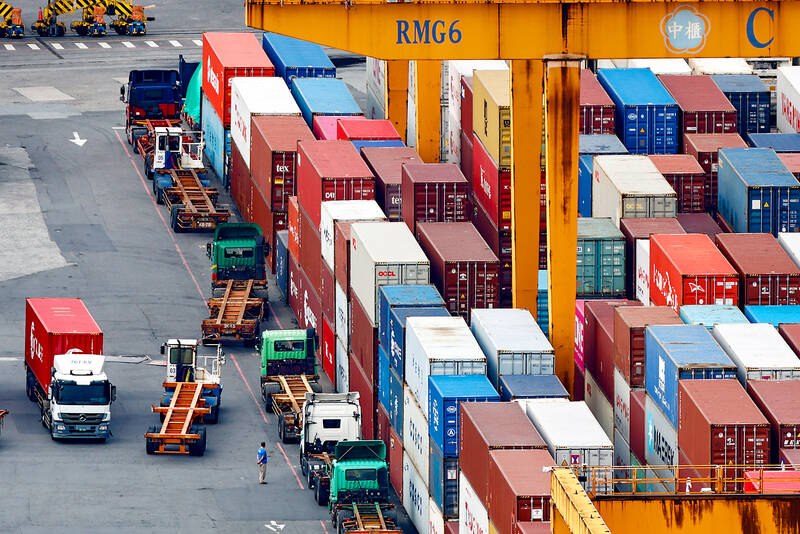
Workers load containers at the Port of Keelung on July 21.
Photo: EPA
AI development has created crowding-out effects, as large high-tech firms generating strong profits are better able to attract investment, skilled workers and energy resources, including renewable energy, Ju said,
Traditional industries, by contrast, face high barriers to transformation because they lack resources such as capital and manpower, he said.
As capital continues to flow into AI-related industries, the gap between the technology and non-technology sectors has widened, exacerbating the country’s “K-shaped” economic development, Ju said.
Taiwan has an unusual economic landscape in which AI development continues to boost GDP growth, while the headline growth rate masks uneven wealth distribution because the benefits of AI are not reaching the broader business community and the general public, he said.
Citing strong export performance, the Directorate-General of Budget, Accounting and Statistics forecast last month that Taiwan’s GDP would grow 11.05 percent this year, following an 8.76 percent increase last year.
Data compiled by the Taiwan Stock Exchange and the Taipei Exchange, which operate Taiwan’s main board and over-the-counter market respectively, showed that average annual pay at listed semiconductor firms was NT$2.58 million (US$81,000) last year, compared with NT$543,000 in the tourism sector, almost five times more.
FDC International Hotels Corp (雲品國際) president David Ding (丁原偉) said rising labor and food costs have led many hospitality firms to target higher-end customers, while others have been forced out of the market because of labor shortages and shrinking profit margins.
Shane Global Holding Inc (商億) chairman Jay Shane (謝智通) said this year has been a difficult year for the global furniture industry, as investment has continued to flow into AI-related industries and the booming stock market.
Furniture suppliers have faced pressure from US tariff policies, inflation and weakening demand, he said.
However, Eslite Spectrum Corp (誠品生活) distribution division head Lin Chia-hsien (林家賢) said AI development has helped boost consumption, allowing the retail industry to share in some of the benefits.
Visits to Eslite stores have increased by about 10 percent from a year earlier so far this year, Lin said.
In response to the difficulties facing traditional industries, Ju said they do not need to transform themselves into technology companies but should use AI applications to create higher-value products and services.
For example, a screw supplier should not simply sell screws but combine manufacturing capabilities, software and services to transform itself from a basic product supplier into a higher-value solutions provider, he said.
The government should allow traditional-industry companies to rent or share AI infrastructure, lowering the barriers to AI adoption for small and medium-sized enterprises seeking to upgrade production, he added.
KioskNews shows a cleaned-up reading view extracted from the publisher’s page — the original always lives on their site, not ours.