8 Most Powerful Spellcasters In Fantasy Books

Spellcasting has been a staple of literary fantasy since Merlin and Morgana le Fay made magic every bit as important to Arthurian legend as a sword or a seat at the Round Table. The mages, witches, wizards, warlocks, and sorcerers who followed have claimed plenty of places among the genre’s most powerful characters. Even in fantasy, though, there’s a considerable gap between a wizard who can call down lightning and one who can have a quiet word with the god responsible for the weather.
The best fantasy novels all seem to have a talented spellcaster or two. A well-timed enchantment can see a hero through an impossible fight, and an ambitious villain can do considerable damage with a vicious curse. At the very top, though, are the spellcasters whose abilities rival those of the gods. Some can reshape reality on a whim, while others cast a single spell that changes the course of history. While all the most powerful spellcasters in fantasy are different, they share one thing in common: proving why magic is a world-changing force in every setting that features it.
8 Pug/Milamber
From The Riftwar Saga By Raymond E. Feist (1982-1986)

Milamber from The Riftwar Saga demonstrates just how powerful he is in the first book of Raymond E. Feist’s Lord of the Rings-scale high fantasy series. 1982’s Magician introduces readers to The Imperial Games, which are both incredibly important for the Tsurani nobility and a spectacularly bad time for them to discover that the realm’s most powerful magic user has objections to blood sport. Appalled by the slaughter staged for their entertainment, Milamber brings fire down on the arena and sets the earth shaking beneath it. Years later, an emperor recalls that the stadium took almost five years to repair. Plenty of powerful fantasy spellcasters lose their temper, but few express their anger so publicly that people are still discussing it generations later.
One of the best things about Milamber as a character is that he wasn’t born with this extraordinary level of power. The boy who grows up to deliver that verdict on the Games spends much of his apprenticeship looking decidedly average. Known as Pug on his native Midkemia, his initial forays into learning magic are marked by repeated failure. It takes captivity on another world to reveal that Pug has such an extraordinary aptitude for spellcasting. This journey gives moments like his destruction of The Imperial Games an especially satisfying weight. Readers have seen how hard Pug worked to cast even the simplest spell. By the time he becomes Milamber, the imperial nobility knows to run for cover when he stands up.
You can purchase Magician, the first book in The Riftwar Saga by Raymond E. Feist, here.
7 Zeddicus Zu'l Zorander
From The Sword Of Truth Series By Terry Goodkind (1994-2020)

A recurring joke in Terry Goodkin’s Wizard’s First Rule, the first book in the classic epic fantasy series The Sword of Truth, is how well people think they know Zedd. The skinny old man who likes a good meal and stands naked on a rock to watch the clouds is certainly eccentric. What many don’t realize is that his true identity is Zeddicus Zu’l Zorander, the First Wizard, and practically everyone who has grown up in Westland has organized their life around a spell he cast. Of all his feats, none are as integral as the boundary at the edge of their territory.
Zedd used raw power to near-permanently separate his chosen home from the more dangerous territories of the world. To create this lasting geographic security, he brought part of the underworld into the world of the living. An invading army could march toward the border, but its soldiers would have to enter the realm of the dead to get across. Zedd has some practical spells up his sleeve too, of course, such as being able to conjure magical fire when a fight calls for it. However, his place among fantasy’s greatest spellcasters comes from solving a huge military problem by literally reshaping the landscape at will and altering the map forever after.
You can purchase Wizard’s First Rule, the first book in the Sword of Truth series by Terry Goodkind, here.
6 Belgarath
From The Belgariad Series By David Eddings (1982-1984)

Seven thousand years is a long apprenticeship, especially when the teacher is a god. This is the case for Belgarath, the incredibly potent mage from David Eddings’ Belgariad novels. Belgarath was the first disciple of the deity Aldur, who taught him the form of sorcery known as the Will and the Word. It’s an incredibly potent magic, and all that stands between the sorcerer and what he wants to do is his imagination. Belgarath gathers his will, pictures what he wants to happen in his mind, and speaks a word to bring it about.
That freedom gives Belgarath an edge over the many magic users in fantasy novels who have to learn a separate spell for every occasion. In any situation, all Belgarath has to do is work out what needs to change and use his will to make it happen. The only real catch is that he has to think through exactly what he’s asking of the world. Fortunately, Belgarath has had seven millennia to learn his craft.
You can purchase Pawn of Prophecy, the first book in the Belgariad series by David Eddings, here.
5 Quick Ben
From The Malazan Book Of The Fallen Series By Steven Erikson (1999-2011)

Quick Ben’s introduction in Gardens of the Moon, the first novel in the grimdark fantasy series Malazan Book of the Fallen, involves a dying man named Hairlock, a mysterious bundle containing a wooden puppet, and a piece of battlefield medicine that would give most soldiers second thoughts about asking for help. By the time Ben finishes working, Hairlock’s ruined body can be left on the field and the puppet has acquired a distinctly unpleasant personality. Even Tattersail, an experienced imperial mage who watches the transfer at close range, struggles to identify the magic she’s just witnessed. That uncertainty suits Ben perfectly, as it’s directly tied to why he’s one of literary fantasy’s most powerful spellcasters.
Mages in Steven Erikson’s Malazan Book of the Fallen draw power from realms called warrens, and knowing which one an opponent uses can give a rival sorcerer a fighting chance. Most spellcasters can call on one warren, or maybe two if they’re especially talented. Ben carries the souls of eleven other mages alongside his own and can call on a dozen. In 2001’s Memories of Ice, for example, he unleashes six against the necromancers Bauchelain and Korbal Broach, with six still in reserve. The resulting display of power is as awe-inspiring as it is devastating, made all the more memorable by the fact that it’s only half of the full potential Ben can unleash.
You can purchase Gardens of the Moon, the first book in the Malazan Book of the Fallen series by Steven Erikson, here.
4 Gandalf The White
From The Lord Of The Rings By J.R.R. Tolkien (1954-1955)

Besides Merlin, Gandalf is perhaps the most iconic wizard in the genre. While he was already powerful when he was introduced as Gandalf the Grey in The Hobbit, it’s not until his death and resurrection in The Lord of the Rings that he’s elevated to one of fantasy fiction’s most powerful spellcasters. When Gandalf returns in white, the change signifies much more than a simple color change. Both he and Saruman, the previous White Wizard, are Maiar, spirits who existed before the world took shape. These spirits, known as the Istari, were sent to Middle-earth in the bodies of old men, tasking them with helping the peoples of the world resist Sauron.
Saruman the White originally led the group, but his downfall came when he decided that his potential for great power meant wielding it was his true goal. Gandalf stays faithful to the task of resisting evil even at the cost of his life. Eru Ilúvatar, the central creator deity in Tolkien’s Middle-earth mythology, recognized this and so returned him to life with greater power. As the White Wizard, Gandalf became so powerful that one word was enough to break Saruman’s staff, and even the most powerful servants of Sauron like the Nazgûl instinctively feared him.
You can purchase The Lord of the Rings by J.R.R. Tolkien here.
3 Ged
From The Earthsea Cycle By Ursula K. Le Guin (1968-2001)

Long before Ged becomes Archmage in the later books of Ursula K. Le Guin’s Earthsea Cycle, he demonstrates his extraordinary magical potential by saving his village with a spell he barely understands. Raiders have landed on Gont, the villagers are hopelessly outmatched, but the son of the community’s bronze-smith knows a charm for gathering mist. He draws enough fog around the village to hide its defenders and send the invaders blundering through familiar ground that suddenly belongs to the locals again. It’s an almost prophetic first victory for the boy who will be called Sparrowhawk and, eventually, the Archmage of Earthsea.
Saving Gont also reveals why Ged is such a potent spellcaster beyond his raw power. It’s his intelligence. Even with a beginner’s grasp of magic, Ged can see possibilities that would escape a more conventional wizard. This is especially important since the unique magic system in Earthsea depends on knowing the true names of things. Ged’s has an exceptional ear for the Old Speech and can use it to discover true names that many wizards spend years trying to learn. That gives him an extraordinary range of magic, which he combines with his intellectual understanding of how his individual powers are all connected. This combination of raw talent and learned skill makes his eventual rise to Archmage feel like it was always his destiny.
You can purchase A Wizard of Earthsea, the first book in the Earthsea Cycle by Ursula K. Le Guin, here.
2 Rand al’Thor
From The Wheel Of Time Series By Robert Jordan (1990-2013)

For most of history in author Robert Jordan’s The Wheel of Time novels, the worst news a man could get was that he could channel. The Dark One’s corruption of saidin, the male half of the One Power, meant that every use brought him closer to madness. For Rand al’Thor, a shepherd from the Two Rivers, that discovery comes with the news that he’s the Dragon Reborn. By the time he stands outside the besieged city of Maradon in Towers of Midnight, the 13th Wheel of Time book, Rand can weave so many attacks at once that he breaks an army of Shadowspawn single-handedly.
Impressive as his display of power at the battle of Maradon was, Rand’s greatest act of channeling gives other men a future he spent much of the series believing he’d never have. In the 9th Wheel of Time novel, Winter’s Heart, he links with Nynaeve al’Meara and draws on two enormous reservoirs of power through artifacts called the Choedan Kal. Rand funnels saidin toward the ruined city of Shadar Logoth, turning the evil that consumed the city against the corruption poisoning the male half of the Source. Essentially, Rand is a spellcaster so powerful that he doesn’t just use magic to change the world, he uses his power to change magic itself.
You can purchase The Eye of the World, the first The Wheel of Time novel by Robert Jordan, here.
1 Coin
From Sourcery By Terry Pratchett (1988)
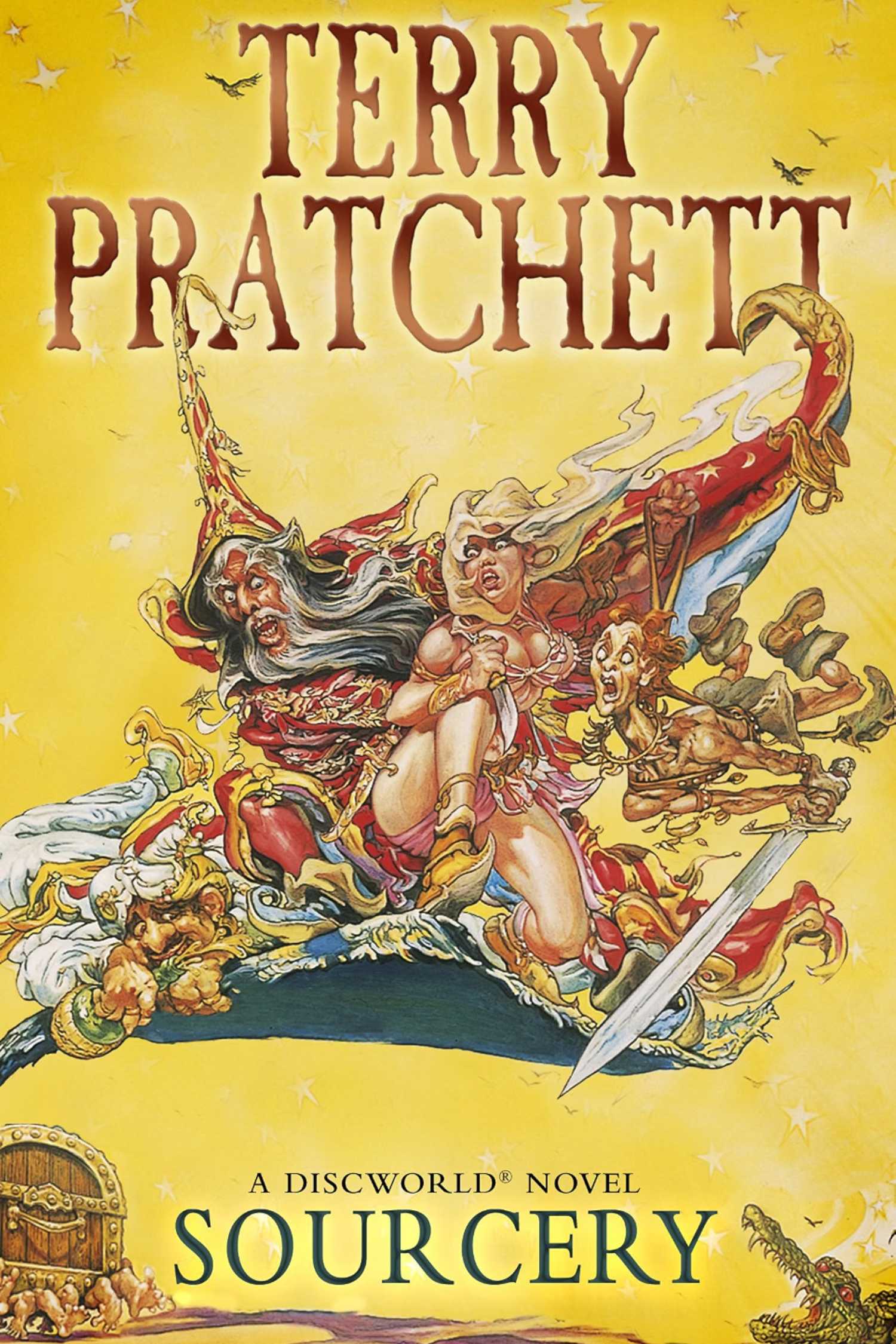
The extra letter in the title of Terry Pratchett’s Sourcery, the fifth novel in the Discworld series, isn’t a typo. It’s a clue as to why Coin, the first sourcerer to be born on Discworld in millennia, is so powerful, and why were strict laws in place to prevent the creation of his kind in the first place. On the Disc, an eighth son of an eighth son is born with the potential to become a wizard. When that wizard has an eighth son of his own, the result is a sourcerer like Coin, a boy who brings fresh magic into the world simply by being there. This is a catastrophic development, since the relatively small amount of magic already on the Disc is enough to create problems.
Coin’s mere presence is enough to risk the end of reality long before he actually starts to use his power. When he does demonstrate his abilities, Coin pulls off feats like imprisoning the gods of the Discworld in a pocket dimension reality small enough to resemble a pearl. He’s so powerful that he’s not even beaten in the traditional sense. Once he realizes just how dangerous he is, he decides to leave reality entirely, and creates his own little universe where he can live in peace. Many of the most powerful spellcasters in fantasy novels gain their abilities through learning how to harness magic. Coin is another level because he is, essentially, raw magic given a physical form.
KioskNews shows a cleaned-up reading view extracted from the publisher’s page — the original always lives on their site, not ours.