China seeks leverage before US summit
DIPLOMATIC TOUR: Chinese President Xi Jinping began a series of overseas visits last month to Kyrgyzstan, Egypt and India, aimed at securing leverage, an official said
By Chen Yun and William Hetherington / Staff reporter, with staff writer


Recent Chinese diplomatic and military moves are aimed at creating pressure ahead of a planned meeting between Chinese President Xi Jinping (習近平) and US President Donald Trump, National Security Council adviser Huang Chung-yen (黃重諺) said.
Trump when visiting China in May extended an invitation to Xi to visit Washington on Sept. 24.
China is yet to officially announce plans for Xi’s visit to the US.
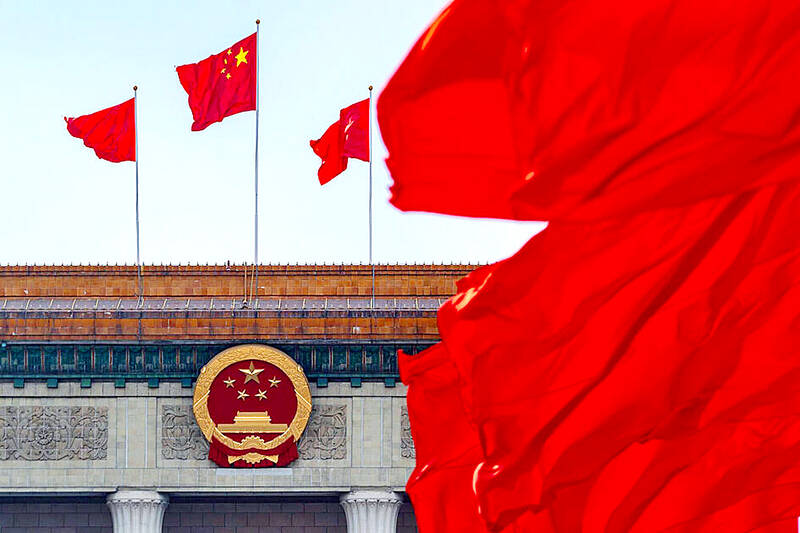
A Chinese national flag is pictured at the Great Hall of the People in Beijing in an undated photograph.
Photo: Bloomberg
In an interview with the Liberty Times (sister paper of the Taipei Times) on Thursday, Huang said Xi’s overseas visits, China’s “gray zone” activities along the First Island Chain and efforts to expand its trade surplus with the US through low-priced exports are intended to create “final pressure” ahead of the meeting.
The moves are aimed at securing leverage in negotiations abroad while creating the impression at home that China is doing well despite its economic downturn, Huang said.
Xi began a series of overseas visits late last month, including attending a Shanghai Cooperation Organization meeting in Kyrgyzstan, where he met Russian President Vladimir Putin, visiting Egypt, the first country to join the Belt and Road Initiative, and attending the BRICS summit in India, Huang said.
China has also stepped up “gray zone” incursions in the East China Sea, South China Sea and waters around Taiwan, particularly in Taiwan’s eastern waters and waters near Japan and the Philippines, using increased geopolitical pressure as a bargaining chip, he said.
Economically, China’s overcapacity and low-priced exports have spilled over into G20 and other countries. Beijing is seeking to use its growing trade surplus with the US as leverage to negotiate increased purchases, Huang said.
The issues are growing concerns for other countries, which must protect domestic industries from low-priced Chinese exports and address geopolitical pressure from Beijing.
The US must protect its trade interests while ensuring regional security, he said.
Regarding a possible US-China dialogue on artificial intelligence (AI) security before the summit, Huang said AI encompasses computing capacity, energy infrastructure, chips and semiconductors, and downstream applications, making it extremely resource intensive.
Countries must establish security safeguards while maintaining technological competition, preventing authoritarian countries from gaining control of critical technologies, he said.
Huang said that during the administrations of former president Tsai Ing-wen (蔡英文) and President William Lai (賴清德), Taiwan’s core objective has been to remain “indispensable” to the geopolitical landscape and global supply chains.
Taiwan’s indispensability is also reflected in the US National Security Strategy and National Defense Strategy, which establish Taiwan as a core element of security along the First Island Chain and in global supply chains, Huang said.
Separately, regarding a Kyodo News report on Saturday saying that China has asked the US not to approve new arms sales to Taiwan before the summit and that Xi could consider canceling his visit if Washington approves such sales, Hung Pu-chao (洪浦釗), an assistant professor at the University of Taipei’s Center for General Education, said yesterday that even an agreement between the US and China would be unlikely to alter their strategic competition.
The meeting would involve negotiations over major strategic interests, and Taiwan must understand how Washington and Beijing handle the Taiwan issue to prevent its interests from being affected by their negotiations, Hung said.
If the two sides reach partial agreements, the key question would be whether US-China relations enter a period of short-term easing or merely adjust the way they compete, he said.
The outcome would affect security in the Taiwan Strait, the US-Japan alliance and the broader Indo-Pacific region’s security framework, Hung said.
KioskNews shows a cleaned-up reading view extracted from the publisher’s page — the original always lives on their site, not ours.