[In This Economy] Less than 10% of Filipinos are now poor? Not so fast
- The Philippine Statistics Authority reported a record low poverty rate of 9.7% in 2025, equating to 11.08 million poor Filipinos, down from 15.5% in 2023.
- Despite this positive statistic, concerns arise regarding the methodology used to define poverty, as well as discrepancies with World Bank data suggesting higher poverty rates using international benchmarks.
- The slow pace of poverty reduction in the Philippines compared to neighboring countries raises questions about the effectiveness of economic growth in alleviating poverty, and upcoming revisions to poverty measurement may reveal a more complex reality.
This is AI-generated. Read the article for full context. Report any errors.
Rather unceremoniously, on August 21, the Philippine Statistics Authority (PSA) announced in a press release that only 9.7% of Filipinos were poor in 2025, the lowest rate on record.
That is equivalent to 11.08 million poor Filipinos, down from 17.54 million or 15.5% in 2023. In just two years, nearly 6.5 million people were supposedly lifted out of poverty.
The PSA added that average income per person grew by 22% from 2023 to 2025, much faster than the 5.5% increase in the poverty threshold. Incomes also rose by 23.8% among the poorest tenth of families and by 22.7% among the next tenth, suggesting substantial income gains among poorer segments of the population.
All of this is welcome news. But why was there no full-blown press conference, unlike in previous poverty reports? Isn’t the Marcos administration proud of these numbers? After all, didn’t they aim to have single-digit poverty by 2028 (meaning they achieved it 3 years earlier)?
When you look deeper, the headline poverty figure is not the end of the story. First, it does not jibe with the World Bank’s report earlier this year that poverty will be stuck at double-digits at least until 2030. (I wrote about this in a previous column.)
Also, the sparkling 9.7% statistic depends heavily on where exactly the government draws the poverty line. In 2025, the national threshold was P14,634 per month for a family of five, or about P98 per person daily. Does earning slightly more than that really make a Filipino automatically nonpoor?
Different yardsticks
Every country sets its own national poverty threshold, or the minimum income needed to meet basic food and non-food needs. These thresholds reflect local prices and national judgments about what counts as deprivation.
But comparing national poverty rates across countries is like comparing distances measured with different rulers. For a fair comparison, we need a common poverty line across countries.
The World Bank does this using purchasing power parity (PPP), which adjusts currencies for differences in what money can actually buy in each country. Since June 2025, it has used three international poverty lines: $3 per person daily for extreme poverty, $4.20 for lower-middle-income countries, and $8.30 for upper-middle-income countries.
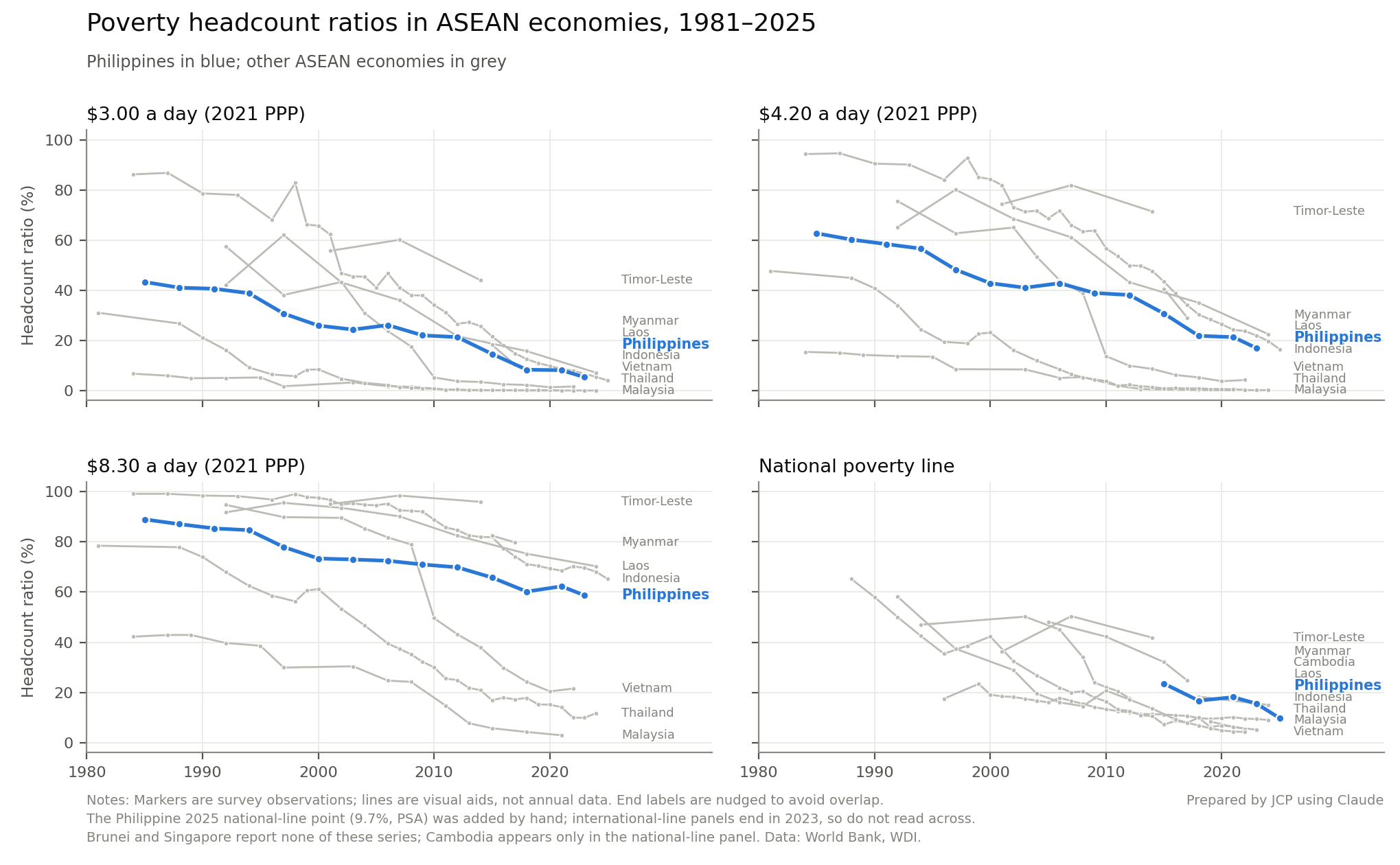
Using the $3 line, only 5.3% of Filipinos were poor in 2023, compared with Vietnam’s 1.6%, while Malaysia and Thailand were both at virtually zero. If you raise the line to $4.20, Philippine poverty rises to 16.9%. Vietnam was at 4.2%, Thailand at 0.2%, and Malaysia at 0.1%.
The gap becomes startling at $8.30. In 2023, 58.7% or more than half of Filipinos lived below this threshold, compared with 21.5% in Vietnam, 11.7% in Thailand, and 2.9% in Malaysia.
In short, under the poverty line most relevant to upper-middle-income countries, nearly three in five Filipinos were poor!
This matters because on August 3, the World Bank officially classified the Philippines as an upper-middle income country (UMIC). That makes the $8.30 threshold a more relevant international benchmark to us, although it does not replace our official national poverty line set by the PSA.
Note that the latest available surveys differ by country, namely 2021 for Malaysia, 2022 for Vietnam, 2023 for the Philippines, and 2024 for Thailand. They also measure either income or consumption, so tiny differences should not be overinterpreted.
But at any rate, the gaps are far too large to ignore. Becoming upper-middle income did not suddenly make most Filipinos economically secure—and Filipinos know this intuitively. (Maybe the reason the government isn’t too proud of these otherwise good statistics is that they know many people will find the data unconvincing?)
Snail’s pace
The level of poverty is troubling enough. But the speed of poverty reduction is even more revealing.
Using the $8.30 line, Philippine poverty fell by a measly 0.64 percentage point yearly from 2000 to 2023. (A percentage point measures the arithmetic difference between two percentages.)
Impressively, Vietnam reduced poverty by 3.41 percentage points yearly from 2002 to 2022, or more than five times our pace. Thailand managed 2.06 points yearly, while Malaysia achieved 1.53 points.
Indonesia’s annual reduction was 1.30 percentage points from 2000 to 2025. Even Laos, which has not yet reached upper-middle-income status, managed 1.06 points from 2002 to 2024.
Imagine that: by this higher and more realistic benchmark, Laos has been reducing poverty faster than the Philippines.
These comparisons do not by themselves tell us why. But they expose a basic weakness of our development story: economic growth in the Philippines has translated into poverty reduction much more slowly here than among several neighbors.
New standards
There is another reason not to celebrate too soon: in November 2025 the PSA Board approved refinements to the official poverty estimation methodology, including a requirement to review the method every 10 years so that the statistics remain relevant.
Experts have been saying that this review is long overdue. The official framework has long relied on a food-to-total-basic-expenditure ratio of 0.6983, derived from household surveys conducted in 2000, 2003, 2006, and 2009.
In other words, the government has been using spending patterns from many years ago to estimate how much poor families need for non-food essentials such as housing, health care, education, transportation, electricity, and water.
We are still waiting for the detailed 2025 datasets and poverty estimates based on the refined methodology. If the revised threshold is higher, the measured poverty rate may also rise significantly—a development that the Marcos administration may find a bit embarrassing, especially in the run-up to 2028.
That would not mean millions of Filipinos suddenly became poor overnight. It would mean the government finally started measuring deprivation with a more realistic metric.
The 9.7% figure therefore tells us something important: poverty under the existing national threshold has fallen, sure, but it does not tell us that literally only one in 10 Filipinos faces serious economic hardship.
In the end, our new upper-middle income label should raise our standards, not lower our ambition. Will the Marcos administration measure poverty honestly, expand protection to families just above the official line, and create the better jobs needed to match our neighbors’ progress?
Until the updated figures arrive, any claim that Philippine poverty has largely been solved is premature. Once the dust settles, we’ll see the fuller story of what really happened to Philippine poverty. – Rappler.com
Jan Carlo “JC” Punongbayan, PhD is an associate professor at the University of the Philippines School of Economics (UPSE). His professional experience includes the Securities and Exchange Commission, the World Bank Office in Manila, the Far Eastern University Public Policy Center, and the National Economic and Development Authority. JC writes a weekly economics column for Rappler.com. He is also co-founder of UsapangEcon.com and co-host of Usapang Econ Podcast.
His first book, False Nostalgia: The Marcos “Golden Age” Myths and How to Debunk Them, was published by Ateneo de Manila University Press in February 2023. His second book, Twin Plagues: How Duterte and Covid-19 Wrecked the Philippine Economy, was published by Penguin Random House SEA in June 2026. Follow him on Instagram (@jcpunongbayan).
KioskNews shows a cleaned-up reading view extracted from the publisher’s page — the original always lives on their site, not ours.