Inside Whalefall: How Austin Abrams & Josh Brolin's Impossible Movie Came To Life
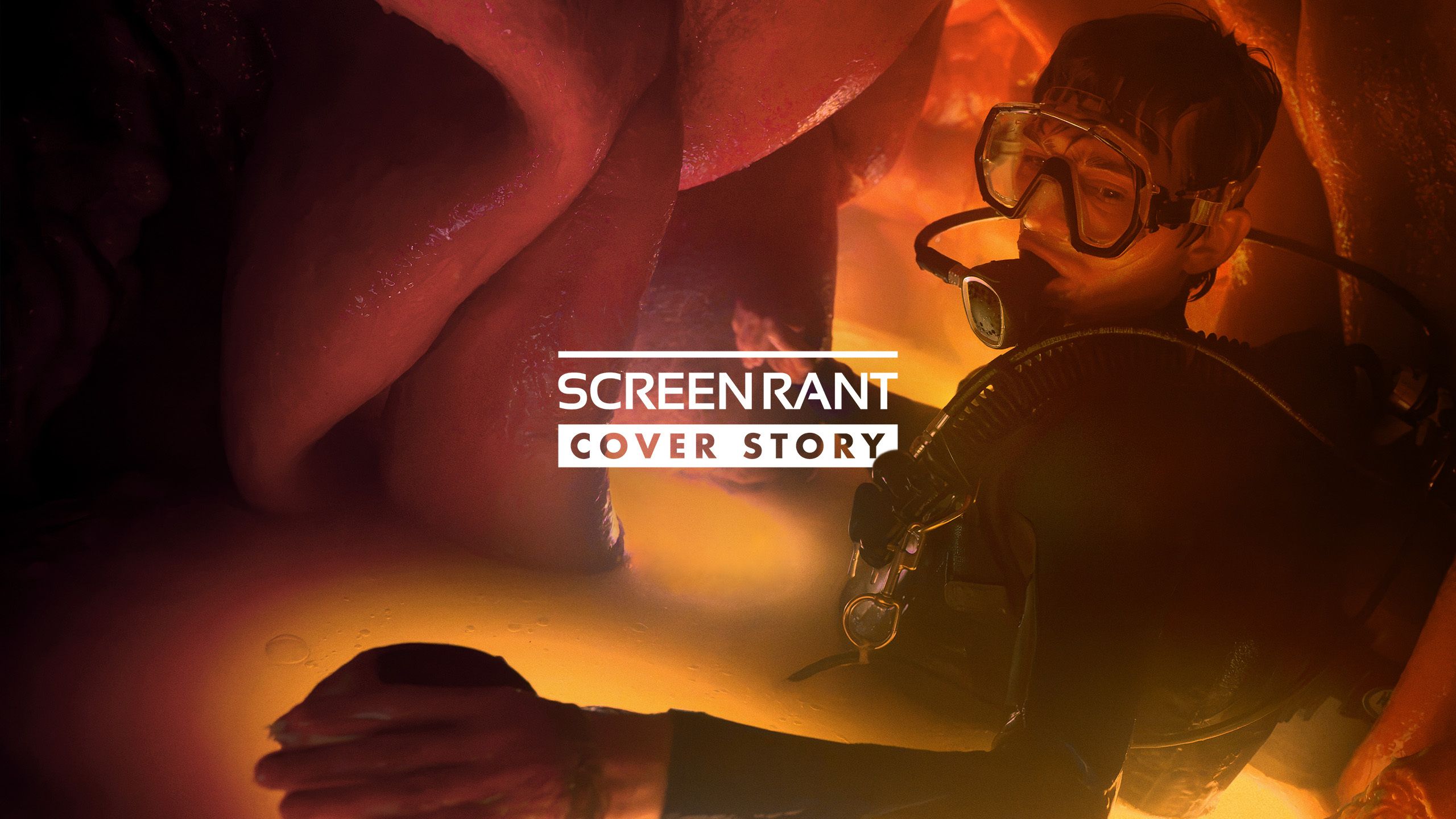
If you've seen a trailer for Whalefall, or even if you've just read the logline, you might feel like you know what to expect from it. A diver struggling to survive being swallowed by a whale? That's a claustrophobic, ticking-clock thriller if I've ever heard one – a fun night out at the movies for anyone who likes to get their heart racing.
See it when it releases on October 16, and it'll certainly scratch that itch. But across a series of interviews with the people who made it, one thing became clear: Whalefall is more than you bargained for.
"It's been an interesting thing with marketing, where it's hard to convey that it's not a shark movie," co-writer and director Brian Duffield told us. "Because, obviously, you look at the materials, and it looks hopefully cool, but it looks like a killer ocean movie. And... it is and it isn't."
Through interviews with Duffield, original author and movie co-writer Daniel Kraus, stars Austin Abrams and Josh Brolin, and producer Allan Mandelbaum, this ScreenRant Cover Story takes a peek behind the curtain at the real Whalefall. Between the practical, realistic filmmaking, the above-and-beyond commitment of its lead actor, and the translation of the book's moving father-son story to a new medium, don't be too surprised if you go from tightly gripping your chair one moment to unexpectedly weeping into your popcorn the next.
Whalefall Was Destined To End Up On The Big Screen

Whalefall began life as an idea sparked by a viral video of a kayaker being engulfed by a whale – something that Daniel Kraus, author of the 2023 novel and co-writer of the screenplay, told ScreenRant happens from time to time. In these encounters, the whale typically releases the bewildered boaters within seconds. But Kraus soon found himself wondering, what if it wasn't brief? What if a person was actually swallowed by one?
"I've written maybe 30 books," Kraus told us, "and this is the only idea I've ever had where instantly I felt the importance of it. It struck something almost primordial in me. There's something about being swallowed by another animal, it's just in part of our brains still."
He did the research: Yes, the esophagus of a sperm whale is hypothetically large enough to fit a human being. He fleshed out the story, sold the book on the premise, and shared the deal memo on his social media.
Soon enough, director Brian Duffield, then in post-production on his 2023 film No One Will Save You, was in his DMs. "He tweeted that he had made a publishing deal for Whalefall, and that it was about a teenage boy who got swallowed by a whale and had an hour left to live," Duffield recalled. "I felt like I got hit by lightning. I slid into his DMs, and I was just like, 'I want to read this as soon as possible.'"
The only problem? The book wasn't written yet. But Duffield was "persistent enough" that Kraus felt compelled to give him an early copy as soon as it was done.
What followed was, according to Kraus, a common experience for readers of the book. "They go in expecting just a thrill ride. And they get that. But I don't think he expected the emotions of it, and that caught him sort of unaware, in a really good way."
From Duffield's telling, the experience was much more intense than the author made it sound:
When I finally did read the book, I was excited for the survival thriller challenge of it, and did not know about the father-son [story], all the emotional stuff. So, I got pulverized reading it. And it was really special, because I feel like I figure out what I want to make, if I'm adapting something, by reading it, and it just starts triggering all these emotions and feelings in me. And I just had my son at the time, and so it was really trippy reading this book about, in a lot of ways, a father's regret – and a son's regret – and, like, holding a baby... and just being like, 'Oh, this book was written for me to be a part of.'
But it was really the surprise of that – I just vividly remember, as I was turning the pages, being shocked at what he was getting out of me.
Duffield's emotional response to Whalefall being part of a trend for anyone reading the book was reflected in SR's interviews: Both producer Allan Mandelbaum and Josh Brolin, who plays the protagonist's father Mitt, told us something similar. In the former's case, it resulted in Imagine Entertainment snapping up the film rights before the book was published. The momentum that would eventually bring this story to a theater near you built up from the very beginning and never really stopped.
Before Building The Whale, Whalefall Had Another Adaptation Challenge To Solve

Getting excited by the potential of an idea is easy. Turning that idea into an actual movie is a whole lot harder. And this idea was harder than most.
DANIEL KRAUS: What I really liked about my first meetings with [Duffield] about it, before anyone else was involved, was his honesty in saying, 'I have no idea how to do this. Like, I don't know how one makes a movie like this. I don't know how one shoots a whole movie inside a stomach. Like, I don't have any answers.' But his excitement over the process of finding the answers was exciting to me.
Kraus and Duffield decided to write the screenplay together, which Duffield called "my big cheat code." At that point in the process, the whale scenes weren't the big challenge they would eventually become. In fact, they were pretty straightforward.
"The book does everything you can do in a whale," Kraus explained. "I always joked that it was sort of studio-proof, in a way, because you can't add anything else to the story, you know? Like, you can't add a car chase in the middle of a whale, right? So, the whale stuff was really never going to change, because there's no other way to change it."
There was no blueprint for how to shoot a movie inside the belly of a whale...
Instead, the flashbacks were the real headache. As much as Whalefall is about Jay, the protagonist played by Austin Abrams, trying to avoid dying in the belly of a whale, it's also about him reflecting on his strained relationship with his late father. These memories are the emotional core of the story, and prove crucial to Jay's struggle to survive. But a film adaptation would be much more limited in its ability to deploy them without deflating all the tension.
"In the book, there's 50 of them. We're constantly shuttling back and forth in time," Kraus said. "And we knew, in the movie, we'd probably get five of those."
BRIAN DUFFIELD: Daniel's prose is really fluid, and so there's a lot of, like, [Jay will] be doing something, and there'll be [a] three-sentence kind of flashback to what's going on in his past. And then it'll be back to the present, then back to another flash... It's not broken up into flashbacks like the movie is, it's just more stream of consciousness.
So, that was the first thing to figure out, like, okay, how do we utilize Mitt in a way that feels earned, that it doesn't feel like you're letting air out of the balloon? You're so tense with Austin in the stomach, you don't want the flashback to be like, 'Oh, a break from the suspense.' So that was the biggest challenge, was just how to elegantly incorporate Mitt into the story in a way that I felt like it kept pushing the story forward.
And then the second thing... was a structural thing: Where do we place these events in the structure, so that you feel like there's always a sense of momentum going? [...] Because there's maybe hundreds of little flashbacks throughout the novel, you were kind of always getting, like, this drip-drip feed of that relationship. So, it was a lot of Daniel and I really pinpointing, what are the landmines that the movie needs to have of this relationship, where it's able to propel you forward, and without taking out the suspense of everything that's happening to Austin in real time?
Getting that balance right took a bit of experimentation. Duffield and Kraus changed the placement of scenes repeatedly during the writing process, and made tweaks during filming when they sensed another flashback was necessary. As a result, arguably the meatiest scene between Abrams and Brolin, which takes place at the end of the book, is moved closer to the start of the movie, when Jay is swallowed by the whale.
"It was like, okay, before he goes into the whale, let's put all of our cards on the table," Duffield said. "This was what their relationship was like. And then, emotionally, it felt like that covered the rest of the movie, where you kind of understood where Austin [Abrams' character] was coming from, [and] you also kind of understand where Josh Brolin's character was coming from. You can understand how they just really missed each other, dramatically.
"And then everything that happens inside the whale, it felt like you had a real grounding effect of, like, you're building off the ruins of that relationship in a way."
Whalefall's 'Living' Practical Set Is True Movie Magic

With the script ready, and the biggest problems on the page squared away, Duffield and his team faced their biggest hurdle. As much as the flashbacks provide a welcome change of scenery from time to time, most of Whalefall takes place inside a sperm whale's stomach. Can't say you've seen that before, can you?
"There was no blueprint for how to shoot a movie inside the belly of a whale," said Allan Mandelbaum, producer and Executive Vice President of Features at Imagine Entertainment. "So we really had to, you know, figure it out as we went."
Thankfully, Disney and 20th Century Studios showed their faith in the project by giving the Whalefall team some time to test things out before officially committing to make the film. They turned to Wētā Workshop, the storied New Zealand special effects house that helped bring Middle-earth, Narnia, and Arrakis to life, to explore how the set could be built, lit, and filmed practically.
ALLAN MANDELBAUM: We were very fortunate to have a healthy R&D period where we had a little bit of financing from the studio before we were officially greenlit to work with Wētā Workshop and figure out, how can we build something that looks like the inside of a whale? How can we light the inside of the stomach? How can we do it in a way where it doesn't feel like there's artificial lighting coming into a space where there should be no lighting whatsoever? And so, how can we use the bioluminescence of the jellyfish and the insides of this whale to basically light every scene?
That became one of the biggest challenges, but also one of the things that I think we're most proud of with the production of this movie – trying to capture that setting as realistically as possible by using methods that really had never been done before. And so, it was challenging, but it was also very fulfilling, I would say, creatively.
In the final film, the result is an impressive, immersive experience. "I'm glad the magic trick works," Duffield told us. At the same time, he's eager for everyone to understand what really went into it. "I do feel like at some point, hopefully, Disney will put out a making-of thing, because it's really insane and nutty."
Everything inside the whale, nothing's stationary. Everything's pulsing, or swelling up, or the reverse, or trembling, or rolling.
Wētā built four versions of the whale's main stomach chamber, plus one version of its second chamber, which Mandelbaum described as the "red, gooey one." To capture the experience of being inside a living animal moving through the ocean, the sets all moved in a variety of ways. "We had rigs that were going 90-degree angles. We had rigs that were twisting and turning. You could capture the movement of the water, and so it mimicked the movement of the whale in the ocean, essentially."
The set was partially submerged in water, which naturally made things more complicated. And, as Duffield reminded SR, "the main stomach chews its food," and thus had to be animated in all kinds of ways. "Austin's just sitting in a live set, basically, the whole time."
The bioluminescence effect that lights the set was its own tricky dance. As you'll see in the movie, it's as active as the stomach movements and reacts to Jay's touch. Duffield broke down how they actually achieved it on set:
The bioluminescence, which we used to do lighting with, is LED noodles that were kind of programmed in a video feed to have different randomized patterns kind of strung up inside [the set]. They get [digitally] erased, but the illumination on Austin and the set remains. And then we also had, like, a light DJ, basically, that was watching a monitor, that anytime Austin, or a squid, or a puppet, is touching something, they're triggering the bioluminescence in the right spot to light up and behave like bioluminescence would.
So, Austin's alone in the stomach, but there are dozens of people – there's a light performer, basically, acting opposite Austin. So, that's our cinematography, in real time, reacting to everything Austin is doing. It took a lot of months to kind of figure out how to do it, with the help of Wētā and then [Industrial Light & Magic].

When Daniel Kraus visited the set during filming, the stomach was what made the biggest impression. Not only did he see something he imagined and wrote down become a place he could climb into ("I did once, and it was disgusting"), he was struck by "how alive everything was.
"Everything moves, you know? Everything inside the whale, nothing's stationary. Everything's pulsing, or swelling up, or the reverse, or trembling, or rolling. There's just... there's not really any steadiness to it.
And I was always super impressed by that."
When Austin Abrams discussed his experience working with the sets, he emphasized just how much harder the filmmakers had made things for themselves by committing to such an ambitious and uniquely challenging practical production.
I feel like there's so many different versions of this where it's not a full 360-degree set, you know? Where maybe they kind of cut some corners and made it a little bit easier. They didn't make it easy for the crew. They had to stuff a dude inside of it most of the time, or figure out how to cut a hole or something like that. They basically just built this thing, and then it was like, okay, now figure out how to shoot with it.
No easy task. With all that going on, and creatures such as jellyfish and a giant squid sharing the space with Jay, the small stomach set would get pretty crowded. Sometimes, the biggest challenge was just figuring out where to put the camera.
"There would be days when we weren't getting a lot of shots," Duffield explained, "because we were just, like, we had a storyboard that was this, but we had to figure out a new place to put the camera, because there are too many people that were doing too many different things that there's nowhere to put a camera.
"We figured it out. We won't do a sequel," Duffield laughs, "but we figured it out."
How Austin Abrams Became Whalefall's Not-So-Secret Weapon

When it came to casting, Josh Brolin was a no-brainer. Daniel Kraus wasn't directly involved in the casting process, but for actors he could picture as Mitt, "Brolin was certainly top of my list." Duffield agreed: "You read this book, and it's Josh Brolin... As I've gotten to know Josh just a little bit, if you had told me, 'Oh, there's this book, Whalefall, this is what it's about,' I would have been like, 'You should send that to Josh.' Like, it's just such a bullseye for him as an artist."
Brolin was sent the book and started reading it on the set of Ridley Scott's The Dog Stars. Though he remembers wondering how, exactly, this adaptation could be pulled off, he connected so strongly to the material that he was in from the jump. "I wasn't really thinking technically. I was really, really moved by the book. I sobbed at the end of reading the book."
Austin Abrams' casting, however, was kismet in multiple ways. When he came through the audition process, his career was starting to heat up. Jon Watts' Wolfs, in which Abrams plays essentially the third lead across from George Clooney and Brad Pitt, had already generated some buzz for his performance. But Weapons hadn't released yet, and Resident Evil was still just a glimmer in Zach Cregger's eye. The wave that would become this current moment hadn't really formed yet.
From his auditions, Duffield said, they knew he was the right actor for the part. "He just came in and knocked all of our socks off... We were all like, it's undeniably Austin." Soon, 20th Century started to embrace the choice.
BRIAN DUFFIELD: I think the studio was really excited about Austin, because Wolfs had just come out, and he steals the show in that movie. And they were kind of like, 'If he's really able to hold his own across from Brad and George, you know, what can't he do?' And I think Watts said great things about him to the studio, and Cregger did [too], and so I think that gave them the confidence.
The only thing that could have held them back was, ironically, Weapons. The story of Cregger's horror movie was a complete unknown at that point, but Duffield knew that both Abrams and Brolin were in the cast. "I had to call Zach, and I was like, 'Can you just please tell me if they're related in your movie?' Because I'm fine with casting the same guys, but, like, it's gonna suck if Austin is playing Josh's son in Weapons. That might be a bridge too far."
Luckily, they weren't, and Abrams got the part.
By the time Weapons was released and "blew up," as Duffield put it, Whalefall was almost done filming. When the team realized Resident Evil would release just a few weeks before their movie, they were in post-production. Now, instead of featuring an exciting young actor with some heat, Whalefall stars a new Hollywood leading man at the moment he's breaking through to another level of stardom. Or, as Duffield put it, we're living through "Austin Autumn."
But his timely boost in profile wasn't the only gift that came from casting Abrams. Everyone SR talked to for this cover story had nothing but praise for his talent and commitment, which began the moment he accepted the part.
"I didn't know how to [scuba dive] before [this]," Abrams told us. "It's quite extensive to learn." He started taking lessons after he was cast, and according to Duffield, "Austin, I think, is qualified to teach scuba diving at this point. Like, he's very advanced."
That training shows up on screen. Experienced divers who watch Whalefall will find that, unlike many scuba movies, this film keeps things as realistic as possible – in part because it was literally happening.
BRIAN DUFFIELD: We just wanted it to feel as real as possible, because I think that's where the terror comes from. And, like, there's no dry-for-wet. Austin, every shot in the water, someone is in the water. [...] We have to obey the laws of physics and scuba diving, because Austin is literally scuba diving in all of those shots.
Also, as Allan Mandelbaum told us, Abrams took his prep work even further. Before production officially started (and the studio might have prevented him from such a thing), he went to swim with real sperm whales.
ALLAN MANDELBAUM: He just decided that he, in order to prepare for the role, wanted to go swim with these magical creatures. And so, even though we in the studio were very concerned about safety and insurance, you know, he wasn't technically on the movie yet. So, he booked it himself, went with a whale expert, and found himself in Dominica swimming with a family of sperm whales.
And he sent us a video of it. And we were like, 'Oh my God, this is the craziest thing.' We're like, 'You know you don't need to do this to prepare for the role.' But that's just the type of actor he is. He really wanted to understand them and feel close to them in some way. And he did, and it was incredible.
Once on set, the challenge for Abrams was more than just physical endurance. There's not a lot of dialogue for much of Whalefall – Jay is often the only character on screen. As much as Duffield & Co. can do many incredible things to keep us locked into Jay's experience, at the end of the day, whether the film is engaging for an audience depends on Abrams' performance.
Everyone involved was impressed with the outcome.
ALLAN MANDELBAUM: God bless Austin Abrams for letting us put him through hell with that, because it was a lot. I mean, often he was the only actor on set for large chunks of time, and... not a whole lot of dialogue throughout chunks of the movie as well. So it's really him reacting and responding to what he sees and feels, and kind of that inner monologue in some ways. We were very fortunate to have an actor like Austin that could carry it.
He's a wizard, that kid.
JOSH BROLIN: The stuff that he did in the whale, like, I gotta hand it to him, man, that could have been really boring. It could have been really redundant. It could have been like, 'Oh, I'm in stomach 2, I'm in stomach 3, oh my god, I'm still suffering,' you know? And he made every moment super unique, super organic. Because I really felt like he was going through something.
There's not a lot of actors that can do that, you know? There's not a lot of people that would lend themselves for 2 months plus to... crawl in a sphincter every day, and with a wetsuit on, and have people jumping on top of it, and be that claustrophobic – because it was a 3D thing. I mean, he was in a pod. He was in a pod of rubber. I wouldn't wish that on anyone.
DANIEL KRAUS: The biggest [surprise] I can think of is just Austin's humor. He's much funnier in the movie than Jay is in the book. Like, the book is very, very dire, and so is the movie in most ways. But he found these moments of humor – and I think Brian [Duffield] had a lot to do with that, too. Brian was really searching for anything that wasn't wall-to-wall doom and gloom. And because of the situation he's in, any time Austin has a chance to smile in the movie, it's such a rare thing that it just felt so great.
He finds these little moments in there where he's like, not just smiling, but laughing occasionally, and that was such an awesome surprise. And I was on set for some of that, and just was so tickled, because it felt so natural, and it really impressed me. I feel like if there's anything I struggle with in novels, it's inserting that exact kind of, like, human humor. And Austin just did that instinctively.
For his part, Abrams struggled to identify the single most challenging moment. It was the accumulation across the shoot that weighed on him. "We shot in order. So, as it went on, I would say, things naturally just got more challenging. I can't say it's one specific scene, because each moment was new and presented its own challenges, you know? But I would just say that as it went on, it started to become more challenging just because of the nature of water and stuff... It all just starts to break you down a little bit."
Given that Resident Evil was also a demanding shoot, Duffield hopes that Abrams picks something more mellow for his next project.
"I do think Austin needs to do a nice, quiet romance or something. The sh*t Cregger and I put him through, he needs just a nice hug of a movie."
Whalefall Is What It Looks Like, And Much More

Whalefall is not a nice hug of a movie. In fact, as an audience member, you'll be pulled as close as possible to Jay's harrowing experience.
"We designed the movie to make it feel like two people were swallowed by a whale: you and Austin," Duffield said. "And everything we did was kind of in service of that idea to really make it feel like
audiences are going through this alongside Austin Abrams in a real, personal way."
Just once in a while, sh*t comes together and you go, 'Wow. That's cool. That could never happen again like that.'
Allan Mandelbaum acknowledges that this visceral survival thriller element is an obvious draw, and has been played up in the marketing. But the cocktail of ingredients that the filmmakers put together has created something beyond what Whalefall is being sold as.
ALLAN MANDELBAUM: I don't want anyone to ever come into this film feeling like they were gaslit into believing it was something else. I mean, my feeling is that it fully delivers on all the genre aspects and the thrill and the incredibly intense, ticking-clock survival story. But I think the emotional aspect is [something] unknown by audiences right now that I'm excited for them to discover, and I hope they'll be pleasantly surprised that this is a movie that offers a lot more substance and thought than your average... down-the-middle thriller, or B-movie.
Because even though it has sort of a B-movie concept, I think we've always looked at this as really dramatic. In some ways, it's a family drama that's wrapped up in this wild genre concept.
Daniel Kraus believes, as with his book, that "people will be surprised by how moving it is." Abrams, unwittingly complimenting Duffield's assertion that this is not a "killer ocean movie," says that Whalefall is "more of a love story to whales than maybe [people have] seen so far through the marketing."
Josh Brolin goes a step further. He compared Whalefall to his experience with No Country for Old Men and Weapons, when, despite a great time working on the movie, he wondered whether what they were making would ever find an audience. As moved as he was by the book, the essential challenge of translating a story set inside a whale's stomach to the big screen seemed "impossible."
"I don't know how you're going to spend... 80% of the story inside a whale, and not lose interest," he recalled thinking. "There's just no way."
Then he saw it.
"I was like, 'Huh! That's super good!' Super visceral and super emotional. And it's not just me, I see people reacting to it now. I showed it to, like, [12] friends in Santa Barbara – I always do that. I just show my friends and say, 'What do you think of this thing?' and all that. It's the one movie that they keep coming back to. It's been three weeks, and they go, 'Dude. Can't stop thinking about that movie. Movie was super good.' [...]
When the alchemy comes together – you have Pietro Scalia, who edited it. You have Ramsey [Avery], who is the production designer. Just once in a while, sh*t comes together and you go, 'Wow. That's cool. That could never happen again like that.' [...]
My experience of this movie is, it does something. It has a tentacle, like a hidden invisible tentacle that grabs people and doesn't let go. And that's pretty cool.
Curious about just how emotional this survival thriller could be? You'll have to experience it yourself, as Duffield says, "in a big, dark, loud theater" on October 16.

- Release Date
- October 16, 2026
- Runtime
- 98 minutes
- Director
- Brian Duffield
Cast
-

Austin Abrams
Jay Gardiner
-

Mitt Gardiner
-

Zara Gardiner
-

Jane Levy
Eva Gardiner
- Writers
- Brian Duffield, Daniel Krauss
- Producers
- Allan Mandelbaum, Brian Duffield, Brian Grazer, Jeb Brody
KioskNews shows a cleaned-up reading view extracted from the publisher’s page — the original always lives on their site, not ours.