UK accused of giving people of Gaza false hope over new refugee safe route

The Home Office is facing claims it gave false hope to the people of Gaza after it emerged that a new safe route for Palestinian refugees will only be open to those who have already escaped to Lebanon or Jordan.
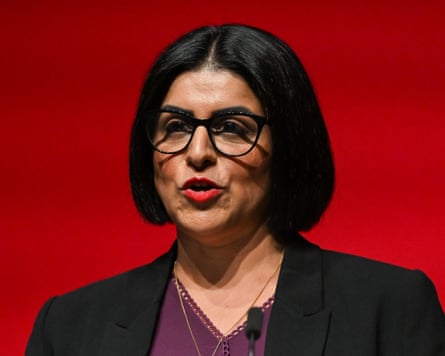
Shabana Mahmood, the home secretary, announced the reopening of a resettlement scheme for refugees at Labour’s annual conference last month. A statement from her department said: “Around one in four referrals will be for Afghan women and girls and Palestinian refugees, fleeing war and persecution.”
But the body administering the scheme has confirmed it would only refer “a very small number of extremely urgent cases”, all of which would be processed in Jordan and Lebanon.
The umbrella alliance Communities for Palestinians (CFP) said this crucial detail was not in Mahmood’s speech or subsequent Home Office statements, giving people in Gaza and their supporters the belief that they could also apply.
Vicky Moller, a co-founder of CFP, said: “The applause at Shabana’s announcement at conference was at the prospect of a resettlement scheme for Palestinians fleeing war and persecution. People understood that would mean rescuing people from Gaza.”
The Home Office has pushed back at the claims, saying the UK resettlement scheme that Mahmood has reopened has always been for people from outside their country of origin.
A Home Office spokesperson said: “To qualify for refugee status under international frameworks, individuals must be outside their country of origin.
“Palestinians who remain in Gaza would not initially be in scope for these routes. However, Palestinians who have fled Gaza could be referred to the UK through the International Refugee Assistance Project [Irap].”
Restrictions on eligibility for the scheme emerged after an exchange of emails between the CFP and Irap, which has been tasked with making referrals.
According to Irap’s website, it will refer “a very small number of extremely urgent humanitarian cases to the UK for consideration for resettlement”, adding: “These cases will be referred to Irap by humanitarian organisations in Jordan and Lebanon and Irap will then hold interviews to determine if these cases can be referred to the UK government.”
The programme focuses on “extremely vulnerable refugees whose lives have become unsustainable in Jordan or Lebanon”.
The non-profit’s website added: “Irap does not know how many people the UK government will accept under the Palestinian resettlement programme. This is ultimately a decision for the UK government and depends on funding as well as local authorities’ capacity.”
Other safe and legal routes administered by the UK have allowed small numbers of people to enter the UK from their country of origin, including previous schemes for Afghan refugees.
Palestinian refugees fall outside the remit of the refugee convention and UNHCR.
Unrwa was instead set up to serve Palestinian refugees who were defined as any person whose “normal place of residence was Palestine during the period 1 June 1946 to 15 May 1948 and who lost both home and means of livelihood as a result of the 1948 conflict”.
As a result, Palestinian refugees live in what refugee charities and NGOs refer to as Palestine – in other words, the West Bank and the Gaza Strip – as well as second countries such as Syria, Lebanon and Jordan.
Jon Featonby, the chief policy analyst at the Refugee Council, said ministers should recognise the particular circumstances that meant Palestinians could be refugees while living in their own country.
“The government is right to commit to safe and legal routes. They provide a vital way for refugees to reach safety without having to put their lives in the hands of smuggling gangs,” he said.
“But the warm words have to be accompanied by ambition, and that means supporting people in the thousands, not the hundreds. They must also recognise the particular circumstances of Palestinian refugees and be accessible to them no matter where they are in the world.”
A renowned expert in asylum systems has said resettlement programmes are usually designed as a solution for people who have already left their own country.
Dr Peter Walsh, a senior researcher at the Migration Observatory at the University of Oxford, said the UK government’s safe and legal route was always going to mean taking Palestinians from neighbouring states such as Egypt, Jordan or Lebanon.
“The Syrian scheme worked the same way: the roughly 20,000 people resettled to the UK between 2014 and 2021 all came from countries around Syria, with nobody to my knowledge being flown directly from Syria,” he said.
“Bringing people directly out of Gaza would be a different kind of programme, closer to an emergency evacuation … And crucially, such an emergency evacuation in Gaza would depend on Israel and Egypt letting people leave and on the Home Office finding a way to do security and biometric checks with no visa centre in Gaza.”
KioskNews shows a cleaned-up reading view extracted from the publisher’s page — the original always lives on their site, not ours.