Kremlin using sport to legitimise aggression, says Estonia PM as he pushes for EU ban on Russian athletes

The European Union has been urged by Estonia’s leader to ban Russians from taking part in sports events that he says are used by the Kremlin to “legitimise” its aggression.
Speaking to the Guardian, Estonia’s prime minister, Kristen Michal, said he was optimistic the EU would stop Russians from taking part in sports competitions under their national flag and symbols.
As Ukraine suffers deadly Russian missile and drone strikes, Russia’s creeping return to international sport has been ringing alarm bells for Kyiv’s allies in Europe and Canada.
The International Olympic Committee announced earlier this year that it was lifting its suspension on Russia, opening the door to Russian teams competing in the 2028 Los Angeles Olympics. Another concern is the ice hockey world championships, scheduled to take place in Germany next May, after the court of arbitration for sport ruled that Russia was eligible to compete.
The European Commission last week proposed a ban on Russian and Belarusian athletes competing in any sports events in the EU under their national flags. Russia would also be barred from sponsoring European sports and cultural associations, while Russian officials would be barred from European sports associations.
The measure, part of the EU’s proposed 22nd round of sanctions against Russia, must be agreed unanimously by all 27 member states.
Russia is increasingly challenging its exclusion from international sport, and international sports bodies seem weary of excluding Russians over the invasion of Ukraine. The president of the European Olympic Committees, Spyros Capralos, told Reuters recently that “the most important thing is for all athletes to take part”.
Estonia’s prime minister had no time for this argument. “The Kremlin uses its sports to legitimise aggression,” Michal said. He contended some Russian athletes served in the Russian army, adding: “How do you look at the pictures from Ukraine, women and children killed, and say this is OK for these people to be part of your sports event?”
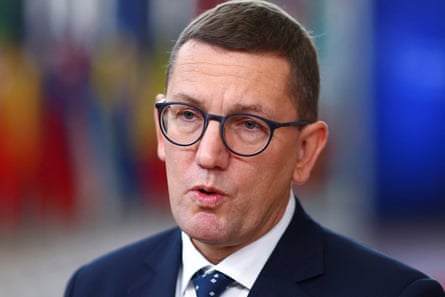
A liberal politician who has been prime minister since 2024, Michal also expressed optimism over a separate proposal to ban current and former Russian combatants from entering the EU.
The idea was postponed earlier this year over objections from France and Italy, two countries that award tens of thousands of tourist visas to Russians every year. To overcome concerns about how to apply the combatants visa ban, the commission last week published guidelines on how to make it work. The plan now has to be agreed by unanimity.
Michal said a series of dangerous events attributed to Russia – attempted assassination in Denmark, the thwarted Leipzig bombing, attempted arson at an Estonian drone factory, missiles and drones in Poland – were shaping the EU’s response. European decision makers were grasping, he said, that if Russia was not doing well at the front, its hybrid activities were “becoming much more dangerous”.
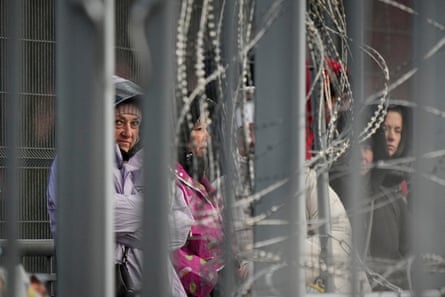
Estonia is closing all border crossings with Russia on Tuesday after the targeting of the Threod Systems drone factory near Tallinn, the second attempted sabotage of an Estonian military plant attributed to Russia.
He assessed the risk of a conventional Russian armed attack on Estonia as low “because Russia knows that European Union and Nato countries are much more capable”. But he did not rule out more hybrid attacks and disinformation.
The prime minister was speaking on the sidelines of an EU summit where the bloc’s future funding for Ukraine went unresolved, amid growing trepidation over a far-right, onetime-Russia-friendly leader taking power in France. The French presidential frontrunner, Marine Le Pen, has vowed to cease funding for Ukraine, which could complicate EU support.
Michal said the EU would “never give up on Ukraine” and even if Le Pen won, others would remain steadfast. Estonia is chairing the Nordic-Baltic eight, a regional group of like-minded countries. “We are not giving up,” he said, referring to this group and putting the UK and Canada in the same camp.
Estonia is spending nearly 7% of annual economic output on defence and related expenditure: 5.4% on core military spending and 1.5% on related projects, such as communications, transport and energy security.
Michal said Estonia would help fill any funding gap caused by other countries dropping out. “If needed, yes, we will do more,” he said.
“There is always a risk of fatigue,” he said. “How can you get tired of war sitting inside a heated room, peace and quiet, water is flowing, and you can watch TV … But in Ukraine, people are fighting against Russia for freedom; civilians are dying; they don’t have heating, electricity and waterworks. And who gets tired? The one sitting in the heated room? This is not an option.”
KioskNews shows a cleaned-up reading view extracted from the publisher’s page — the original always lives on their site, not ours.