Notes from Central Taiwan: Illegal but ineluctable
Pervasive unlawful building in Taiwan has made its farmland among the most expensive in the world
By Michael A. Turton / Contributing Reporter


In the late 2010s, Taiwan reached another one of those extraordinary and entirely negative superlatives that seem to define its existence: its farmland had become the most expensive in the world. Between 2010 and 2018, agricultural land prices more than tripled, reaching NT$48.03 million per hectare. That price was, according to a widely cited China Times report, “750 times that of farmland in Australia, 157 times that of the US, and 62 times that of the UK.”
The reason for this were changes to the Agricultural Development Act (ADA) in 2000, according to numerous observers. Back in 1999, Council of Agriculture head Peng Tso-kwei (彭作奎) began the process of amending the ADA in anticipation of Taiwan’s entry into the World Trade Organization (WTO).
WTO accession would have a broad impact on Taiwan’s farmers, already struggling with low prices for their products and heavy dependence on government subsidies. Agriculture contributed just 2.1 percent of Taiwan’s GDP in 2000. Many farmers, given the low returns to farming, preferred to collect the subsidy for keeping their land fallow that had been instituted in the early 1980s for a brief period of overproduction.
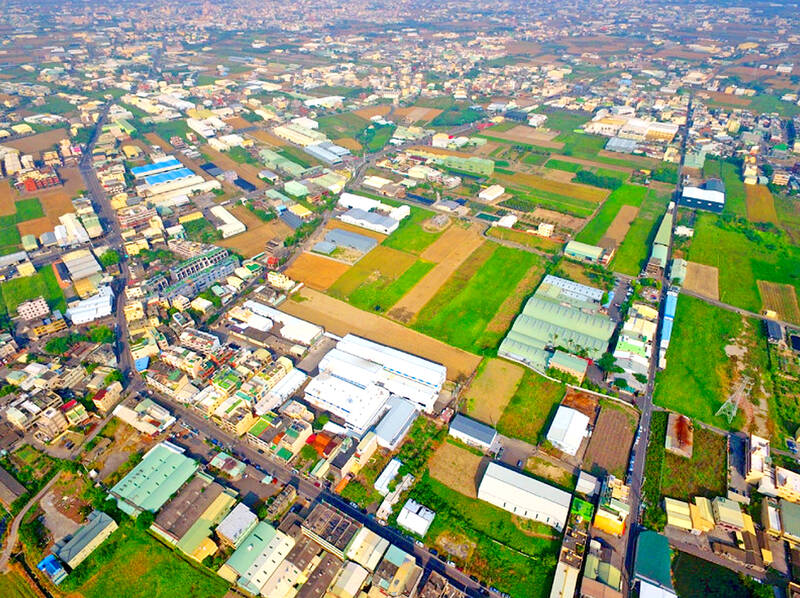
Illegal buildings on farmland contribute to increasing land fragmentation in Taiwan.
Photo courtesy of Citizens of the Earth, Taiwan
Peng decided on a partial deregulation of the agricultural land market to increase mechanization and modernization in the uncompetitive farming sector. His draft legislation permitted non-farmers to buy farm land.
However, the Chinese Nationalist Party (KMT) was facing a tough election battle in the 2000 presidential election, and its legislators decided to loosen Taiwan’s farmland policy to get votes, going far beyond Peng’s revisions to permit the construction of individual residences on farmland and reduce restrictions on subdividing holdings under three hectares. The KMT proposals had widespread support from farmers who felt farming no longer paid, and widespread opposition from individuals who felt that farmland would become the target of speculators. Previously, Taiwan had supported the ideal of a nuclear family operating a small-scale farm, the end result of the famed “land to the tiller” reforms of the early 1950s. That reform had distributed one to three hectare farms to tenants, vastly increasing agricultural production and incomes (now forgotten is that under that program, the state seized land that had been under collective production and ownership, leaving those owners destitute).
Despite attempts in later legislation to rein in the conversion of farmland to residences and factories, the result of the ADA, as scholar Jessica Li observed in “Farmland deregulation and third-stage land reform in Taiwan,” was the proliferation of houses on farmland. Farmhouses constructed under the revised ADA were tax-free, “providing a perverse incentive for farmers to build and sell farmhouses for elevated prices, or for non-farmers to acquire farmhouses.” Since farmland could easily be converted to houses and factories, farmland prices began to skyrocket.
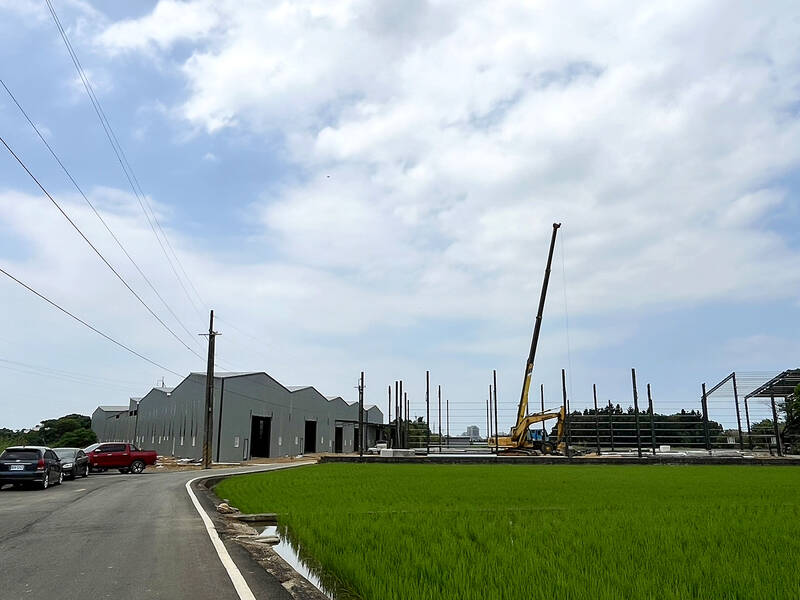
Illegal structures seen on farmland in Hukou Township, Hsinchu County in 2024.
Photo: Liao Hsueh-ju, Taipei Times
HOUSES AND FACTORIES
A good example of the effects of the ADA revisions is the sprouting of houses in Yilan since the completion of the Hsuehshan Tunnel in 2006. To circumvent the requirement that buildings be for “farm use,” developers entered into informal understandings with farmers to get around the law and then transfer ownership.
In 2015, the Yilan County tax bureau discovered that 60 percent of farmhouses built had seen their ownership transferred from farmers to buyers within three years of construction, in violation of the five year minimum required by the revised ADA. Between 2000 and 2022, Interior Ministry figures show that over 10,000 houses were built, though in reality there were more as the local government simply turned a blind eye to construction. Hundreds of these buildings became factories. Note that Yilan was a Democratic Progressive Party (DPP) fief throughout most of this period.
Illegal farmland construction in Taiwan has an east-west divide: in the east it is houses, in the west, factories, especially in Taichung and Changhua. It also shapes the built environment, as Li notes. Sprawl in Taiwan is intensified by farmland conversion to illegal buildings, “whereby residential land is randomly scattered throughout a village rather than consolidated into a central village housing complex as Peng’s original ADA amendments intended,” she writes.
Various attempts have been made to tame these issues. The 2016 National Spatial Planning Act attacked the illegal factory problem by mandating the demolition of such factories, with the owners paying to have the farmland restored. The Factory Management and Counseling Act currently stipulates that factories illegally built on farmland after May 20, 2016, must have their power and water supply cut off or be demolished. Those built prior to that date must become compliant with the Act by the end of 2039. “However, over the past six years,” the Taipei Times reported in July, “only 10 such buildings were improved after up to 32,498 nationwide were listed for management.”
UNRESOLVABLE?
Last week, the Legislative Yuan passed the third reading of amendments to several acts intended to increase the penalties for illegal agricultural land filling and illegal hillside development. The revisions also include government relief for crop losses due to wildlife action (such as Formosan Macaques eating fruit from farms). As with illegal factories and farmhouses, illegal dumping on farmland seldom comes to the attention of the authorities.
Illegality is pervasive. A 2023 report of the Construction and Planning Agency of the Ministry of the Interior said that the total number of illegal buildings in Taiwan reached 716,372 in July, up from 602,885 in 2014, or more than 10,000 new cases a year. High housing prices drive building owners to add illegal floors, rooftop structures, and similar. The authorities cannot hope to keep up.
In Taipei, for example, the law requires that such illegal structures built after Jan. 1, 1995 be demolished on report. However, as Taiwan.md
described in May of this year, the problem is that cases are queued and triaged, with the most dangerous being demolished first and the rest having to wait. According to Taiwan.md, a review of illegal structures in Wanhua showed a case from 2001 still unresolved in 2018.
Three common strands run through these problems of illegal structures. The first is that legislation ostensibly intended to reform or eliminate the problem invariably worsens it.
The second is that enforcement is spotty or nonexistent, and local governments plead a lack of resources when confronted about the excruciatingly obvious illegal structure issue in their neighborhoods. They must have some rational reason for ignoring it.
The third is that these illegal structures, the nexus of vast visual and environmental pollution and the target of periodic bursts of enforcement and regulation, produce important public resources such as tax monies, jobs, economic wealth, and public safety.
As a 2019 piece in Business Weekly describes, in Taiwan’s high density inhabited areas, with little enforced zoning, crammed with wildly mixed use structures, the existence of illegal structures guarantees that people are out and about at all hours, keeping services open and inhabited areas safe.
Notes from Central Taiwan is a column written by long-term resident Michael Turton, who provides incisive commentary informed by three decades of living in and writing about his adoptive country. The views expressed here are his own.
KioskNews shows a cleaned-up reading view extracted from the publisher’s page — the original always lives on their site, not ours.