Carney prepared for risk that Trump might order U.S. to invade Canada: ‘That’s just risk management’
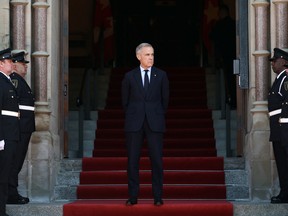
Prime Minister Mark Carney touched on a wide range of topics during an hour-long interview with the New York Times yesterday — F-35 jets, Starlink satellites, trade in potash and automobiles and more — but the biggest takeaway was that he had prepared over the past year for the “extreme tail risk” that U.S. President Donald Trump might order military action against Canada.
Sign In or Create an Account
“I think you have a responsibility in these roles to look at extreme tail risk,” said Carney, using a term from the financial world that was his metier as a former central banker for Britain and Canada. “That’s just risk management … it would be irresponsible not to.”

Get a dash of perspective along with the trending news of the day in a very readable format.
By signing up you consent to receive the above newsletter from Postmedia Network Inc.
A welcome email is on its way. If you don't see it, please check your junk folder.
The next issue of NP Posted will soon be in your inbox.
We encountered an issue signing you up. Please try again
The expression refers to a scenario that is considered unlikely but not impossible — the “tail” of a probability curve where the centre represents the most likely outcomes.
Carney told the Times that, based on Trump’s threats to make Canada a 51st state, he had carefully examined the possibility of U.S.-led military action, but declined to discuss in detail what that involved.
Timothy Sayle, a professor at the Munk School of Global Affairs and Public Policy at the University of Toronto, said Carney’s comments indicate a valid concern.
“It makes sense to me that it’s at the real extreme end of possibilities, but I don’t think it’s a zero per cent chance,” he told National Post.
The U.S. incursion into Venezuela this year and its threats against Greenland made its allies, including Canada and Europe, take notice, Sayle said.
“It can seem outlandish, but … the United States has made these decisions to enter Venezuela and then to attack Iran that were pretty low-probability events, and yet they did happen. So that’s why I can understand the prime minister’s point that it’s maybe very very very low risk but, as he said, can’t be totally ignored.”
As to what form a potential invasion might take, Sayle said the “wild unpredictability of the current American administration” made it difficult to predict, but he imagined several small-scale scenarios. They included “some sort of hot pursuit of a suspected criminal, or somebody that ICE was seeking, across the Canadian border.”
He added: “You could imagine an increase of U.S. forces, like the strengthening of U.S. forces in Canada in some way.” (According to the U.S. Department of Defense, as of March there were 159 active duty military personnel serving in Canada, plus 33 civilian DoD staff.)
Sayle also suggested “the presence of naval ships, the presence of or overflights by aircraft and … what could be described as something in the shared interest, but in which Canada was not consulted in the usual means. Americans could either publicly or invisibly flex their might and indicate that Canada’s sovereignty wasn’t quite as secure as we’d like to think.”
The notion has been ridiculed at high levels. This month, when a Canadian reporter asked Admiral Samuel J. Paparo, commander of the U.S. Pacific Command, about the possibility of military action against Canada, he was met with incredulity. Paparo called it “preposterous” and added: “Would you ask me please, also, what my attack plans are for the Martians?”
Sayle said that could change. “Canada and the United States militaries obviously have worked so closely together for so long,” he said. “I’m sure there’s a lot of goodwill and close relationships in the senior ranks, but we are, of course, seeing changes to how general officers are selected in the United States, and who keeps their jobs.”
Paparo concluded his remarks by saying he will ultimately follow the orders of the commander-in-chief. “And so we have, I think, lots of protections against this; relationships, friendships, common sense,” said Sayle. “But these things don’t always govern in a crisis.”
Carney is hardly the first to speculate on the possibility of war between Canada and the U.S. Back in 1921, Lieut.-Col. James “Buster” Sutherland Brown drafted Defence Scheme No. 1, a plan for a Canadian pre-emptive attack against the United States in the event of a conflict between them and the British Empire.
A Washington Post article from 2005 said the plan called for Canadian soldiers to make for Albany, Minneapolis, Seattle and Great Falls, Mont., at the first signs of a possible U.S. invasion. The article quotes Floyd Rudmin, Canadian author of the 1993 book “Bordering on Aggression: Evidence of U.S. Military Preparations Against Canada,” as saying Brown even entered the country in civilian clothing to do reconnaissance.
“He had a total annual budget of $1,200,” said Rudmin, “so he himself would drive to the areas where they were going to invade and take pictures and pick up free maps at gas stations.” The plan was terminated in 1928, and many of the documents relating to it were destroyed.
Vincent Rigby, Canada’s former national security and intelligence adviser, told National Post this year that a U.S. invasion “falls into the category of very low probability, but very high impact, to put it mildly.”
Rigby, who spent 14 years with the Department of National Defence, said the Canadian military is supposed to plan for all scenarios. “They’re very good at it and, given the current situation in the world, given the current state of Canada-U.S. relations, given the current state of U.S. foreign policy, I’m not completely surprised that they’re looking at possible scenarios.”
Carney’s comments to the New York Times also included talk of the trade war, a fact Sayle calls salient.
“It’s a signal to the whole world,” he said. “I don’t think it’s a significant signal to the American government, but maybe a signal more broadly to American politicians and industry leaders as to how seriously Canada is taking this current difficult period with the United States, and I think in some ways it might strengthen the Canadian negotiating hand when it comes to trade issues, because the prime minister is signalling that this was a sort of existential moment for Canada.”
He added: “Even though it’s an American news outlet, this is a major headline in an international paper that Canadians will see too. So … there may be these instrumental reasons for doing it, like the trade negotiations, and signalling to Canadians just how serious he’s taking this moment. But it’s obviously a pretty important signal of the state of the relationship with the United States, and how different that is than anything in our living memory.”
Our website is the place for the latest breaking news, exclusive scoops, longreads and provocative commentary. Please bookmark nationalpost.com and sign up for our newsletters here.
Join the Conversation
This website uses cookies to personalize your content (including ads), and allows us to analyze our traffic. Read more about cookies here. By continuing to use our site, you agree to our Terms of Use and Privacy Policy.
KioskNews shows a cleaned-up reading view extracted from the publisher’s page — the original always lives on their site, not ours.