Vision Quest Set Visit: How Marvel Finished Its Most Creative Trilogy Ever

Lewis is a Lead Writer for Screen Rant and has written for the site since 2022. This has allowed Lewis to explore a vast array of films, TV shows, books, comic books, and games from across the mainstream world of pop culture, reflecting his lifelong love of all media and typifying his experience in the world of fiction storytelling. To top this off, Lewis graduated from Northumbria University with First Class Honours in Film & TV Studies, truly exemplifying his experience in the medium.
VisionQuest is the final step in the MCU's most creative trilogy, promising Paul Bettany's hero a journey of self-discovery, family, and an AI environment filled with creativity. VisionQuest's MCU story has been shrouded in secrecy for a while now, but October 2026 will see the series land on Disney+. It will be a story for fans of the titular robot and his related franchise characters, but more importantly, VisionQuest's first trailer dubbed the project the final installment of a groundbreaking trilogy, with the preceding two titles being WandaVision and Agatha All Along.
Indeed, this was certainly the view of VisionQuest's showrunner, Terry Matalas, formerly of 12 Monkeys and Star Trek: Picard. In May 2025, I was invited to the famous Pinewood Studios on behalf of ScreenRant. Almost immediately, I was taken from the overcast skies of southern England into an AI-fueled world in the MCU's vast timeline, as the production team was gearing up for day 68 of their 100-105-day shoot. As alluded to, VisionQuest was somewhat of a mystery at the time of my visit, with little to no public knowledge of the show available.

Not knowing what to expect, I was taken on a journey through the massive production, from huge practical sets and costume displays to exclusive footage of VisionQuest being filmed. After the end of my day-long visit, it would be an understatement to say my excitement for the show went through the metaphorical roof. A big reason for this was the sheer wealth of creativity on display; every costume, set, and the tiny Easter eggs they contained oozed reverence for the MCU, its characters, and the source material.
The initial war room we were ushered into at the start of the day was just a teaser, and even that was chock-full of props, posters, concept art, and costumes related to the production we were about to delve deep into. The same can be said for the exciting sizzle reel I was shown, which was later followed by interviews with showrunner Terry Matalas and episode 1's director Christopher Byrne. The former only went to reinforce my surprise over how huge the production was, and how being a fan can only enhance that:
I think if I was younger and had just started this... I would've been so intimidated by the Marvel machine because I'm just, again, I'm not just one of the storytellers; I'm a massive fan of it... To go into Marvel... just being there was kind of an honor, and just to develop something with them, especially Vision, who's easily one of my favorite characters, it worked out in a way that was a dream come true for me.
As we went on and spoke more with Matalas, other crew members, and the core cast, including Paul Bettany, Emily Hampshire, and MCU newcomers Rauridh Mollica and Lauren Morais, the fan-like giddiness displayed by VisionQuest's showrunner proved to be infectious. Be it the exploration of the show's themes, the arcs of its characters, the depth of its production, or its exploration of a hot real-world topic in the rise of AI, VisionQuest proved to be an MCU show that is very different and, because of that, all the more intriguing.
Vision Quest Explores The Final Step In A Unique MCU Trilogy

Knowing a show centering on Vision was in the works at Marvel Studios, I expected a few links to his past, namely WandaVision and the exploration of his fate after that show's conclusion. What became immediately clear, though, was how VisionQuest was being viewed internally as the final piece of a trilogy. This trilogy began with the aforementioned WandaVision, continued with the surprisingly great Agatha All Along, and will now round off with VisionQuest. As Byrne himself pointed out, "VisionQuest is the second branch of the WandaVision tree after Agatha [All Along]."
Matalas stated that the show picks up right after WandaVision in the MCU, though he has, in the time since, stated that a few years have passed, placing VisionQuest alongside Spider-Man: Brand New Day. "He was already on an identity quest right from that last moment we saw him in WandaVision," the showrunner explained. "This is a character who has lost everything; he's lost a wife, the children didn't really exist, or did they? It just felt like, what an amazing journey to put him on." Evidently, concluding the WandaVision story was always part of VisionQuest's DNA, which the trailer echoes.
This even feeds somewhat into Scarlet Witch's MCU fate after her supposed death in 2022's Doctor Strange in the Multiverse of Madness. As alluded to by Matalas before, "Vision is aware of the fate of Wanda Maximoff." In his continued quest for family and connection, this turns Vision towards an unexpected person, Rauridh Mollica's Tommy Shepherd, aka Tommy Maximoff, teased in VisionQuest's trailer. Agatha All Along revealed that the soul of Billy Maximoff found the recently deceased body of William Kaplan, bringing back one of the WandaVision twins.
VisionQuest will complete this same transformation for the second twin, Tommy, with Matalas explaining that "this is happening as a direct result, I would say, of Billy in Agatha," before leaving us with the tease that we'll have to watch to find out more. Although this is true, I later got the chance to sit down with Mollica and dig a bit deeper into Tommy's role in VisionQuest, as the familial arc that began in WandaVision comes full circle. In terms of how that connects to Agatha All Along, Mollica doubled down on the trilogy idea.
When asked about his favorite Marvel projects, Mollica insisted that you cannot beat the first Iron Man before saying, "Of course, I did get really into WandaVision and Agatha, so it's nice to be adjacent to those and echo what they brought." A show about Vision was always going to be unique, but it being derived from two of the more creative Disney+ shows of the MCU's last decade only enhanced that. In fact, it was the trilogy aspect that first piqued my interest when visiting VisionQuest's set, with the aforementioned creativity only bolstering that.
Vision Quest's Endless Creativity Was Constantly On Display

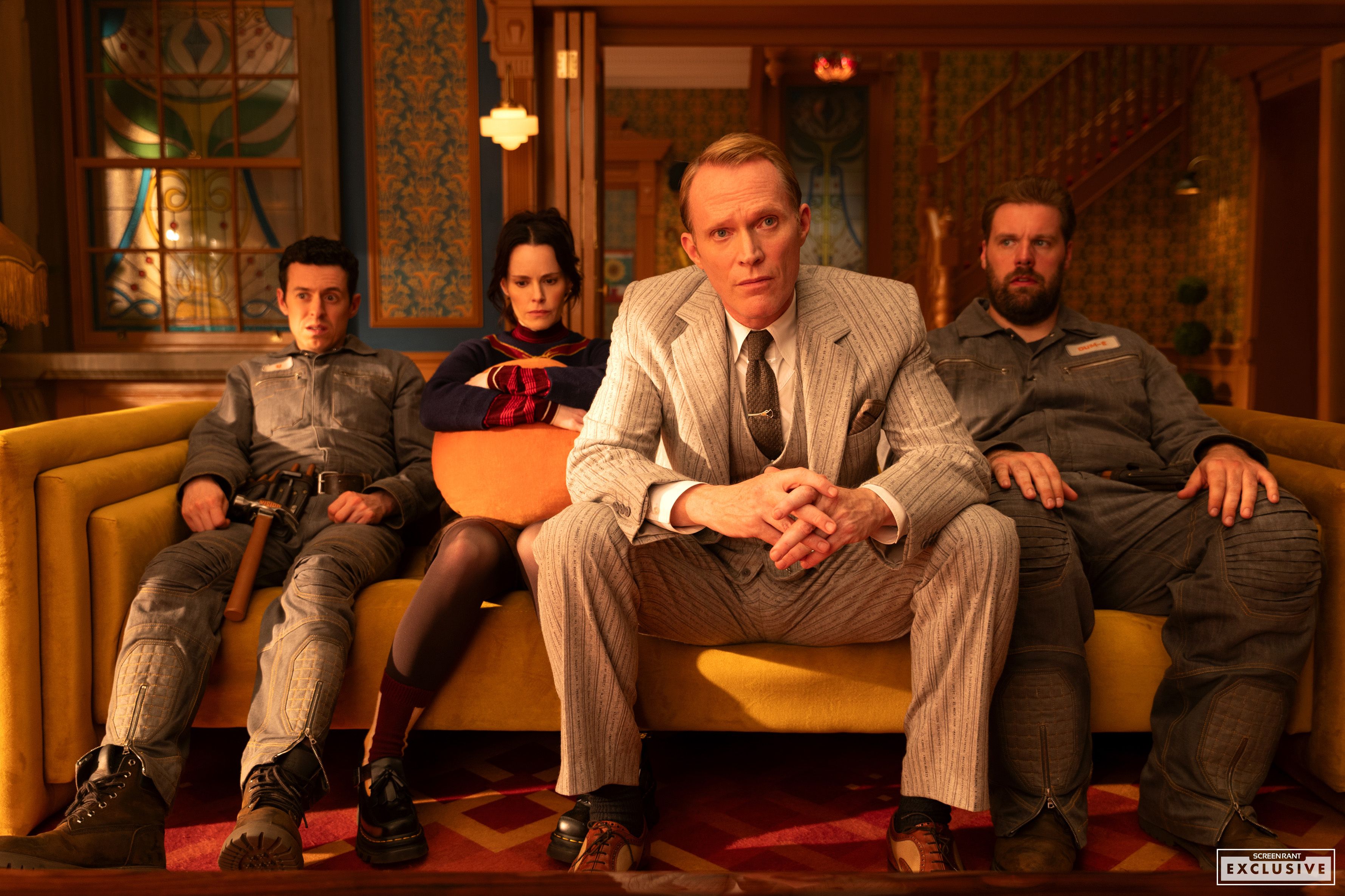
Throughout the course of the day, we were shown around two primary sets that were used extensively in VisionQuest's production. The first was a huge, practical, two-street construction set in the MCU city of Madripoor, where a lot of the show's story takes place. The second set was the basis of the second half of VisionQuest's unique story: the Mindspace. This is a house in Vision's mind, filled with human avatars of past Stark AIs, including EDITH, FRIDAY, JARVIS, DUM-E, U, and, of course, Ultron.
From a practical standpoint, these sets were outstanding. Madripoor's streets were filled with props and set dressings to convey the griminess of the MCU's crime-laden city. VisionQuest's production designer, Will Hughes-Jones, took us through these streets personally, even revealing that one of them was being redressed for another upcoming Marvel project, without acknowledging which one. Hughes-Jones explained the intricacies of the carts, shop windows, stalls, and various decorations created to bring Madripoor to vibrant life.
Will Hughes-Jones confirmed that one of the buildings is named the Princess Bar, an Easter egg to the iconic location from Marvel Comics.
Some of the small details that exemplified VisionQuest's creativity were the paper lanterns, complete with the logo of a bounty-hunting villain named Paladin. Hughes-Jones slyly implied ownership of parts of Madripoor by Paladin, even if his hunt for Vision could not be explained due to spoilers. All this said, while Madripoor was excellent, the Mindscape set was the true star of the show. As the internal space of an AI robot, the Mindscape was filled with creativity.
In a world that is becoming ever more worried about the rise of AI, Matalas was sure to put minds at ease when asked if generative AI was used on VisionQuest's production: "No, not at all. There hasn't really been a need. All the designs nod to how our current form of AI processes things... That felt like a fun way for us to comment on it." Repeatedly, Hughes-Jones echoed Matalas' words, insisting no AI was used during production, but that human creativity was employed to emulate the AI "creations" of 2025.
For instance, the Mindspace was filled with quirks from early AI renderings. Be it stair banisters that do not connect all the way up, chairs that were built halfway into the walls, as AI of May 2025 couldn't get furniture right, or repeated design elements, AI concepts were not used in the final product but were instead copied directly by Hughes-Jones and his team. Regarding the latter aspect, the Mindspace set was filled with sunflowers, oranges, and lemons. As the production designer explained, AI cannot create; it can only use and then reuse words told to it by humans.
Therefore, Hughes-Jones and his team would use the aforementioned aspects throughout the house; picture frames featured endless sunflowers, lemons, and oranges, with some furniture even being constructed using the flowers and fruits. At every turn, the Mindscape exuded creativity, with everyone on set constantly reminding us that all of it was created by human hands and only inspired by the misguided "creation" of AI software.
One of the cooler practical elements of the house was how it reflected Vision's mood. An example included a wall made of lycra that crew members stood behind and shoved their hands through to grab at Vision when he got stressed. Other elements include the oven in the kitchen having a happy-face and sad-face setting, the door frames collapsing to become wonky, grates slamming shut over doors, and an elevator filled with flashing lights. Outside the windows, a purposefully constructed Windows XP-like background was built to emulate a PC in standby mode, which changes colors depending on Vision's mood.
This is without mentioning the Mind Stone motifs throughout the house, on cushions, paintings, in wall patterns, and so on. In the kitchen, every single cupboard was filled with Vision-or-computer-themed produce; the Vision-branded refrigerator was filled with milk cartons donning Wi-Fi symbols and battery percentage levels. The cupboards were stocked with products riffing on everyday brands, from Visto gravy and Vision Pringles to Ram instead of Spam and Firewall hot sauce. In every room, practicality and creativity were as far as the eye could see, and even beyond.
As our time with Hughes-Jones came to an end, we came to a painting of a man on fire, which happened to be the one thing Hughes-Jones was stopped from talking about by nearby Marvel and Disney execs. Later, Sarah Young (costume designer) and Frances Hounsom (hair and make-up designer) only further reiterated how much thought went into VisionQuest. When designing Ultron, Young delved into some of the intricacies of the design work:
Another thing I worked on... I took silhouette lines from the Ultron robot... they're all embedded into the coat. These buttons, they're lines you see on the robot, his belt buckle, as well. If you look at the robot, you'll see it. It's something that fans will discover as they're watching. The color palette even came from the robot: the gun metal and red.
Another similar instance of ingenuity came with Vision's pinstripe suit, with Young revealing that a robotic code is written as the suit's stitch lines, which Matalas wrote alongside her. Similarly, Vision's costume has silhouette lines from his robotic form, including a jumper with the Mind Stone in its center. Characters like EDITH had different costumes to represent her fun-loving personality, while Tommy's costumes were constructed with Speed's comic book color palette in mind. What stuck out most about the day was how excited VisionQuest's crew members were for the show, and how that excitement translated into endless methods of genius creativity.
Vision Quest's Title Wasn't Clear, But Now It Is

One of the more interesting tidbits revealed by Matalas during my visit to VisionQuest's set was that this title was not actually set in stone at the time. Christopher Byrne insisted the same, stating that even they don't know what the final title will be, nor how many episodes will be in the show. Now, though, almost a year-and-a-half later, VisionQuest is the show's definitive title, and eight episodes will be dropping on Disney+ starting in October 2026.
After seeing what I could during the set visit, though, VisionQuest is a perfect title. Not only is the show a genuine quest to stop Ultron and reunite with Tommy, but the show has deeper themes about questing to find oneself. Be that Vision, Tommy, or Ultron, the themes of VisionQuest center around uncovering the humanity within.
Matalas, Bettany, and Hampshire delved deeper into this. The former described the different AIs in Vision's Mindscape as beings who represent different parts of humanity and are thus helping Vision get in touch with them after being distanced from himself in WandaVision. When speaking to Hampshire later on set, she doubled down on this idea: "I think, for me, EDITH, her thing is fun. There's Jarvis, who's socialization, and FRIDAY, who's security."
Matalas even used the word "quest" when talking about Vision and his dynamic with the AIs within the Mindspace. "FRIDAY, EDITH, Dum-E, U, and an older form of Jarvis, whose code he is based on and is almost like a brother to him. They are helping Vision understand humanity; they are his company on this identity quest," Matalas outlined. "That led to Ultron being the messed-up father you have to deal with." Clearly, a quest best describes Vision's story here, not only in the literal sense, but also in the metaphorical sense of uncovering who he is, who he can become, and how that links to his newfound family.
Vision Quest Takes Two New MCU Teams On Different Journeys

One of the final aspects of VisionQuest that seemed to be a prevalent throughline of my time on set was the team dynamic of different characters. The first is the so-called "AI Avengers," consisting of Vision and his Mindscape allies. Each one of these AIs is there to teach Vision a different thing about being human, with all of them coming together to form a team that can overcome different hurdles. In fact, the scene we got to watch being filmed highlighted just how real the AI Avengers might be after VisionQuest.
The scene included the AIs trying to break free from a lock placed upon them by Ultron, who is in control of Vision's body in the real world. Each of them has different things to do in this scene, from FRIDAY emphasizing her security protocols by stating that taking down Ultron's firewall to fight him on the outside is a mistake. EDITH, as more of an over-the-top, impulsive AI, criticizes this, pushing Vision to take the fight to Ultron. After this, Vision discovers what Ultron is doing on the outside, as well as information about the mysterious Paladin.
After the endless talks about the AI Avengers and how big a role they play in VisionQuest, this scene drove home that idea. On the other side of the story is Tommy Shepherd, who, like Billy before him, will undoubtedly be set up as a future MCU hero, possibly in Marvel's Young Avengers story, were it to happen. When asked about Tommy's superspeed powers from the comics and whether that will translate into VisionQuest, Mollica simply smiled and replied, "This is a mystery that I am not comfortable answering."
The lack of an answer is one within itself. Combined with Billy's evolution into a wizard in Agatha All Along, it seems all but guaranteed that Tommy will become Speed as of VisionQuest's ending. Speaking of Billy, when he was asked about whether he has met Agatha All Along star Joe Locke, Mollica again pulled a wry smile and stated, "In real life? Sure, I've met Joe for a pint."
All signs are pointing to the Young Avengers being born out of the WandaVision trilogy, with Billy and Tommy at the head of such a team. Whether this happens remains to be seen, but everything from the set visit seemed to all but confirm that Tommy is interlinked with Billy. With two teams at its center, an incredibly creative production, and a unique premise that builds on the previous two projects in its groundbreaking trilogy, VisionQuest immediately jumped from a Marvel project I hadn't heard a lot about to one I could not wait to see play out after visiting its overly creative, incredibly infectious Pinewood Studios set.
VisionQuest will be released on October 14, 2026, on Disney+.

- Release Date
- October 14, 2026
- Network
- Disney+
- Showrunner
- Terry Matalas
-

The Vision
-

Henry Lewis
D.U.M.-E
-
James D'Arcy
J.A.R.V.I.S.
-

Orla Brady
F.R.I.D.A.Y.
- Directors
- Christopher J. Byrne, Gandja Monteiro
- Writers
- Terry Matalas
- Franchise(s)
- Marvel Cinematic Universe
- Creator(s)
- Terry Matalas
KioskNews shows a cleaned-up reading view extracted from the publisher’s page — the original always lives on their site, not ours.