‘Sham tribunal’: one family’s battle with Louisiana’s ‘feudal’ eviction courts

The eviction notice stuck to Lesley Wilson’s door, with two streaks of green tape and a hand-scrawled note, was left at a precise moment of crisis in her life.
It was April 2025 and Wilson, a 54-year-old mother of six, was living with her partner and her 11-year-old granddaughter named Kat in a stilted bungalow, surrounded by sugar cane fields and a small trailer park. She loved the peace and quiet of the place, about 10 miles from the rural city of New Iberia in southern Louisiana. A crawfish pond was a short walk away.
But the night before the notice was stuck to the door, her partner became abusive again, she told police. She called 911 multiple times, and she and her granddaughter cowered inside a locked room, according to interviews and her statement to police.
“It kept escalating and escalating,” she recalled. “And I don’t handle conflict well. My brain just shuts down.”
He eventually agreed to leave their home, a police report confirms. The following morning she obtained a temporary protective order to keep him away. As she returned from court, she was met with the eviction notice that Kat plucked from the door.
The handwritten note cited the reason as “disturbing the neighbors + fighting”.
Louisiana’s Violence Against Women Act, passed in 2015, limits landlords’ ability to evict victims of domestic violence, mirroring similar protections in federal law. But, Wilson said, despite her presenting the temporary order to her landlord, he made clear he wanted her gone.
“He told me he knew the justice of the peace,” she recalled. “And that: ‘All I’ve got to do is tell him what I want, and that’s the result I’ll get.’”
Three weeks later, Wilson arrived for her eviction hearing in Justice Patrick Broussard’s courtroom – the backroom of a small public library.

‘The stakes are extreme’
Across rural Louisiana, dozens of justices of the peace courts operate on the fringes of judicial formality. These elected justices, who are required only to hold a high school education and be of “good moral character”, are allowed by law to hold court in unconventional venues. They are required to complete 16 hours of training every two years. Many do not even comply with this basic requirement, a Guardian investigation has found.
Because operating expenses for these low-profile courts are paid with court fees, hearings can be held in almost any venue, except for those that sell alcohol. Living rooms. A spare bedroom. An old jailhouse. A small office next to a roadside daiquiri bar. A cellphone repair store. All have been used to hold eviction proceedings in Louisiana justice of the peace courts, according to interviews with 10 housing attorneys who have practiced within them.
The use of such venues “gives the signal to both parties that evictions are unimportant and uncomplicated legal proceedings”, argued Hannah Adams, a senior attorney at the National Housing Law Project. “But the stakes are so extreme for a tenant and these are often complicated cases.”
Adams is a former legal aid attorney in Louisiana and has fought evictions in venues including a pool house and a kitchen table. She described the process as “a real holdover from the feudal era”.
Documents released under a public records request reveal that dozens of justices mostly in these rural locations are failing to comply with their mandatory minimum training requirements.
For the past nine months the Guardian has been examining evictions in Louisiana’s justice of the peace system, which operates in every parish of the state except the city of New Orleans.
A handful of these justices earn hundreds of thousands of dollars a year via revenue from court filing fees. Critics argue the system is plagued with potential conflicts of interest and routinely denies tenants their rights to due process under the US constitution.
The majority of these courts sit in rural settings with lower populations, so most generate little income. A Guardian review found that 52% of Louisiana’s 390 justices declared less than $10,000 in fee revenue over the past decade.




Still, experts say, the conflicts of interest are baked into the system – they exist no matter how much money is made.
“Whether it’s a high-volume court or a low-volume court, the more landlords that file evictions, the more dollars go into the justice of the peace’s pocket,” Adams said. “It’s still extra money for the person who is supposed to be a neutral arbiter of these cases.”
‘It all felt illegal’
Lesley Wilson’s hearing was scheduled for 4.45pm on 29 April last year.
She had found pro-bono legal assistance after the eviction notice was stuck to her door, a civil rights attorney named Donald Hodge.
She arrived at her local public library 20 minutes early and headed to the backroom that served as the courtroom. The corridor was daubed with canvases decorated with self-help quotes: “be humble & gentle”, “be patient & kind”. A librarian could be heard scanning books around the corner.
“It all felt illegal,” Wilson recalled. “I don’t know how else to describe it.”
As she waited inside, she spotted her landlord, named Steven Freyou, and Justice Broussard deep in conversation outside, she said.
“That’s not right,” she thought to herself. “That’s not how this should go.”

What followed, Wilson would later claim in legal filings, was a “sham tribunal”.
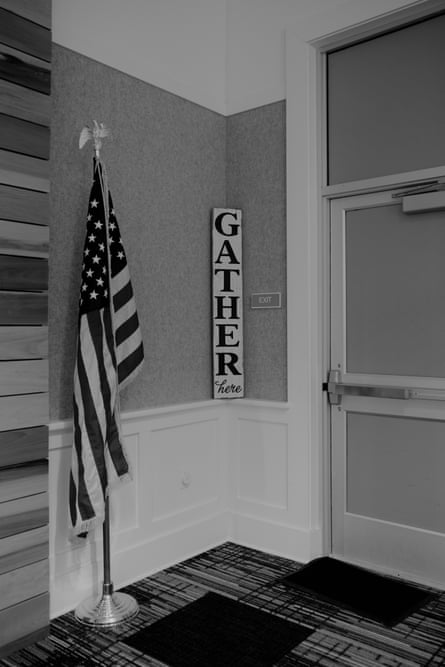
Justice Broussard sat behind a grey library table near a large US flag. “All rise,” his constable instructed the almost empty room. Wilson’s attorney, Hodge, listened in over the phone.
The justice first announced it was his intention to “wrap this up quick”, according to Wilson and Hodge’s recollection. It was his birthday and he had plans. It was also, the justice remarked, the first time he had ever presided over an eviction hearing where a tenant had secured a lawyer.
The grounds for Wilson’s eviction had now multiplied. Along with claiming she was “disturbing the neighbors”, her landlord was now also arguing that she had not paid her rent on time. This, Wilson said, was untrue. The cash-in-hand payments had always been delivered correctly, she claimed. Documents supported her: a petition of eviction signed by her landlord on 21 April recorded that “$00.00” rent was due.
The petition also stated her landlord was seeking eviction because her lease had expired.
To her horror, the court then called a witness. It was her ex-partner, who she now had a full restraining order against. He was invited to testify over the phone and supported the landlord’s claims that she and her ex-partner were behind on their rent, Wilson and Hodge recalled. His evidence was not sworn testimony, according to a lawsuit Wilson is currently pursuing in federal court.
“I was in shock,” she remembered. “Like, you’re really going to let him testify over the phone?”
At the hearing Wilson and her attorney also argued that her lease contained an unlawful clause that permitted eviction if law enforcement officers were called to the home.
But, as proceedings progressed, the lawsuit claims, Broussard “threatened” to charge Wilson three months’ rent as a bond if she appealed his decision and delayed the eviction. It was an amount she had no means to pay. She felt as though she was being bullied into submission.
After a few minutes weighing up her options she decided it would be impossible to stay in the house at this point, and asked Hodge to try to negotiate a deal. She was adamant she would not pay another penny in rent. After a 40-minute hearing, Wilson signed a “judgment of compromise” that compelled her to leave in a month’s time and forfeit her deposit.
It would not constitute a formal eviction, “but I was still being forced out,” she said.
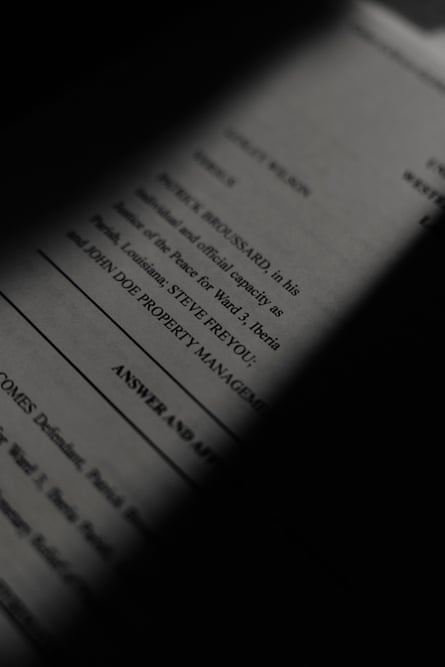
The federal lawsuit that Wilson filed alleges she was harmed by violations of due process and seeks damages against Broussard and her landlord. It claims the agreement was “extracted by duress, by the threat of an unpayable appeal bond … by the admission of ex parte hearsay from her abuser, and by the deprivation of every procedural safeguard to which a litigant before a court of law is entitled.”
Hodge recalled in an interview: “There was no order. No rules. No procedure. No law.
“It speaks to why the justice of the peace system needs to be reformed,” he said. “Lesley is just one example of who this is happening to every day across the state. And most people don’t know their rights and can’t afford an attorney.”
Justice Broussard and the landlord, Freyou, did not respond to detailed questions from the Guardian.
In legal filings, Broussard laid out a lengthy list of defenses, including judicial immunity, and denied any unlawful conduct. He also claimed a lack of sufficient information to assess Wilson’s status as a survivor of domestic violence. His motions, which seek to have the lawsuit thrown out of court, were written by Louisiana’s attorney general’s office, which was representing him.
The landlord denied he violated any state or federal law in terminating Wilson’s lease, according to recent legal filings, which also seek to have the case thrown out. One document states Wilson’s lease was not ended “because she contacted law enforcement, obtained a protective order, experienced domestic violence or possessed any protected characteristic”.
‘Their own fiefdoms’
Louisiana is among 17 states that allow judges, including magistrates, with no law license to preside over eviction hearings, according to research. The state mandates that all justices must attend a minimum of 16 hours of training every two years. Legal experts and housing advocates argue these basic training requirements are not enough to prepare many of the state’s justices to handle often complex areas of housing law.
A separate lawsuit being pursued as a class action in federal court in Louisiana argues the system routinely violates tenants’ due process rights. The case, which was filed by the Southern Poverty Law Center and the National Housing Law Project, notes that the state’s justice of the peace training manual contains just 10 pages on evictions “and does not include any relevant or even binding case law governing evictions”.

Justice Steven Sanders of East Baton Rouge, the named defendant in that litigation, acknowledged under sworn deposition that the training courses contain roughly “an hour and half of discussion” on evictions.
Despite these basic requirements, documents obtained by the Guardian under a public records request revealed that over a quarter of the state’s justices failed to comply with even these standards. An analysis by the Louisiana attorney general’s office, covering the years 2024 and 2025 showed that 98 justices and 142 constables had failed to complete mandatory training. The documents revealed that 37 of these justices and 52 constables had completed no training at all during that time period.
Broussard, a retired engineer who indicates online that he does not hold a law license, was among those listed as non-compliant, having attended only nine hours of training in two years.
“These courts are acting like their own fiefdoms, where they get to act with impunity and do not do the training they are required to,” said Micah West, a senior supervising attorney at the Southern Poverty Law Center.
The Louisiana attorney general’s office did not respond to detailed questions from the Guardian.
In the month after her case was heard in eviction court, Lesley Wilson scrambled to find a solution to impending homelessness.
She had been unhoused once before in her life, at the beginning of her last marriage when her partner lost his job and they lived together with their children in a tent for three months.
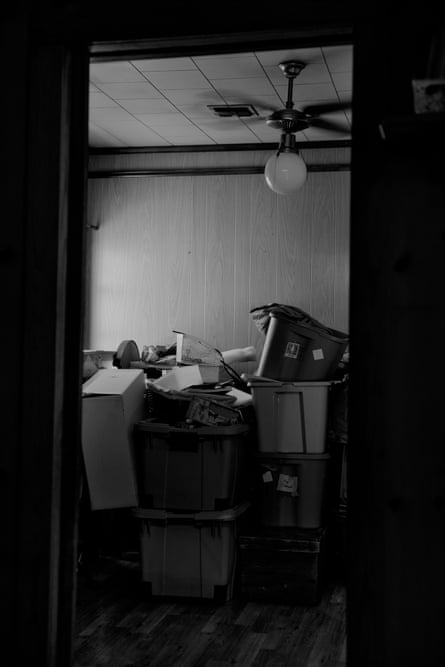
She always prided herself on being resourceful and working to solve problems in her life. Her only available option this time was to move with her granddaughter to the small, unincorporated town of Harwood in Texas and live with a friend, about 400 miles away from the rest of her close family. She borrowed money to rent a U-Haul, and put all of her belongings into storage: mattresses, bed frames, the balls of yarn for her crochet business, and her late daughter Kelsea’s ashes.

Wilson had become her granddaughter Kat’s legal guardian shortly after she was born. Kelsea, Kat’s biological mother, had died in 2018 after a fentanyl overdose at the age of 21. Kat had only been told about her birth mother two months before the eviction ordeal. She still calls Wilson “mom”.
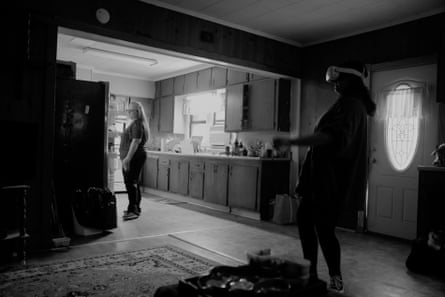
They arrived in Harwood, a dusty railway town with a population of fewer than 200 people, and moved into a travel trailer that sat in the front yard. There was no running water. Electricity ran via a cable plugged into an outdoor shed, which frequently short circuited. It had only one bed.
She was able to get a job at a local Buc’ees, working a night shift at the bakery. The pay was decent, but the living situation became untenable within a month. They decided Kat would have to move in with relatives in New Mexico. Wilson would stay behind. It was the first time they had been apart in all of Kat’s life.
“I already felt alone,” Wilson recalled. “But now even more so. I just couldn’t see the way out. Every single thing that has happened in my life since is tied to that eviction proceeding.”
The rule of law
In 2009 a justice of the peace named Keith Bardwell from the rural parish of Tangipahoa caused outrage after he refused to conduct an interracial marriage, over four decades after the landmark US supreme court decision Loving v Virginia ended legal restrictions against people of different races being married. In a referral to the state’s judiciary commission, the ACLU of Louisiana argued that Bardwell’s “blatant bigotry poses a substantial threat of serious harm to the administration of justice” and highlighted he was “persistently failing to follow the law”.
Bardwell resigned shortly after.
The case was extreme, but Louisiana’s justice of the peace courts have faced recurring criticism for over a century. Ahead of a state constitutional convention in 1921 a local legal scholar named Edmond Bourgeois argued for complete abolition of the system, citing concerns over justices’ lack of legal training. In an article for the Loyola Law Journal, he wrote: “The procedure is a farce; the courts’ dignity a myth; justice is frequently absent; attorneys hold the courts in virtual contempt, and in some instances indignantly refuse to practice before them.”
Nonetheless, accounts from the time indicate that while the issue was considered, the lobbying in support of them “was too strong”.

The convention occurred at the height of Jim Crow segregation in the south, and was attended by only white delegates, who passed further laws to suppress black citizens from voting in the state.
The pro-justice of the peace lobby remains strong in Louisiana today. Along with voting earlier this year to expand the territorial jurisdiction of some high-earning justices, the Republican-dominated legislature passed a law in 2020 that exempted justices of the peace from mandatory retirement. While all other judges in the state must leave the bench when they turn 70, Louisiana’s justices of the peace can continue holding court at any age from 18 onward. A November “Peace Talk” newsletter published by the Justices of the Peace & Constables Association, announced the news under the headline “Mission Accomplished!”.
Last month, the state’s rightwing attorney general attended the annual justice of the peace convention and described their “vital role in serving our communities and upholding the rule of law”.
A delivery
Part of Lesley Wilson’s salvation came in the form of a garden ornament. While scrolling online one evening earlier this year, she discovered a resurgence in the popularity of a beloved porch goose statuette and in particular the tiny custom stitched sweaters people were dressing their porch geese in. She put her crochet skills back into use, and started posting images of her unique goose sweater designs. They came in many colors and were selling for $50 a piece.
Wilson had spent eight months living in the travel trailer in her friend’s yard. But with the Texas winter setting in and no heating inside, the cold had begun to bite. She moved again to live with another friend in Colorado, hauling many of her belongings with her.
Two months later, Kat left New Mexico and rejoined Wilson in Colorado. They had been apart for more than seven months.
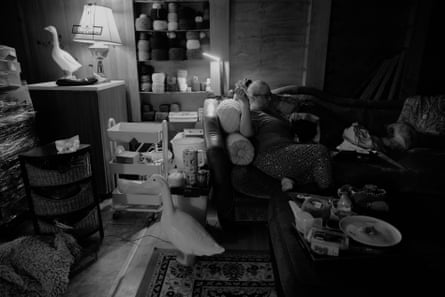
The funds from her increasingly popular porch goose knits had helped make it possible to think about moving back to Louisiana. She found a small place with two bedrooms and told Kat it was time to come home.
In May of this year they got the keys to their new rental unit, and spent two full days cleaning it out front to back. Wilson’s possessions were split between storage units in Texas and Colorado. Some items had been destroyed or damaged after a leak in one of the units; an antique mirror passed down between generations, a bedroom set now covered in mould.
“Unless you’ve lost everything, you just don’t know what it’s like,” she said.
After moving in, both were still sleeping on air mattresses as they waited for a final large delivery to arrive from Colorado amid persistent delays. The shifting timelines compounded her worry and triggered diverticulitis, a painful inflammation of the digestive system linked to stress.
One day in late August, the delivery arrived. There was one item she had thought about more than any other: Kelsea’s ashes, which she had left behind in Colorado.
She found them days later nestled in an unmarked box. She placed them on the kitchen counter and felt a moment of relief.
-
Contributors
Additional reporting by Tom Richards, Rachel Shur, Sophie Sullivan, Cameron Armstrong, Mahesh Makani, Georges Lebreton, Izzy Kiff, Frederick O’Brien and Aliya Uteuova
KioskNews shows a cleaned-up reading view extracted from the publisher’s page — the original always lives on their site, not ours.