Electric vehicle targets and reality are now on a collision course | Letters
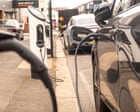
George Monbiot is right that European carmakers have dragged their feet, but his column describes only half the problem (Why are Britain’s streets still so polluted? Because the car industry dinosaurs do what they like, and politicians let them, 11 November). About 40% of UK households have no off-street parking, rising to around 60% in urban areas.
For us, the cheap home charging that makes electric vehicles (EVs) economical is out of reach. Ministers may have removed the need for planning permission for cross-pavement charging channels, yet more than 20 councils still refuse them, while others, like my own Green-run council, dither and leave residents waiting for a policy. (I have been waiting for over two years.)
China did not rely on mandates alone. It paired purchase-tax exemptions with licence-plate privileges and parking and charging discounts: a coherent carrot-and-stick policy approach. Britain offers a patchwork instead. We need national leadership: cheaper parking and VAT-free public charging for EVs, heavier charges on the most polluting vehicles, and one national rule on pavement charging.
Telling carmakers to “move or get squashed” is easy from a house with a driveway. Until families on terraced streets can charge as cheaply as their wealthier neighbours, the transition will feel like something done to them, not for them.
Paul English
Bristol
George Monbiot claims that the western automotive industry has failed to keep pace with Chinese and other counterparts, and that government should not bend to requests to have the zero-emission vehicle mandate amended.
However, these “foot-dragging, planet-trashing car companies” have actually helped create a new car market with more than 180 electric models available, with more to come, whatever happens to regulation. Average range exceeds 300 miles, enough for at least two weeks’ average driving. And most electric vehicles sold in the UK are actually from European brands.
Consumers have every reason to switch: massive manufacturer discounting, heavy promotional spend, a government grant and sky-high fuel prices; and, as Mr Monbiot says, they are cheaper to run if you can charge at home. Despite these advantages, fewer than three in 10 new car buyers in the UK will choose a pure electric car this year. Rather than western carmakers not being ready, perhaps it’s the consumer?
Mike Hawes
Chief executive, Society of Motor Manufacturers and Traders
Relaxing zero-emission vehicle targets would send entirely the wrong signal at a time when climate action needs to be accelerated, not delayed (Labour expected to cut EV targets for UK’s car industry despite MPs’ protests, 8 November). As the prime minister himself has acknowledged (British people understand the climate crisis threat. Today I’m empowering them to tackle it, 17 September), the impacts of climate change are no longer a distant threat; they are already being felt across the UK. Yet the government continues to fall short of the pace of action needed.
The Climate Change Committee has repeatedly warned that progress on transport emissions is too slow. Transport remains the UK’s largest source of greenhouse gas emissions, but the good news is that we know what to do to cut those emissions. Electrifying cars and vans through the zero-emission vehicle mandate is the single most important tool available for decarbonising road transport. Weakening those targets would make it significantly harder to meet future carbon budgets and legally binding climate goals.
At the same time, we cannot rely on vehicle technology alone. Improving public transport, increasing car-sharing and making walking and cycling easier are more important than ever if we are to cut emissions while giving people the affordable, sustainable travel choices they need to create prosperity in every postcode.
Ben Plowden
Chief executive, Campaign for Better Transport
George Monbiot’s article focuses on Britain, but the issues apply equally elsewhere. As usual in this debate, little mention is made of those on a limited income, who cannot change their car on a whim. I bought mine before retiring, at a price I could afford, so that I could hope not to have to change it again.
Mr Monbiot writes “electric cars, if you can charge at home, are much cheaper to run”. This may well be so, but first there is the added expense of installing the system for charging them at home.
The article also states: “We should be reducing transport demand, through a shift towards the 15-minute city model of which Paris is an exemplar. We need better and safer provision for cyclists and pedestrians. We need more investment in public transport.”
This would be ideal if we all lived in cities; we do not. There is one bus service from my local village to the nearest town; the bus stop is 4km from my home. There are two buses into town, one early in the morning and one at lunchtime. The one return journey is scheduled to suit commuters returning by rail in the evening. The terminus (the railway station) is a half-hour’s walk from the shops. How can I, on foot, carry 7kg-12kg sacks of animal food and all my weekly groceries from the town centre to the bus stop and from the bus stop to home? Mr Monbiot, answer me that, if you please.
Anne Maclennan
Cuguen, France
KioskNews shows a cleaned-up reading view extracted from the publisher’s page — the original always lives on their site, not ours.