Decomposing whale near Sydney’s Coogee beach should be towed out to sea, Indigenous rangers say
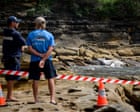
A First Nations ranger group says a whale carcass that closed two of Sydney’s most popular beaches after washing up this week should be towed out to allow it to decompose in the ocean.
Coogee beach reopened on Friday after closing on Thursday, when a whale carcass, believed to be a juvenile humpback, was found washed up in Lurline Bay, between Coogee and Maroubra beaches. Randwick city council confirmed the reopening on Friday but said Maroubra beach remained closed due to “dangerous surf conditions”.
But the council said the carcass remained wedged among rocks after high tide had failed to move it out to sea as hoped.
“People should avoid Lurline Bay and not swim or enter the water in the immediate area. The area remains barricaded off,” the council said.
They said a drone flyover on Thursday evening had not spotted any shark activity, so lifeguards decided Coogee was safe to reopen. Swimmers were urged to swim between the flags.
But they added that high tide on Friday evening could move the carcass closer to the water’s edge one again, potentially attracting sharks.
The whale is an important totem animal to the local Bidjigal people. Robert Cooley, a senior ranger at the Gamay Rangers, who have been working with the council on a culturally respectful way to deal with the remains, said the tide had pushed the carcass higher up towards a coastal walkway, requiring an intervention.
“The preferred option now is to tow it back out to sea.” he told Guardian Australia ahead of an afternoon briefing with the council.
“Now that it’s up there and decaying and several vertebrate and other bits of bone are showing, people have a habit of taking collections home, which is quite distressing to us.”
The Gamay Rangers undertake natural and cultural resource management activities like protection work, conservation, and threatened species management in the La Perouse Local Aboriginal Land Council area.
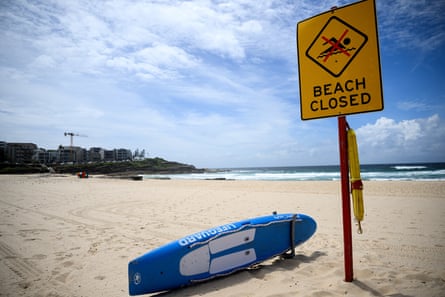
Cooley said that because the whale was in an advanced stage of decay, it was too challenging to lay it to rest on conservation land owned by the land council, as a young humpback that washed up on Cronulla beach earlier this year had been.
“It’s just a big pile of blubber now, but the priority is to let nature take its course [out at sea]. The second priority would be lay it to rest on our conservation land.”
He said the Gamay Rangers did not support taking the whale to landfill.
“It’s really distressing to know that a significant ancestor of ours is taken to landfill with the rest of the city’s rubbish.”
Concerns were raised earlier this year about the towing of a sperm whale carcass along a 20km stretch of coast south of Sydney to Wollongong before being taking it to landfill, resulting in increased shark activity and catching swimmers off guard.
Olaf Meynecke, manager of the whales and climate research program at Griffith University, has been involved two successful whale tows this year in New South Wales and one in Queensland.
He said taking whale carcasses to landfill was “unethical, and … not very environmentally friendly”, towing them far out to sea, typically to the start of the continental shelf – up to 50km offshore – allowed them to decompose naturally and support the marine environment, including sharks.
“We actually do want the sharks to bite into these carcasses because it helps to decompose it quickly,” he said.
“It’s actually a pretty good thing because then you get rid of the sharks from the nearshore areas where people are bathing.”
He said while explosives had been used in the past to break up whale carcasses onshore, now they were typically only used while towing to “open up one side of the whale so that the decomposition will happen a lot faster”.
“The only thing that keeps the whale buoyant is is the intestines and the methane that’s being created through gut bacteria.
“Once that compartment is opened and the guts release all the methane, the whale will start sinking.”
In Western Australia this week, the popular Cottesloe beach was closed amid fears of shark activity due to a three-metre decomposed partial whale carcass.
The Cottesloe mayor, Melissa Hawkins, told the ABC the council had organised a bulldozer to take the remains to landfill.
With whale migration season in full swing, the ABC reported that watchers in Jervis Bay off the NSW south coast were greeted by the a rare sighting of an orca pod, believed to be hunting a humpback.
KioskNews shows a cleaned-up reading view extracted from the publisher’s page — the original always lives on their site, not ours.