We love Cameron Highlands. But are we caring for it? – Nadiah Mahmad Nasir
OCTOBER 1 — Cameron Highlands has followed me through different stages of my life.
My earliest memories are from childhood, when I visited with my family and on school trips. Back then, Cameron Highlands meant cold mornings, winding roads, strawberries, tea plantations and colourful flowers. As the road climbed higher and the air became cooler, it felt as though we were travelling somewhere completely different.
As I grew older, my relationship with Cameron Highlands changed.
Once I was able to drive, I started making my own trips there. Sometimes I went with friends. Sometimes I went alone. Instead of rushing through a short holiday, I preferred staying longer and enjoying the place at my own pace.
Over the years, the simpler things became just as meaningful. I enjoy walking around Taman Sedia, stopping at small businesses and chatting with local people. Even something as ordinary as walking to a roti canai stall in Tanah Rata in the morning has become part of what Cameron Highlands means to me.
Later, Cameron Highlands became part of my academic journey too.
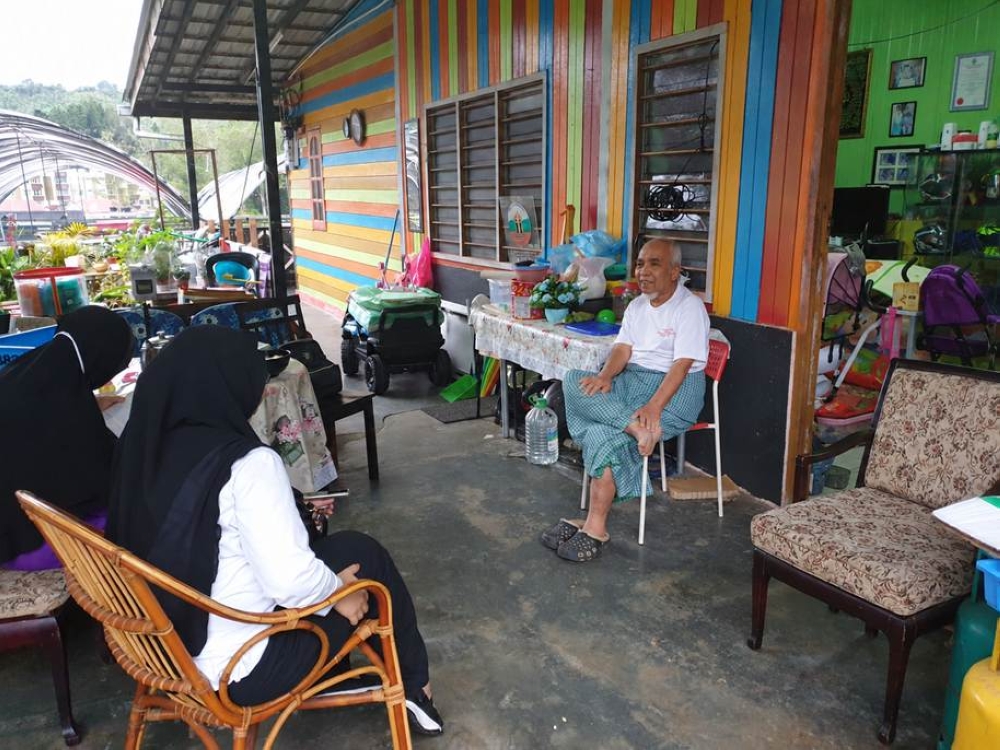
Listening to the stories of a Kampung Taman Sedia resident about the history of Cameron Highlands, the local community and how local businesses have evolved over the years. — Picture by Nadiah Mahmad Nasir
From holiday destination to research site
Cameron Highlands eventually became a place where my research team and I collected data on Muslim-friendly tourism.
That experience allowed me to see a familiar destination differently. We spent time with local residents, entrepreneurs, tourism stakeholders and travellers.
But some of my nicest memories were not necessarily the formal interviews. They were the moments around them.
Walking around Taman Sedia. Sitting and talking with local people. Listening to stories about their families and businesses. Having casual conversations about how Cameron Highlands had changed.
Research gave me a reason to listen more carefully.
As tourists, we usually experience the finished product. We arrive, check into our accommodation, eat, visit attractions, buy strawberries and vegetables, take photographs and go home.
Behind those experiences, however, are people building businesses and livelihoods. In Taman Sedia, for example, local families participate in tourism through homestays, eateries, cafés, farms and local products.
I began to understand that Cameron Highlands is not simply a destination. It is home to people whose everyday lives continue after tourists have gone home.
Even when friends from overseas came to Malaysia for holidays, Cameron Highlands was one of the places I wanted to introduce to them. I wanted them to experience the cool weather, farms, food and landscape I had enjoyed for so many years.
They enjoyed it too.
Perhaps that is what we naturally do with places we love. We want other people to experience them.
But there is a contradiction hidden in that love.
The more people who love a destination, the greater the pressure we can place on it.
When everybody loves the same place
Anyone who has travelled to Cameron Highlands during a school holiday or long weekend knows what its popularity can look like.
Sometimes, much of the journey is spent looking at the car in front of us.
I have complained about the congestion too. Over the years, however, I learned a simple trick: go on weekdays whenever possible.
If I have the choice, I avoid weekends and public holidays. I would rather have a quieter drive up, stay a little longer and enjoy Cameron Highlands at a slower pace.
But not everyone has that flexibility. For many families, weekends and school holidays are the only opportunities to travel together.
It is easy, while sitting in traffic, to complain about how crowded Cameron Highlands has become.
But there is an uncomfortable truth behind that complaint.
We are also the traffic.
Every car carries people who probably came for the same reasons I did.
The answer is not to tell people to stop coming. Tourism supports businesses and livelihoods. The real challenge is how a destination that so many people love can continue welcoming visitors without becoming overwhelmed by its own popularity.
Our research made this tension clearer to me. Mass tourism and environmental sustainability remain concerns, including heavy traffic during peak periods and growing pressure on the highland environment.
There were also concerns about visitor behaviour, including waste and incidents involving plants being taken from their surroundings.
One piece of rubbish may seem insignificant. One additional car certainly does not create a traffic jam. But our individual actions accumulate.
When enough of us do the same thing, we can slowly change the place we came to enjoy.
Muslim-friendly should work both ways
This has also made me think differently about Muslim-friendly tourism.
We usually discuss it from the perspective of what a destination should provide. We look for halal food, convenient prayer facilities, suitable accommodation and an environment where Muslim families can travel comfortably.
These things matter, and Cameron Highlands has developed many of these attributes.
But perhaps we should look at the relationship from the other direction too.
We often ask whether a destination is friendly to Muslim travellers.
Perhaps we should also ask whether we are being friendly to the destination.
For me, this is where Muslim-friendly tourism and responsible tourism should meet.
Cleanliness, moderation, avoiding waste and respecting other people are values that should travel with us.
Responsible tourism does not always require complicated policies. Do not leave rubbish behind. Do not damage or take plants. Respect local communities. Support local businesses where possible. Remember that the farm we visit may be someone’s livelihood and the village we explore is someone’s home.
While we are on holiday, other people are living their everyday lives around us.
Caring for Cameron Highlands is a shared responsibility
Of course, tourists cannot carry the responsibility alone.
Tourism operators need to consider how development affects the environment. Local authorities must manage infrastructure, traffic, waste and development. Government agencies have to balance tourism growth with environmental protection. Local communities should also have a meaningful voice in shaping the future of the place they call home.
Our research points towards this shared responsibility. Visitors can also be encouraged to make better choices through information, signage, conservation activities and cooperation between businesses and authorities.
But signs and regulations can only do so much.
Responsibility also comes down to how we behave when nobody is telling us what to do.
Perhaps I care about this because Cameron Highlands has been present at so many stages of my life.
I first knew it as a child travelling with my family and joining school trips. Later, I drove there myself, sometimes with friends and sometimes alone. Then I returned as a researcher, walking around Taman Sedia, interviewing local people and listening to their stories. And when friends from other countries visited Malaysia, it became a place I was happy to introduce to them.
Through all these stages, what I appreciate about Cameron Highlands has become increasingly simple.
The cold morning air. Walking for roti canai in Tanah Rata. Wandering around Taman Sedia. Chatting with local people. Hearing stories about their businesses and families. Seeing friends discover Cameron Highlands for the first time and enjoying it as much as I do.
These may not be the things that appear on tourism posters, but they are what make a destination memorable.
Malaysia has worked hard to strengthen Muslim-friendly tourism. The next step should not simply be more halal restaurants, prayer facilities or Muslim-friendly accommodation.
We should broaden what Muslim-friendly tourism means.
A destination should be friendly to Muslim travellers. But Muslim travellers should also be friendly to the destination, its environment and the people who call it home.
I hope children travelling to Cameron Highlands today with their families and school friends will return decades from now, just as I did. I hope they will still feel the cold morning air, enjoy the landscape, walk around its communities and create their own memories.
For that to happen, we cannot simply love Cameron Highlands as tourists.
We also have to care for it as a place that must continue long after our holiday ends.
* Dr Nadiah Mahmad Nasir is a senior lecturer at the Faculty of Business & Communication, Universiti Malaysia Perlis. She may be reached at [email protected]
** This is the personal opinion of the writers or publication and does not necessarily represent the views of Malay Mail.
KioskNews shows a cleaned-up reading view extracted from the publisher’s page — the original always lives on their site, not ours.