Indonesia ensures stable fuel prices protect purchasing power
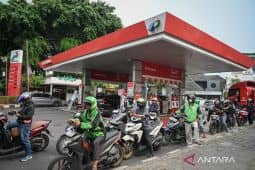
Jakarta (ANTARA) - Indonesian Finance Minister Suahasil Nazara said the government’s policy of maintaining stable domestic fuel prices is important for protecting people's purchasing power and driving economic momentum.
Speaking to reporters following the 2026 Bank Indonesia Annual Meeting in Jakarta on Friday (Nov 27), Suahasil responded to the Organization for Economic Cooperation and Development's (OECD) recommendations concerning energy subsidies as pressure on the State Budget.
"Maintaining domestic fuel prices stable strengthens Indonesia's economy, allowing us to achieve growth of 5.47 percent in the third quarter," Suahasil said.
The minister said the government's policy of keeping fuel prices steady continues to yield tangible benefits by supporting domestic economic activity and protecting consumers' buying power.
The Ministry of Finance recorded that as of October 31, 2026, the realization of energy and non-energy subsidies and compensation reached Rp415.8 trillion (around US$22.72 billion), marking a 32 percent increase compared to the same period last year.
The disbursement comprised Rp261.4 trillion (around US$14.28 billion) in subsidies and Rp154.4trillion (around US$8.44 billion) in compensation, aimed at safeguarding public purchasing power and supporting various economic activities.
Addressing the OECD's recommendations on increasing state revenues, Suahasil noted the organization's findings serve as valuable input for the government's ongoing policy evaluations.
"All of the OECD's suggestions are contained in its Economic Survey, which is published every two years. Of course, they examine the condition of the Indonesian economy in depth, and therefore, it becomes input for us to carry out continuous policy reviews," he said.
In its OECD Economic Surveys: Indonesia 2026 report, the international organization highlighted substantial government spending on energy subsidies, particularly during periods of rising global energy prices.
The OECD noted that energy subsidies strain state finances and recommended scaling back fuel subsidies by reintroducing a semi-automatic fuel price adjustment mechanism paired with targeted social aid to cushion the impact on the public.
Furthermore, the report outlined several strategies to increase state revenues, including strengthening tax compliance through the Coretax platform, broadening the value-added tax (VAT) base by gradually adjusting the VAT threshold to match international practices, raising the standard VAT rate to 12 percent, increasing tobacco excise, and implementing an excise on packaged sweetened beverages.
Translator: Rizka Khaerunnisa, Yashinta Difa
Editor: Bayu Prasetyo
Copyright © ANTARA 2026
KioskNews shows a cleaned-up reading view extracted from the publisher’s page — the original always lives on their site, not ours.