Taxi, private-hire drivers can switch to bus driving under new career pathway amid AV rollout
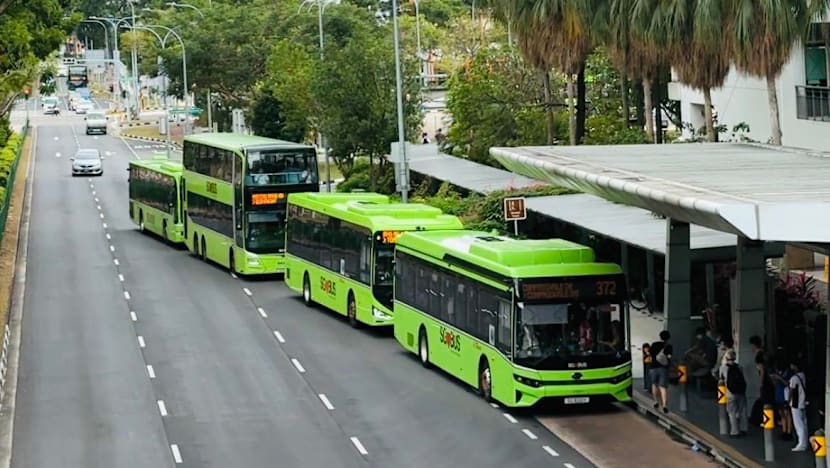
SINGAPORE: Taxi and private-hire car drivers can switch to bus driving under a new career pathway launched on Monday (Sep 28), as autonomous vehicles are progressively introduced on Singapore's roads.
Drivers' experience remains highly valued as the sector evolves, said the Ministry of Transport, the Skills and Workforce Development Agency and the National Trades Union Congress (NTUC), which jointly announced the pathway in a media release.
Autonomous vehicle numbers are expected to reach the hundreds in the next two years, so job displacement is not "imminent", they said.
A support package is nonetheless in place to give drivers more options to diversify their skills and progress in their careers.
Senior Minister of State for Transport Sun Xueling announced a transition package during a parliamentary motion in July. It comprises career conversion programmes and up to S$1,600 (US$1,250) in training incentives.
One of those programmes trains drivers for roles in the autonomous vehicle sector, including safety operators, remote operators and fleet management.
The new pathway is another option for drivers who want to become bus drivers but need more flexibility and support during the transition, the organisations said.
FLEXIBLE TRAINING
Taxi and private-hire drivers transitioning to the public bus sector can train part-time or full-time, allowing them flexibility to balance work with personal responsibilities.
The programme lasts two to six months and includes on-the-job training in areas such as electric vehicle diagnostics and bus interchange operations.
Drivers who hold a Class 4 licence, which qualifies them to operate heavy motor vehicles with an unladen weight exceeding 2,500kg, are eligible for a shorter programme and a faster transition.
"Many point-to-point drivers value point-to-point work for its flexibility to balance work and personal or caregiving responsibilities. Government, industry and unions have worked together to build flexibility for the point-to-point driver to bus captain pathway, including part-time on-the-job training," the organisations said.
The Land Transport Authority (LTA) facilitated the development and implementation of the pathway, which was formulated in consultation with NTUC, its affiliated National Private Hire Vehicles Association and National Taxi Association, and the National Transport Workers’ Union.
Both the career conversion programme and new pathway are administered by the Singapore National Employers Federation.
Ms Dilys Boey, chief executive of the Skills and Workforce Development Agency, said workers need access to different pathways as Singapore's transport landscape evolves. She added that the training builds on drivers' existing experience while equipping them with emerging competencies needed in the broader transport industry.
NTUC's assistant secretary-general Yeo Wan Ling said taxi and private-hire drivers will remain needed even as autonomous vehicles are introduced.
"We are also working with the public transport operators on flexible work arrangements, so that drivers have the option of balancing bus driving and other work opportunities," said Ms Yeo, who is adviser to the National Private Hire Vehicles Association and National Taxi Association, and executive secretary of the National Transport Workers' Union.
"As mobility evolves, we will continue working to create more opportunities and pathways for our drivers, so that the future of mobility provides flexibility, viable livelihoods and meaningful choices for them."
Singapore's four public bus operators – SBS Transit, SMRT Buses, Tower Transit and Go-Ahead Singapore – welcomed the move, saying more bus drivers will strengthen the manpower pipeline and support the industry's needs.
In June, the operators, the LTA and the National Transport Workers' Union announced higher starting salaries and larger sign-on bonuses for new Singaporean and permanent resident bus drivers from next year to help attract and retain drivers.
KioskNews shows a cleaned-up reading view extracted from the publisher’s page — the original always lives on their site, not ours.