Letters: The good and bad of Alberta’s vote
Sign In or Create an Account
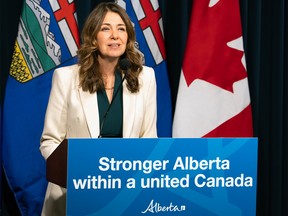
This week’s referendum in Alberta could result in both good and bad. It is good, obviously, because a majority of Albertans voted to remain in Confederation, and it will be good if the fact that the province even contemplated separation convinces the federal Liberal government to pay attention to the issues confronting Western Canada, instead of ignoring the region because it doesn’t elect enough Liberals. (Remember when then rural economic development minister Gudie Hutchings suggested during a 2023 televised interview that if westerners wanted more influence with the federal government, “Perhaps they need to elect more Liberals in the Prairies”?) Prime Minister Mark Carney’s “Build Canada Strong” (as if we would ever “Build Canada Weak”) should not depend on how many seats a region contributes to the government benches.
On the other hand, Alberta’s referendum could encourage the separatist Parti Québécois government in Quebec to continue that province’s extortion of the Rest of Canada. Just as Mark Carney must pay more attention to the West, he must resist the Liberal Party of Canada’s constant urge to pander to Quebec for votes. For instance, how does a high-speed rail line to Quebec City deserve to be a national priority? The answer is, it doesn’t. It is simply the Liberals’ most recent concession to Quebec while the Rest of Canada gives.

Columnist Jesse Kline keeps you up to date with what’s happening in Israel and the effects of antisemitism on life here in Canada. Friday mornings.
By signing up you consent to receive the above newsletter from Postmedia Network Inc.
A welcome email is on its way. If you don't see it, please check your junk folder.
The next issue of Channel Israel will soon be in your inbox.
We encountered an issue signing you up. Please try again
Paul Clarry, Aurora, Ont.
It’s richly absurd that U.S. Ambassador Pete Hoekstra has warned Canadian politicians “to keep your nose out of American politics,” when the American administration has put its entire face into Canadian politics, from calling Canada the 51st state and the prime minister its governor, to changing the name of one of the Great Lakes, to saying Canadians are nasty, to instigating a tariff war on their closest ally, to getting upset when Canada responds to their tariff war, which they actually started, and so on.
Hoekstra is more of a rough-and-tumble tavern bouncer than he is a diplomat. The late Sir Peter Ustinov once said, “A diplomat these days is nothing but a head waiter who is allowed to sit down occasionally.” It would be nice if the U.S. ambassador to Canada sat down and kept his mouth shut.
Douglas Cornish, Ottawa
So we have yet another “kiss and tell” exposé from another of our former “feminist ” PM’s cabinet ministers. Unlike former ministers Jody Wilson-Raybould and Jane Philpott, who had the moral courage to walk away from the cesspool of woke virtue signalling and grammatical pettiness, Chrystia Freeland’s desire for power (or blind loyalty to her boss) would not allow her the same until she was forced out of her job as minister of finance.
It must have been some consolation that former Liberal PM Jean Chrétien praised her as “a very good finance minister.” Might that have been one too many Chardonnays for Chrétien or was it that the criteria for such stellar performance are outlandish spending and taxing already over-burdened Canadians?
If we dared to compare Freeland’s record to that of the late Jim Flaherty, finance minister in the Harper government from 2006-2014, we would be reminded that under his astute fiscal management, Canada emerged from the 2008 world financial debacle faster and with more stability than most other G7 countries.
The sordid details (and accompanying cringeworthy photo) of Freeland’s last days in the Trudeau-sphere are hardly worthy of front-page news in one of Canada’s esteemed newspapers.
Susan Silverman, Toronto
I am not a resident of Toronto and I thank goodness it will definitely not be included in my retirement plans. Regardless, while there is appeal to Toronto Mayor Olivia Chow’s focus on making it easier for seniors to live in their homes for as long as possible, the alternate proposal being suggested by columnist Scott Stinson is downright discouraging from a humanitarian perspective. There is no justification for viewing seniors as an impediment to younger citizens achieving home ownership.
Many current senior homeowners live in houses they purchased decades ago to raise their families, having worked and invested to make those purchases possible. This was achieved at a time when a home could be afforded and birth rates required sufficient space for larger families. With the passage of time and rising demand — created by central planners bringing unjustifiable numbers of immigrants into the country, who clustered in large cities like Toronto — housing values increased exponentially without any causation from senior homeowners.
Now faced with the results of their own demographic mismanagement, the creators of the problem have focused on eliminating the rights of senior homeowners as their solution. As it seems to be the standard Marxist solution to take from the rich to give to the poor, seniors are now the prey of activists who see opportunities to promote their own political objectives. Whether to subsidize or penalize seniors is irrelevant to the fact that seniors should not become the lightening rod of political exploitation.
It is true that taxes on seniors with fixed incomes are high and constantly rising, but that should not lead to an acceptance that yet another tax cut-out would solve their problems. The solution is lower taxes overall. And moving seniors into 600-square-foot condos is not going to enhance anyone’s quality of life. Seniors and everyone else should have the opportunity to live wherever they want without legislative extortion.
While social engineering has become an obsession of our political classes, it is time for them to focus on the objectives of running our cities, and Toronto in particular, in a way that makes them liveable for everyone.
Raymond Foote, Ottawa
“You’re out of order! The whole trial is out of order.” My apologies to Al Pacino for borrowing his line from the 1979 movie “And justice for all.” But that was my reaction after reading Jamie Sarkonak’s column about a part-Mi’kmaq man in Nova Scotia who savagely beat his Mi’kmaq girlfriend by smashing her face into a sidewalk and brutally kicking her in the head and ribs. Then, thanks to the intervention of an Indigenous sentencing circle, his five-year sentence was reduced to time served — three years — and house arrest.
The rational of the sentencing circle was that additional incarceration wouldn’t help the man become a better person. The question of the day is: Who speaks for the man’s savagely beaten victim? We learn that he was subsequently charged (in other cases) with attempted murder, aggravated assault, assault with a weapon, and with stabbing two individuals. It is obvious that he has a problem knowing right from wrong. A lengthier incarceration might not have made him a better person but it certainly would have protected society from his criminal behaviour.
You do the crime, you do the time. There has to be justice for all.
Bob Erwin, Ottawa
I would have never thought so, but it appears that I and Sophie Grégoire Trudeau, the now separated wife of Justin Trudeau, have something in common.
During an interview in a recent episode of the Canadian podcast Built For This, Grégoire Trudeau said she never saw her “former partner as a prime minister.”
On that we are in complete agreement.
Tom Tulloch, Halifax
I have been treating those with Opioid Use Disorder for going on 30 years. The practice of providing short-acting opioids is in fact harm-producing, not harm-reducing.
The vast majority of these so-called “safer supply” medications are being diverted and the proceeds used to buy fentanyl, crystal meth, cocaine etc. Worse, they are finding their way to opioid-naive individuals, creating another cohort of those with Opioid Use Disorder.
The availability of these drugs disincentivizes patients with Opioid Use Disorder from seeking evidence-based Opioid Agonist Therapy (OAT) (Buprenorphine/Naloxone, Methadone, Sustained Release Oral Morphine). In some cases patients who have been stable on OAT elect to discontinue in favour of returning to these short-acting opioids and in short order relapse to fentanyl, making them more susceptible to fatal overdoses.
I and many of my colleagues have called on the Ontario Ministry of Health, the College of Physicians and Surgeons of Ontario and Public Health Ontario to intervene.
Those aforementioned agencies cannot move fast enough to curtail this harmful practice.
Dr. Mark A. Greenberg, Consulting Staff, Department of Psychiatry, Addiction Medicine, Sunnybrook Health Sciences Centre, Toronto
In his thoughtful commentary on the government of Canada’s decision to finally propose something definite about medically assisted suicide, Chris Selley observes: “This is never going to be black and white.”
Given the assumption that assisted suicide is morally permissible (the majority opinion in Canada today), Selley’s observation is correct. But what grounds do we have for making that assumption? Public consensus cannot infallibly determine morality.
In debating when, how and for what reasons people may choose death, MPs and senators would do well to remember that there is another option. That other option is respect for humanity and personal dignity, which would motivate us to help people to live worthwhile, fulfilling lives, in whatever state of health — not to help them end their lives.
Instead of regulating assisted suicide, a healthy society would ban it altogether. The issue really is “black and white.”
Brendon Johnson, Courtenay, B.C.
National Post and Financial Post welcome letters to the editor (250 words or fewer). Please include your name, address and daytime phone number. Email letters@nationalpost.com. Letters may be edited for length or clarity.
Join the Conversation
This website uses cookies to personalize your content (including ads), and allows us to analyze our traffic. Read more about cookies here. By continuing to use our site, you agree to our Terms of Use and Privacy Policy.
KioskNews shows a cleaned-up reading view extracted from the publisher’s page — the original always lives on their site, not ours.