Insurer flags husband’s ‘inflated’ income, widow gets Rs 1 crore insurance payout
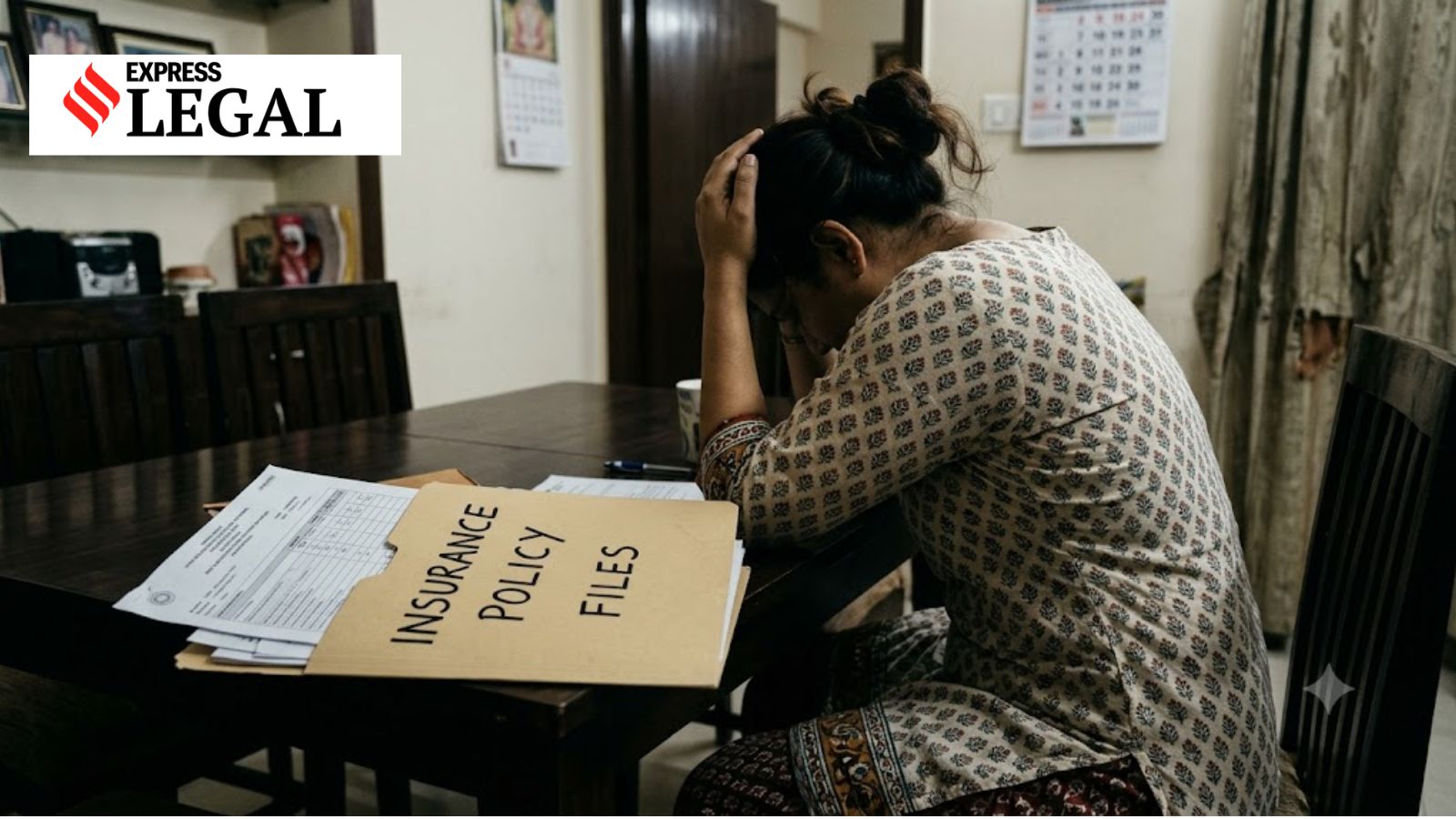
The commission held that the insurer failed to prove that the policyholder had deliberately inflated his income. (AI-generated image)
An Andhra Pradesh consumer commission has directed an insurance company to pay Rs 1 crore to the wife of a stone factory owner after it rejected her claim on the ground that her husband had suppressed his income while taking the policy. The stone factory owner died in a road accident in July 2025, more than a year after taking the policy.
The commission held that the insurer failed to prove that the policyholder had deliberately inflated his income or that the alleged discrepancy was enough to reject the claim.
President Karanam Kishore Kumar, along with members N Narayana Reddy and S Nazima Kausar of the Kurnool District Consumer Commission, allowed the complaint filed by the wife of the policyholder and also directed the insurance company to pay Rs 35,000 as compensation for mental agony and litigation costs.
“Since the policy was subsisting on the date of the accident and the death of the insured has been established, the complainant (wife), being the nominee, is entitled to the policy benefit of Rs 1 crore,” the August 28 order read.
Died in road accident
The woman said that her late husband was a stone factory owner and had obtained a Rs 1 crore insurance policy from the company. The policy commenced on March 13, 2024 and was valid until March 11, 2027. As per the policy terms, in the event of accidental death, the nominee was entitled to the assured amount along with the applicable accidental death benefit.
Later, on July 28, 2025, at about 8.45 pm, the man met with an accident while travelling in a mini truck. He suffered serious injuries to his head and legs and was taken to a government hospital, where he was declared dead.
After her husband’s death, the wife, being the nominee, submitted the claim form and required documents to the insurance company. However, the insurer rejected the claim in October 2025, alleging that the policyholder had suppressed his income while obtaining the policy.
Story continues below this ad
The wife said the allegation was baseless and that her husband, who owned a stone polishing factory, lorries and agricultural land, had enough income and financial resources to pay the premiums. The wife was represented by advocate Siv Sudarsha before the commission.
Insurance company’s defence
The insurance company, represented by advocate Palle Niranjan Kumar, argued that it had investigated the claim and found material misrepresentation and manipulation in the policy documents. It alleged that the man had been engaged in the stone business for about 10 years and that, during the investigation, his son stated that his income had been intentionally inflated to qualify for the policy.
The insurer also relied on bank statements and a declaration allegedly submitted by the insured’s wife, claiming that these documents showed discrepancies in the income disclosed when the policy was taken. It argued that the policy terms allowed it to reject a claim involving fraudulent or false statements.
‘No proof of fraud, misrepresentation’
The commission noted that the insurance company relied mainly on the investigation report, and the alleged statement/admission attributed to the son of the man. However, it found that the investigation report essentially contains the conclusions of the insurer’s investigator and, by itself, cannot be treated as “conclusive proof of fraud or intentional misrepresentation”.
Story continues below this ad
The commission also questioned the alleged statement of the son. “The opposite party (insurance company) has not satisfactorily established that the statement constitutes a clear and unequivocal admission that the insured deliberately inflated his income in the proposal form,” it held.
It further said that even if the statement was made, it could not by itself establish what the policyholder intended when he filled out the proposal form.
The commission noted that the insurance company accepted the proposal, issued the policy and received the premium. “Having undertaken the risk, it is bound to establish a valid contractual or statutory ground for repudiation. A repudiation based on an unproved allegation of income inflation cannot be sustained,” it added.
Consequently, the commission held that the October 23, 2025 repudiation letter was not justified and amounted to deficiency in service.
Story continues below this ad
The commissions, accordingly, directed the insurance company to pay the wife Rs 1 crore towards the assured amount under the policy and further directed it to pay Rs 25,000 towards compensation for mental agony and Rs 10,000 towards costs within 45 days.
Takeaway
This ruling highlights that an insurance company cannot reject a claim merely based on an alleged income discrepancy. It must establish that the policyholder deliberately made a material false statement or suppressed information that justified repudiating the claim.
For consumer-related grievances, individuals may contact the consumer helpline in their respective states (Andhra Pradesh: 0866–2551431) or call the National Consumer Helpline at 1915 for assistance.
Don’t miss out on these stories:
Cancer patient dies before ‘using’ Ayurvedic treatment, hospital to pay parents Rs 63,000
Story continues below this ad
‘Faulty’ paper-straw machine hits start-up, device makers to pay Rs 11 lakh
Kerala hospital to pay Rs 1.14 lakh to patient over ‘fake signature’ to insurer, inflated bill

Richa Sahay is a Legal Correspondent for The Indian Express (Digital), where she focuses on simplifying the complexities of the Indian judicial system. A law postgraduate, she leverages her advanced legal education to bridge the gap between technical court rulings and public understanding, ensuring that readers stay informed about the rapidly evolving legal landscape. Expertise Advanced Legal Education: As a law postgraduate, Richa possesses the academic depth required to interpret intricate statutes and constitutional nuances. Her background allows her to provide more than just summaries; she offers context-driven analysis of how legal changes impact the average citizen. Specialized Beat: She operates at the intersection of law and public policy, focusing on: Judicial Updates: Providing timely reports on orders from the Supreme Court of India and various High Courts. Legal Simplification: Translating dense "legalese" into accessible, engaging narratives without sacrificing factual accuracy. Legislative Changes: Monitoring new bills, amendments, and regulatory shifts that shape Indian society. ... Read More
KioskNews shows a cleaned-up reading view extracted from the publisher’s page — the original always lives on their site, not ours.