Yashar ahead of Likud in election polls, but Knesset majority still out of reach for both - poll

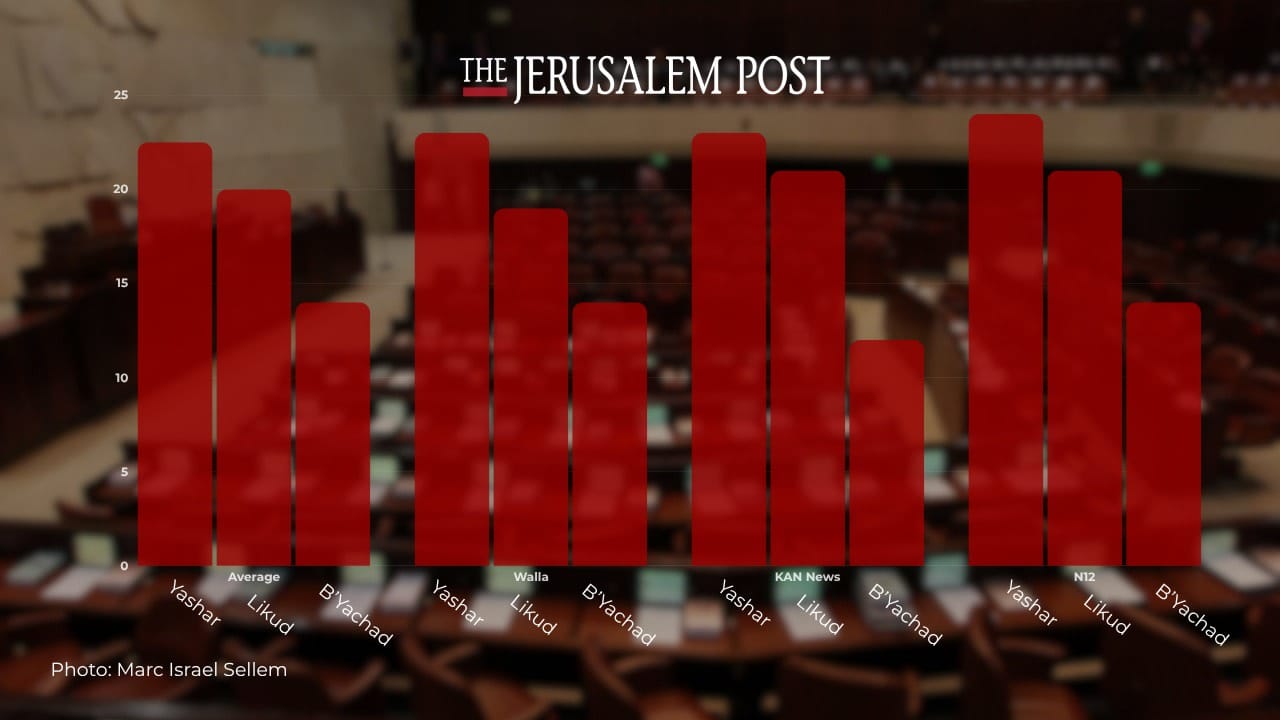
Less than a week before the elections, the four latest Knesset seat polls painted an almost identical picture: Gadi Eisenkot and his Yashar party led Likud in every poll, but neither bloc comes close to a 61-seat majority.
The polling average put the Zionist opposition at 51.25 seats, compared with 51 for Prime Minister Benjamin Netanyahu's bloc, a near-perfect tie that leaves the Arab parties and parties hovering around the electoral threshold in a pivotal position ahead of election day.
Walla poll: Eisenkot widens lead over Likud
A Walla poll indicated a shift in momentum, although neither bloc secured a 61-seat majority. The poll also revealed significant differences in voters' confidence in their choices.
According to the poll, after Benny Gantz withdrew from the race, Eisenkot's Yashar party gained one seat, reaching 23. In contrast, Netanyahu's Likud lost one seat, falling to 19.
One of the remaining questions ahead of the elections concerns the chances of Ofer Winter's People of Israel party entering the Knesset. According to the poll, the party remains below the electoral threshold, with just 2.9% support. Meanwhile, the Reservists and Economic Party alliance, led by Yoaz Hendel and Yaron Zelekha, continued to cross the electoral threshold, winning four seats.
Despite the changes in individual parties' standings, the distribution of seats between the blocs continued to point to difficulties in forming a government. Netanyahu's bloc weakened by one seat, falling to 48 from 49 in the previous poll, while the opposition parties maintained their strength with 54 seats.
Outside the two main blocs, Hendel and Zelekha's Reservists and Economic Party alliance held four seats. The two Arab parties won 14 seats combined, up one from the previous poll.
Channel 13 poll: Opposition bloc leads Netanyahu
A Channel 13 News poll gave Netanyahu's bloc 50 seats, while the "change bloc" held 51.
According to the poll, Eisenkot's party received 20 seats, while Likud won just 18.
KAN news poll: Netanyahu gains ground, three seats separate the blocs
A KAN poll put Eisenkot's Yashar party first with 23 seats, up one from the previous poll.
Netanyahu's Likud also gained one seat to 21, while former prime minister Naftali Bennett's B'Yachad party held steady with 12 seats.
The Reservists and Economic Party alliance, led by Hendel and Zelekha, also held steady with four seats.
In contrast, Winter's People of Israel party, which won four seats in the previous poll, failed to cross the electoral threshold this time.
The most significant change between the two polls was the shift in seat distribution between the blocs. In the previous poll, Netanyahu's bloc led with 53 seats, compared with 50 for Eisenkot's bloc, a three-seat advantage for the prime minister.
Channel 12 poll: Major parties gain ground, Hendel and Zelekha fail to enter Knesset
A Channel 12 News poll put Eisenkot's Yashar party first with 24 seats, up one seat from the previous poll.
Netanyahu's Likud also gained one seat, reaching 21, leaving the gap between the two parties unchanged.
Bennett's B'Yachad party also gained one seat, rising to 14.
The Reservists and Economic Party alliance, led by Hendel and Zelekha, which won four seats in the previous poll and crossed the electoral threshold, fell to just 2.1% support, leaving it outside the Knesset.
Winter's People of Israel rose from 1.8% to 2.8% of the vote.
According to the poll, Eisenkot's bloc gained one seat, rising from 54 the 55.
Netanyahu's bloc gained two seats, rising from 49 to 51, while the Arab parties increased their combined representation from 13 to 14 seats.
Polling average: Eisenkot holds narrow lead, blocs remain nearly tied
The average of the four latest polls, conducted by Channel 12, Channel 13, KAN, and Walla, painted a fairly clear picture of the election race: Eisenkot's Yashar party leads with an average of 22.5 seats, compared with 19.75 for Likud.
Bennett's B'Yachad party ranks third with 13.5 seats, followed by the Democrats with nine, the Joint List with 8.5, and Avigdor Liberman's Yisrael Beytenu with eight.
On the right, Otzma Yehudit and Shas each average 7.75 seats, United Torah Judaism stands at seven, and the Religious Zionist Party at 6.75.
Ra'am averages 5.5 seats.
The Hendel-Zelekha alliance, which crosses the electoral threshold in three of the four polls, averages three seats, while People of Israel crosses the threshold in just one poll and averages one seat.
The seat distribution between the blocs also reflected an advantage for the camp opposing Netanyahu.
Netanyahu's bloc averaged 50 seats, compared with 53 for the Zionist opposition. The Arab parties averaged 14 seats combined, bringing the Zionist opposition and Arab parties to 67 seats.
Meanwhile, Hendel and Zelekha's alliance averaged three seats and is not fully aligned with either of the two blocs.
The overall picture showed Eisenkot holding a modest lead in the race to become the largest party, alongside a wider gap between the political blocs. However, it also pointed to an election in which parties hovering around the electoral threshold could significantly alter the distribution of Knesset seats.
The Hendel-Zelekha alliance and People of Israel are the most prominent examples. If they cross the electoral threshold, they could shift several seats between the political camps and change the outcome on election day.
The average is based on the distribution of seats in four separate polls and does not constitute a new poll or a forecast of the election results.
KioskNews shows a cleaned-up reading view extracted from the publisher’s page — the original always lives on their site, not ours.