Notes from Central Taiwan: Immigration: are we on the cusp?
Taiwanese are more accepting of outsiders than ever before. Could it lead to a formal immigration program?
By Michael Turton / Contributing reporter


Apetition on the Web site of the National Development Council (NDC) arguing that non-citizens receiving National Health Insurance (NHI) should make up payments from their birth to their current age has reached 5,000 signatures last week, the threshold requiring a response. The comments under the petition are predictably odious, proving once again that the Venn diagram of racism and idiocy is a perfect circle.
Also last week, the Ministry of the Interior proudly announced that the 400th “high-level professional” was approved for citizenship on Aug. 26. Four hundred carefully selected dual citizens! At that rate, sometime around the year 2600, Taiwan will finally have permitted enough dual citizens to make up for its current immigration deficit.
The suicidal immigration policies (remember that Venn diagram cited above?) are easy to see. But for all the frustration foreigners of every type experience with racism, it is easy to forget that things are much better than they used to be. I am old enough to remember being removed from two different cram school classrooms around 1990 at a parent’s request because I did not have blue eyes, hence my English clearly wasn’t good enough. Many old-timers can recount similar stories.

The 2026 Indonesian Migrant Workers’ Cultural Carnival is pictured last month in New Taipei City.
Photo courtesy of the National Immigration Agency
CHANGING ATTITUDES
The changes show up in the data. Every few years, the Taiwan Social Change Survey (TSCS) has a question about attitudes toward immigration. In 2003 it asked about what should happen to the number of immigrants using a scale of 1 (increased greatly) to 5 (reduced greatly). Less than 5 percent wanted increased immigration, while 66.1 percent wanted reductions. Since 2010, however, positive attitudes have outweighed negative, though negative attitudes have risen. Increased immigration seems to have modified Taiwanese attitudes somewhat.
It is easy to root out the response in racism and xenophobia. Yet the nation faces a massive external threat. One way the Taiwanese cope with that is resorting to economic nationalism. “In this light,” as Minjin Choi put it in a PhD thesis on welfare chauvinism in East Asia: “the fruits of economic growth are portrayed as strategic assets that must be reserved for the Taiwanese people to maintain sovereignty.”
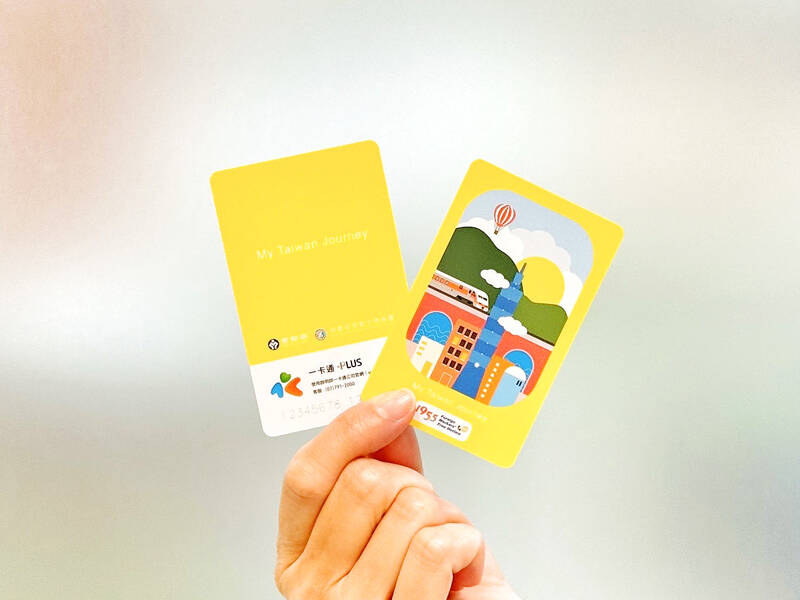
A “Welcome Card” exclusively for migrant workers, which has been officially included in the Ministry of Labor’s “Migrant Worker Welcome Kit,” is shown in this undated photo. The agency has also produced videos in several languages spoken by migrant workers to help them quickly adapt to their daily payment needs in Taiwan.
Photo courtesy of the Ministry of Labor
Hence, to the people on the inside of that dynamic, outsiders may appear as plunderers of hard-won gains.
At the same time, as much research shows, migrant groups are busy reshaping attitudes. The most obvious marker is language. It is one thing to see multiple languages in government-mandated domains like department offices or trains. It is quite another to marvel at the scrolling displays at 7-11 displaying beverage menu choices in several languages. That was unthinkable 30 years ago, and not just because the technology did not exist.
‘PERCEPTUAL BIAS’
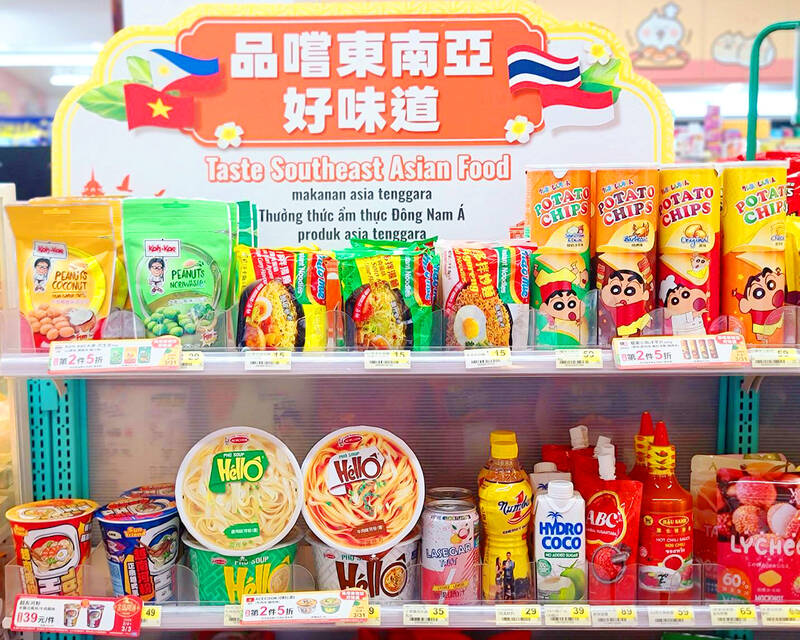
A display of South East Asian food is pictured at a 7-Eleven store in an undated photograph.
Photo: Yang Ya-min, Taipei Times
A team led by Timothy S. Rich of Western Kentucky University explored attitudes towards southeast Asians in Taiwan (“All Are Not Equal: Taiwanese Public Opinion on Southeast Asian Immigration”, International Journal of Taiwan Studies). Although Taiwanese often claim to want skilled immigrants, Rich found that racism remained a problem.
“In sum, the results show a clear perceptual bias against Southeast Asian immigration, even when skills are taken into consideration,” they wrote.
Their survey also revealed that the strongest biases were against Indonesians, who were the largest group of migrant workers when the survey was performed.
As the researchers point out, Indonesian migrant workers are disproportionately women employed in caregiving (another cohort represents fishers in the distant water fleet, who Taiwanese seldom interact with). They are also Muslims, while Thais and Vietnamese are Buddhists or Christians, religions Taiwanese are more familiar with. In fact, a decade ago the Thai-style Four-Faced Buddha (四面佛) became popular, “with shrines popping up all over the place,” as Josh Ellis, the popular photo blogger, observed at the time. Many of my students reported visiting them to resolve personal problems.
Further, Thai and Vietnamese foods are ubiquitous, while Indonesian food remains a niche cuisine of migrant workers. Still, acceptance of religion and food augurs the possibility of acceptance of people.
CITIZENSHIP FOR MIGRANT WORKERS?
Although many of these migrant workers would make excellent citizens, the issue of “skills” remains a stumbling block. The Choi thesis suggests the reason: the demand for “skills” on the part of immigrants is a response to the perception that outsiders are plunderers and raiders of precious Taiwan economic development. If immigrants arrive with “skills” they evade the nationalist perception that they are plunderers.
The government’s pride in the tiny dribble of 400 high-level professionals is thus a distortion created by the shaping effect of economic nationalism. It is the wrong response, catering to rather than confronting the problem. It is also a dead end: Many of the economies from which Taiwan hopes to recruit skilled professionals are themselves aging and will increasingly compete for talent.
In two decades the global competition for skilled workers is going to be fierce, and countries with less brutal work cultures and higher salaries are going to easily out-compete Taiwan. The only solution is to do it the hard way: import couples with small children and train up the children.
The stumbling block is that many can’t imagine a world where children are vital economic assets whose potential is fostered by enculturation and education. Instead, they live in a mental world where children of outsiders are eternally parasites who never grow up to become productive citizens.
This year the number of foreigners in Taiwan broke 1 million. As Taiwanese age, this number will continue to rise. The policies to smooth this transition need to be implemented as soon as possible, and as they are implemented they will change the way Taiwanese think about migration. As dim as the prospects look at the moment, we may actually be sitting on the cusp of profound change. Much will depend on the leadership from above.
First, the government needs to directly address how economic nationalism distorts views of potential immigrants. Ironically, the very public investments of Taiwan Semiconductor Manufacturing Co (TSMC, 台積電) in Arizona (and Japan) may help change the possessive attitudes of Taiwanese toward their economic champions.
Another thing the government must do is raise the status of both children and motherhood. This is a moral action that relies on authority’s bully pulpit.
It should also begin by permitting migrants with children under three to bring them to Taiwan and raise them here. If handing out citizenship to migrant workers proves too radical, the government can grant the workers permanent residency and their children citizenship provided they are schooled in Taiwan. That first generation will encounter much racism, but their children will be Taiwanese.
As Taiwan ages and more migrant workers come in, change is inevitable. There is still time to choose the right direction.
Notes from Central Taiwan is a column written by long-term resident Michael Turton, who provides incisive commentary informed by three decades of living in and writing about his adoptive country. The views expressed here are his own.
KioskNews shows a cleaned-up reading view extracted from the publisher’s page — the original always lives on their site, not ours.