'Slow Horses' Star Officially Confirms Whether Lamb Can Come Back From the Ultimate Betrayal

Carly Lane is an Atlanta-based writer and critic who has been with Collider in some form or fashion since 2021. She considers herself a television nerd, diehard romance/sci-fi/fantasy reader, and nascent horror lover. Her fondness of books is only eclipsed by the towering TBR that her shelves can't possibly contain.
She is the author of A REGENCY GUIDE TO MODERN LIFE: 1800s ADVICE ON 21ST CENTURY LOVE, FRIENDS, FUN AND MORE, published through DK Books (an imprint of Penguin Random House) and currently available wherever books are sold.
Sign in to your Collider account
Editor's note: The below interview contains spoilers for Slow Horses Season 6 Episode 5.
With only one episode remaining, Slow Horses Season 6 still has plenty of loose ends to tie up, with more than one threat still at play against MI5's biggest misfits. Although most of the team has now made their way to Diana Taverner's (Kristin Scott Thomas) vacation house, Frank Harkness (Hugo Weaving) and his own ill-equipped sidekicks are about to close in, while River Cartwright (Jack Lowden) and Sid Baker (Olivia Cooke) might be one step closer to... admitting to some real feelings? Yet one of the characters is still reeling from a jarring discovery in the season premiere, and there's been no time whatsoever to really process it. What will Catherine Standish (Saskia Reeves) do now that she's learned the truth about what Jackson Lamb (Gary Oldman) did to her old boss — and will Slough House's longest-tenured members ever be the same again?
Before the premiere of Episode 5, "Sayonara," Collider spoke with Reeves about the moment that literally brings Catherine Standish to her knees (and why she wanted to do her own stunts for the scene in question), whether Lamb's betrayal will push Standish off the wagon, and if these two characters will ever be the same again in the wake of that revelation.
COLLIDER: There are a lot of really great, emotionally meaty elements for Catherine Standish this season, but I wanted to start with a scene in the first episode, which is River's eulogy for his grandfather while Lamb's giggling in the pew. What's your biggest memory from filming that scene in the church?
SASKIA REEVES: Well, it's actually incredibly touching. When we were filming it, I was thinking how brilliantly Jack [Lowden] did it. Having read it on the page and then hearing him do it, I thought, “Oh, that's really good.” Gary [Oldman] and I played around with what I would actually say to him, so I think we were quite focused on Catherine and Jackson, what story we were going to tell.
But when you’ve done it three, four, five times, it doesn't quite hold the hilarity, as you might imagine. So, I thought it was a very touching scene, actually, rather than funny. And Jackson is just horrible. He knows exactly what's going on. He knows exactly the situation, and yet he's undermining it. I think the line, “Try and behave like a human being for once,” is quite appropriate.
Saskia Reeves Wanted To Do Her Own Stunts in the 'Slow Horses' Season 6 Premiere
"When you're in the moment of it, it just seemed so important to me that I carry out the whole thing."

There's a more serious moment outside the church, after a very off-hand quip that Tavener makes about Charles Partner right in her hearing. You see it in how Catherine responds, even literally falling down. Was there a discussion about how much she was going to physically react? Did you film different versions of that scene?
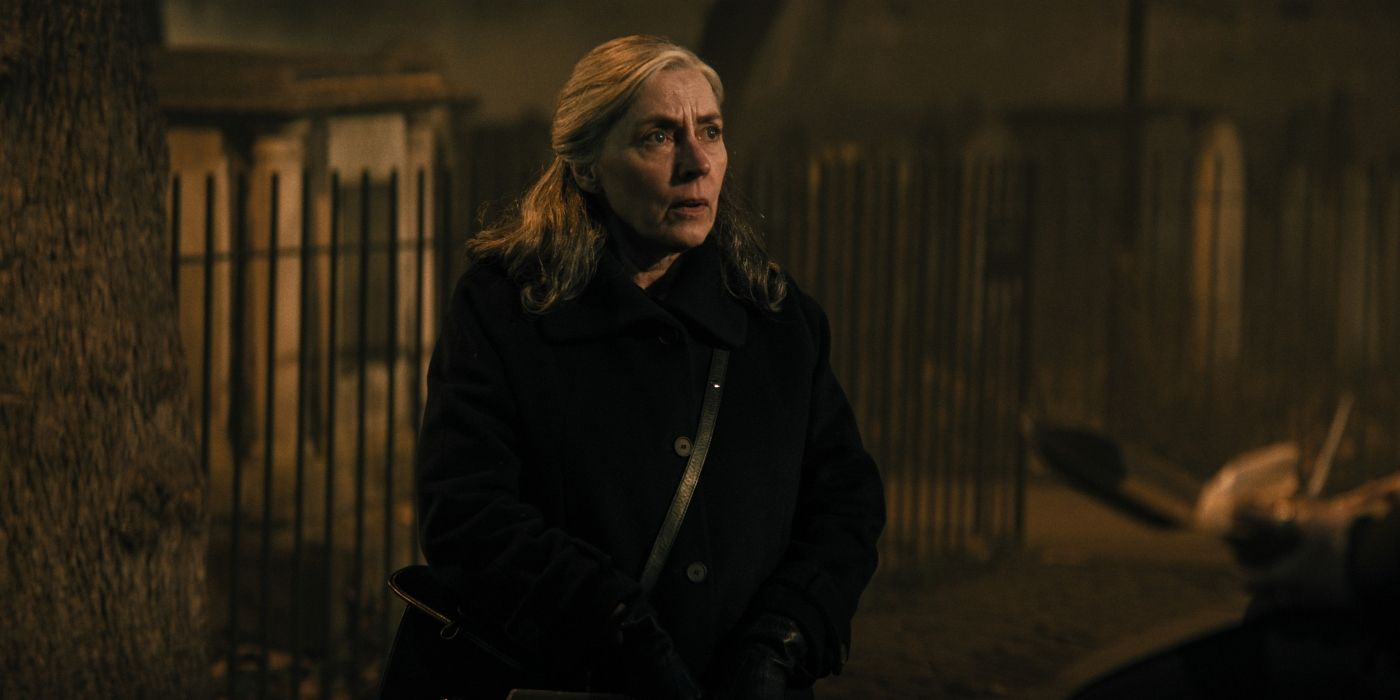
REEVES: That was a conversation that happened as we developed the script together. Once the scripts had been published to the actors. I had a conversation with the director [Adam Randall], and I said, “This information is like a punch to the stomach. If I can, can she…?” And actually, I’d been to a funeral not very long ago before we shot this, and I was really standing around the place where the coffin was going in. There were other gravestones and lumpy bits of grass, and I thought, “If you just step back, because you can't believe what you just heard, and you were to trip, you would physically fall over.” To be able to physicalize that shock by actually literally falling over was really important to me.
Also, that horrible humiliation. When you fall over, when you're an adult, it's so humiliating, and she's also upset. So that thing of, “No, no, I’m fine.” It's all going horribly wrong for her, and I wanted it to be as uncomfortable and as awkward and as chaotic as possible, rather than close up on Catherine's face. Do you know what I mean? Adam agreed with me, so we went ahead and thought about it.
Adam, at one point, thought maybe she'd step back and trip over somebody's wheelchair or something, but actually, the shoes that I was wearing, it was quite easy to pretend to lose my balance in them. I did all those falls myself, and they kept saying, “We can use a stunt double.” When you're in the moment of it, it just seemed so important to me that I carry out the whole thing. So, I was very happy with that. He shot it in many different ways, and I remember complaining to him after, saying, “But Adam, you have loads of angles. Couldn’t we have seen this a bit more?” But I think that's just me wanting to show off my stunt abilities.
Do you think it's crueler for Catherine that comes from Tavener as this semi-public, off-hand joke, or that she's hearing it from Tavener and not Lamb? Or is it both of those things?
REEVES: It was just hearing a secret, but also, yeah, that Lamb didn't have the balls to tell her herself. That probably comes a bit later. You’re shocked to realize, “Oh, it was Lamb who shot him. He didn't kill himself.” And then, “Wow, he kept that quiet.”
But she works for the service. They've all done terrible things. They all know how to be deceitful and sly and slippery. It's something she has to suck up, actually, in the end. Well, actually, it challenges her sobriety. She nearly drinks more than once, and each time, she's saved by something else, and I like that. I like that we still don't know whether she would. It gets so close. She gets so close, but she still doesn't fall off the wagon.
I wanted to ask about the scene where Catherine goes into the wine store and what you were interested in conveying about her state of mind. We know that she's just been dealt this huge blow, and this feels like she's walking right into her biggest temptation and almost seeing how close she can get to drinking again without actually doing it.
REEVES: I don't know. I don't think there's one linear way of thinking about it. I think addiction is very complicated. The brain tells you all sorts of things. I do think there is, inside Catherine and the Catherine of years ago, when she was drinking... I thought about this, obviously, when I was preparing the character, that she is somebody who doesn't seem outwardly very sociable or confident. She's very, very clever. She didn't go to the right university. I think she had many problems at home. I think one of her parents was probably an alcoholic. I think her father probably wanted a boy. All sorts of things I invented for her to help me understand the sort of insecurity of a person who's obviously talented, but. Self-sabotages. Many, many, many reasons.
I think the drink for Catherine would have been something that would bring her out of herself to the point where she would then black out, and as Lamb keeps reminding her, she'd be under a truck, obviously. She can't remember these nights of passion or madness or whatever. And I think that there is a part of Catherine that is really wild, or wants to be, and therefore, thinking about drinking is realizing that, “I have a secret weapon.” As the story continues, we're in danger, but I always felt that it was like having a terrorist inside her. It's like, “You think this is bad? Just you wait until I start drinking.” So there's an element of danger and excitement. Also, people don't know who she is. It’s like, “You don’t know what I'm like when I'm drinking. Just you wait.” That sense of, “You underestimate me, you lot.” So that gave me something to really play.
And also, the idea of it being something lovely, something exciting and fun and mad. Of course, because she's an addict, it will never be normal. It'll never be that you wake up with a hangover and go, “I'm not going to have a drink for a few days. That was a bit excessive.” No, if she starts, it's going to be very difficult for her to stop, which is why people who are in the program, who realize they are alcoholics, usually it means they can never, ever have another drink again.
And she has to wake up every day and decide not to drink.
REEVES: Exactly. Yeah.
Saskia Reeves Reveals Standish's True Feelings About the Other Slow Horses
"She's just trying to guide everybody in the best way possible — and again, gets ignored a lot of the time..."

Once the Slow Horses realize that assassins are being sent to target not just the current members, but also former members of Slough House, Lamb tasks Catherine and Shirley with rounding up some of their longtime allies, and so you get to have a really fantastic subplot with Aimee [Ffion Edwards], Joanna [Scanlan], and Rosalind [Eleazar]. In many ways, it feels like Catherine has to herd these women when Louisa and Shirley are fighting, or Moira is doing things like shouting in the middle of the pharmacy.
REEVES: Moira is a whole different thing. When we were talking about it and the opportunities between the four of them, I remember saying Moira and Catherine will never be friends. They’re just poles apart. But the problem is with women over a certain age who do not have children, they don't have partners, who give their life to their job, you tend to sort of lump them in together, and they're not. They're very, very different animals. So, that was fun. That was lovely to think about in that respect.
Catherine has a lot of time for Louisa and Shirley. Ros and Aimee, I love what those two do with those characters. I don't think Catherine, in any shape or form, believes she has any real agency. She's just trying to guide everybody in the best way possible — and again, gets ignored a lot of the time, which is a situation she gets used to, but she doesn't give up.
How would you describe Catherine's feelings towards Lamb, at least by the back of the season? They do have that phone conversation where she says she still wants to shove his head in a mangle, but then they just slip right back into that old tête-à-tête.
REEVES: Forgiveness, frustration. She's a realist. That’s what I think I was trying to say at the beginning of the interview. They work for MI5; terrible things happen, people are made to do terrible things, and it's the system that Catherine hates. I think it was difficult for her not to be able to say to Lamb exactly what she wanted to say. We played around with that for a while. What would she say?
But actually, I really like it in the end, the fact that she never really gets to say what she would like to say, and then that becomes internalized, that frustration and anger, this feeling of being betrayed. However, she knows him to be loyal, and actually she knows if he did that, it was because he was being made to do it, and Charles Partner was a traitor, and it's Cartwright who made him do it. He’d been made, I think Lamb says it, to do unconscionable things, and in the end, you have to forgive and move on because that's the job.
New episodes of Slow Horses Season 6 premiere Wednesdays on Apple TV.
KioskNews shows a cleaned-up reading view extracted from the publisher’s page — the original always lives on their site, not ours.