The para-athlete who once won a medal for Singapore and now sells art on the streets of Kuala Lumpur
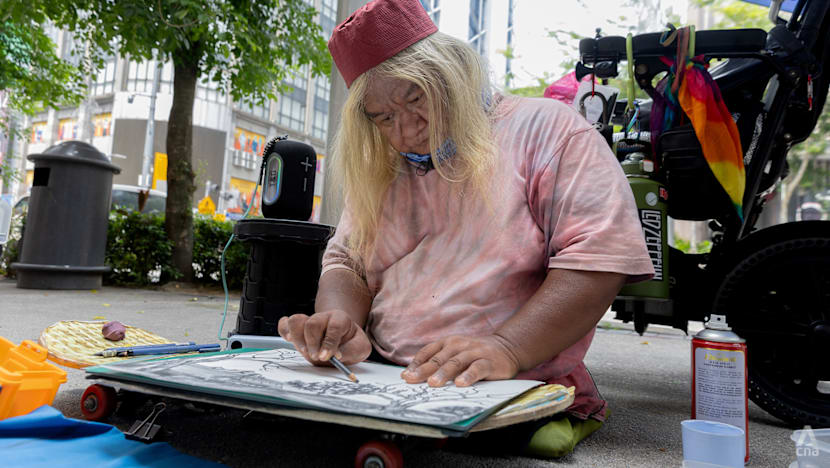
Every morning, 58-year-old Dasuki Johari wakes up alone on his motorised wheelchair, which doubles as his bed in a tiny room in Kuala Lumpur, Malaysia.
He takes a sip of last night's iced teh-o (tea with sugar) from his insulated tumbler, heavily decorated with stickers of his favourite heavy metal bands and Liverpool Football Club.
With no one to exchange "good morning" greetings or eat breakfast with, he gets dressed in an old, worn T-shirt – one of several in a plastic bag in a corner of his room.
Then he sets out on his morning commute, a 10-minute journey in his wheelchair from his room in a building along Jalan Masjid India to an open spot on Jalan Tuanku Abdul Rahman, just across from the Sogo mall.
He has no colleagues to greet or make small talk with upon reaching his "workplace". He ties an umbrella to the back of his wheelchair and crawls down to the pavement to lay out a cloth, a donation box, a portable speaker and a skateboard that he uses as his work desk.
He puts on a slow rock tune, picks up a charcoal pencil and starts sketching.
"I need to listen to music, then I'll have the 'feel' to draw," he told me when I visited him in August.
Apart from the music he constantly has playing while at work, Mr Dasuki makes little sound. He interacts little with others, outside of the occasional customer and a handful of regular passers-by who stop to say hello.
This is how he has spent nearly every day of the last five or six years, eking out a meagre living as a street artist in Kuala Lumpur. But his life was not always this solitary.
Over three decades ago, Mr Dasuki was working as a data entry clerk in Singapore, where he was born. He even became a competitive para-athlete for some time, clinching a bronze medal for Singapore in para-skiing in 1995.
In 1998, he decided to leave behind his life in Singapore – his job, family and friends – to "find something for myself" in Malaysia.
Now, nearly three decades on, it's hard to determine what exactly Mr Dasuki set out to find.
LONG HAIR AND A LONGING FOR SOMETHING MORE
Born without legs, Mr Dasuki has relied on mobility aids for as long as he can remember.
At age 12, he made headlines in Singapore for coming in second place in a 50-metre wheelchair dash at a sports meet for the handicapped.
He studied in a schooling programme run by the Red Cross Home for the disabled in Changi Village, completing it in 1983.
Soon after, he developed a taste for moving around on a skateboard instead of a wheelchair, eventually earning him the moniker "Dasuki Skate" among his friends.
"I'd (skate) to the MRT station, take the escalator up and down, get on the train and everything." He recalled a particular fondness for hanging out with his friends around City Hall MRT station.
He was so distinctive that when he started resurfacing in news media over the last few months, several online users piped up, easily recognising him as Dasuki Skate.
Despite working as a street artist for the last 10 years, Mr Dasuki was completely inept at art when he was growing up.
"In school, when a teacher asked me to draw even an apple, I couldn't."
Instead, music was his main creative preoccupation during his youth, especially rock and heavy metal bands such as Led Zeppelin and Iron Maiden. He spent many a night watching live performances by pioneer rock bands in Singapore, including Sweet Charity and Bumiputra Rockers.
The long-haired look of these 1970s and 1980s rockers motivated him to keep his own hair long – which didn't always go down well.
"When my oldest sister made me cut my hair when I was in school, I cried," he said, adding that his shoulder-length mane remains his pride and joy to this day.
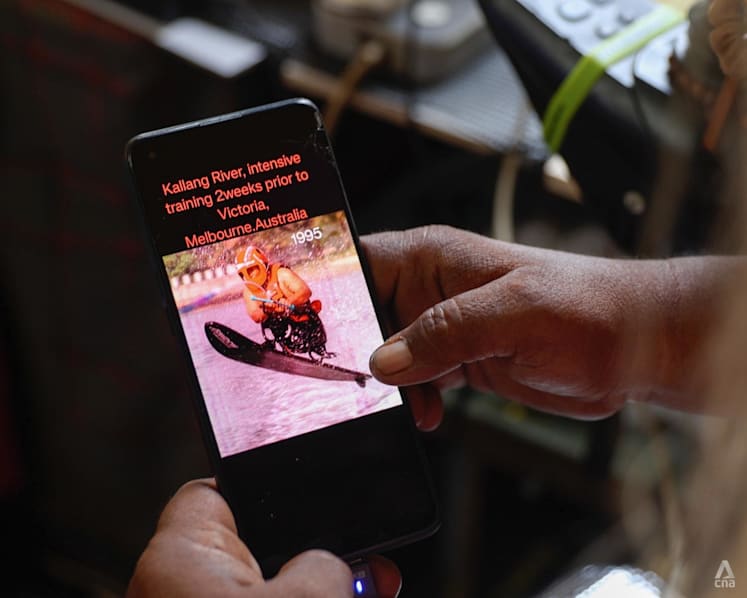
In 1995, Mr Dasuki again made headlines when he took home a bronze medal for Singapore at the 2nd World Disabled Water Ski Championships in Australia, his very first pro sports outing.
He had picked up para-skiing when a friend told him of an opportunity to learn it in the Kallang area. The instructors quickly saw potential in Mr Dasuki and invited him to train and to represent Singapore at the world championships.
He competed in the slalom, a version of water skiing that requires competitors to navigate buoys in a zig-zag pattern.
"When I saw the Singapore flag go up after I won third in the slalom event for my (disability) category, I was proud and I cried. I was so happy," he reminisced.
Despite his stellar debut, his competitive sporting days were cut short because of his severe fear of flying – one he developed as a teenager from watching La Bamba, a 1987 biographical film of American singer Ritchie Valens who died at age 17 in a plane crash.
Even the Australia trip had been a traumatic ordeal for Mr Dasuki, and he had no inclination to travel for other overseas competitions.
I thought it unfortunate that his prospects wound up dashed by such a fear, but Mr Dasuki had a surprisingly zen attitude towards it.
"I was sad at first, but that's how it is," he said. "Even though I didn't get to represent Singapore (anymore), I still got to do the sport while I was working at the Singapore Water Ski Centre."
For all that he had – a full-time job and a rich social life in Singapore – Mr Dasuki still felt that something missing in his life.
When a friend in the music scene suggested that he travel up north to Malaysia to "make something of yourself", he readily agreed – though he admitted that at the time, even he didn't know what that something was.
"I just know Malaysia is bigger than Singapore," he said.
"I wanted to have an adventure and to know what life is like for me outside (my) world."
FINDING HIMSELF
With a backpack in tow, the then 30-year-old made his skateboard sojourn to Malaysia in 1998 by bus and train.
His departure was so sudden that his family in Singapore had no idea where he had gone. Mr Dasuki now reckons his mother may have later figured out that he was in Malaysia, since he had briefly stayed at his sister's place in Johor.
With no idea where to go or what to do, he spent the next several years wandering through Peninsular Malaysia, taking up odd jobs and seeking temporary shelter at mosques or whatever he could find.
"At one point, my backpack was stolen while I was asleep in a mosque in Johor," he recounted. "Luckily, I slept with my skateboard under my head (like a pillow), or else it might have been stolen, too."
One of his pit stops was Langkawi, an island in the northwestern state of Kedah. He spent about six months helping out on prawning boats, which he enjoyed.
"When we had nothing to do out at sea, I'd jump off (the boat) and swim," Mr Dasuki said, adding that he had been an avid swimmer in his youth.
Next, he headed to the northeastern state of Terengganu, where he found work as a packer for keropok lekor (traditional fish cracker), earning RM7 (S$2.20) a day.
More unexpectedly, he also found a new family of sorts.
"When I reached there, a resident saw me at a mosque and asked, 'Where are you going to spend the night?' When I said I planned to sleep at the mosque, he told me to go live with him and his family instead."
Mr Dasuki still acknowledges them as his "adoptive" family, returning to Terengganu to visit them many times over the years. Those visits later came to an end, for a reason some may find peculiar.
"The patriarch kept asking me to cut my hair each time I visited. And he's an elder, so I tried my best to show him respect. So I eventually stopped visiting."
I just know Malaysia is bigger than Singapore. I wanted to have an adventure.
During his travels, he met people who had a keen interest in art: a scenery sketch artist in Langkawi, Kedah, and a portrait artist in Kuala Pilah, Negeri Sembilan.
He recalled being entranced by the Langkawi-based artist, who used a ballpoint pen to draw "beautiful sceneries" on white cloth.
Mr Dasuki spent about six months learning from that artist, and then went to Kuala Pilah, where he met the portraitist, with whom he spent another six months. He sat with each of them daily for hours to hone his budding skills – skills that would later turn out to be his main source of income.
On his visibly aged smartphone, Mr Dasuki showed me dozens of portraits and sketches he had drawn. A coloured painting of a sailboat immediately stood out to me, the 2.1m-tall artwork more than twice Mr Dasuki's full height.
The oil-on-canvas painting was commissioned by a German expatriate family who had read about him in Malaysian media and saw him practising his art in Johor around 2013.
The colourful painting depicts a sailboat competing in the America's Cup sailing race in San Francisco Bay, with Alcatraz Island and the Golden Gate Bridge in the background. Mr Dasuki about two weeks to complete it.
The German family paid him RM3,500. To date, it remains the most expensive piece of artwork Mr Dasuki has ever sold.
While some of his commissioned works fetch a pretty penny – he charges RM350 for a single portrait, which takes about a week to complete – the reality is that they are few and far between, numbering less than 10 a year.
The morning we spent along Jalan Tunku Abdul Rahman, he sold nothing, though three passers-by did stop to drop some money in his donation box.
His scenery pencil sketches used to sell for RM50, but he brought the price down to RM20 after the COVID-19 pandemic because they were not selling. Even then, sales have remained low.
On a decent day, he earns about RM50 to RM60 on average. "But if there are beggars along the same street, I'll get much, much less," he said.
Weather is another issue. On rainy days, he can't work at all.
Mr Dasuki receives about RM900 through financial assistance schemes for people with disabilities and those on very low incomes.
The monthly rental for his room is already RM450, which means that to cover his day-to-day living costs, he must rely heavily on his street art earnings – but working the streets requires money, too.
"There were days ... I could not work for a while because I ran out of art supplies and had to wait for the handouts at the end of the month to replenish them before I can resume busking."
"I'D BE LYING IF I SAID I'M HAPPY"
From the first time I spoke to him – on the phone about a week before we met in KL – Mr Dasuki immediately struck me as a happy-go-lucky guy.
Every conversation with him is generously peppered with laughter, thanks to his droll comments and larger-than-life anecdotes, delivered in rapidly alternating English and Malay.
As we set off to his place, my colleague and I asked Mr Dasuki to hold a 360-degree camera to record his journey.
He quickly sped off with his new toy, rambling merrily into the camera to a pretend audience: "Hello, guys, my name is Dasuki Johari. Welcome to my vlog!"
He even stopped to conduct mock interviews with stallholders along the street, who were as tickled as we were by his behaviour.
His cheery demeanour stands in stark contrast to his living conditions.
His "apartment" is a single room, one of seven formed from subdividing a small flat in an aged building.
His room is sparse but organised, with two wall shelves holding a stash of instant noodles, an electric kettle, a mini pocket-size stove and some art supplies – practically everything he owns in the world.
Even with the little that he had, the room could barely accommodate both of us at the same time. My colleague had to sit by the door.
And yet, "it's okay, lah", he said almost jovially.
"I've already tasted what youngsters typically go through – nightlife and enjoyment. Now that I'm getting old, I just (take things) day by day."
Despite his carefree, animated demeanour, Mr Dasuki turned noticeably subdued when our conversation turned to his family and personal relationships.
He has long grown apart from his six siblings – of whom two have died, and the rest are living either in Singapore or Malaysia. He had a "very good" relationship with his mother, but she died in 2007. His parents were divorced when he was very young.
He still harbours regrets about not being by his mother's side when she died, and not visiting her grave in Singapore more frequently owing to the distance.
He himself has been married twice and divorced twice. He has one teenage son from his first marriage, whom he hardly sees.
"I'd be lying to you if I said I'm happy," he said.
He expressed gratitude to Allah for his good health and what he called "rezeki" (sustenance) through art, but acknowledged feeling lonely.
"The only thing (Allah) didn't give me was a relationship – relationship, companionship or whatever, as long as there's a 'ship' behind it, I'm still finding it."
He still exchanges the occasional text message with friends in both Malaysia and Singapore, but it's far from the close companionship he craves most.
"Once I finish my (work) as a street artist, I'm all alone in my room, in my own world."
I noted that he left his home and loved ones more than 30 years ago, looking for "something". Has he successfully found it, whatever it was?
"I won't say that I've failed," he said, pensive but firm. "I've found my art."
All the same, there might be one or two things he would do differently if he could turn back the clock.
As stories go viral online of young, successful professionals leaving traditional career pathways in search of greater purpose in life, Mr Dasuki offered a word of caution, hard-won from years of struggling to survive.
For anyone seeking to uproot themselves and move somewhere without friends or family, he urged them to plan ahead and put in place a financial safety net before taking the plunge.
"Then, if you think you have it in you to work hard, go and chase your dream."
KioskNews shows a cleaned-up reading view extracted from the publisher’s page — the original always lives on their site, not ours.