The true effect of Trump halting military aid to Israel - analysis

The prospect of US military aid to Israel ending within months has alarmed Israelis, raising the specter of security vulnerability at a time when the country is still fighting enemies on all fronts.
But the ambassador to Israel said the decision was in the best interests of the US-Israel relationship, and Prime Minister Benjamin Netanyahu has hinted that moving to change the status quo may have been coordinated with Jerusalem.
In a post on X/Twitter on Friday morning, the Prime Minister's Office (PMO) stated, “Today, Israel has a strong and stable economy. The move by PM Netanyahu and President Trump from aid to partnership shows the strength and sophistication of our relationship, and its ability to adapt and stand strong over time.”
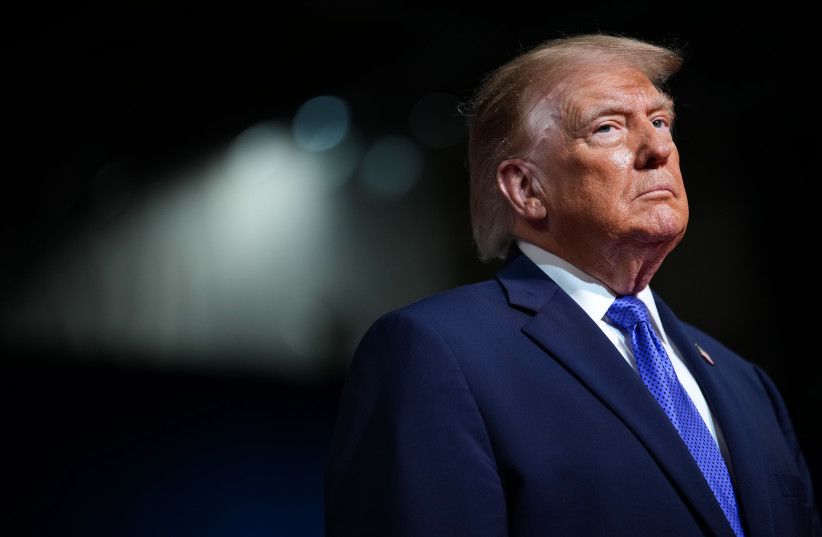
US President Donald Trump’s announcement this week that the United States would halt billions of dollars in annual aid to Israel by the end of 2026 came at a politically sensitive time for both countries. The US president spoke on the day millions of Americans went to the polls to determine control of Congress at the end of a campaign season in which Democrats hammered the GOP over aid to Israel.
It also came a week after Israel’s own elections, in which both Netanyahu and the opposition failed to secure a majority and are now jostling for public support as each tries to form a governing coalition.
Yesh Atid lawmaker: Trump halting US military aid to Israel 'a major mistake'
“Cutting military aid to Israel is a major mistake,” lawmaker Moshe Tur-Paz of the opposition party Yesh Atid told the Jewish Telegraphic Agency.
“While we might like to think we can manage on our own, it’s important to understand that this military aid isn’t just a simple transfer of funds to Israel,” said Tur-Paz, a retired lieutenant colonel in the IDF reserves who recently served as a member of the Knesset Foreign Affairs and Defense Committee.
US Ambassador to Israel Mike Huckabee, by contrast, argued that cutting aid ensures the longevity of security ties between the two allies.
Huckabee, for decades one of Israel’s staunchest defenders in the United States, told Israel’s Channel 12 that the plan to taper military assistance to Israel had been jointly agreed upon by Netanyahu and Trump - something the post from the PMO on Friday appeared to confirm.
The annual $3.8 billion sum is mostly spent in the United States to purchase weapon components or weapons systems manufactured in American factories. Huckabee noted the production has created American jobs. A memorandum of understanding between the two countries calls for that level of aid to continue through 2028.
While there had been some speculation that Washington and Jerusalem might not renew the arrangement, as has happened after previous MOUs have ended, Trump’s announcement about curtailing the aid early was unexpected.
What is happening now, he said, is that Israel and the US “are wanting to move to a different relationship where it does not look like a package of aid, but rather a relationship of trade,” Huckabee explained.
That had always been the goal as the sides negotiated the next round of the memorandum of understanding that underpins the military aid, he said. He said that transitioning from an aid to a trade relationship could stem growing stateside criticism of the expenditure.
However, while such an approach appears to align with Netanyahu’s thinking, the speed at which Trump is acting has caused consternation in Jerusalem, with Israeli financial and military figures expressing surprise and concern at the move.
During a radio interview on Wednesday morning, Maj.-Gen. (ret.) Giora Eiland, the former head of Israel’s National Security Council, called Trump’s announcement “an unexpected blow” that will cause “a great deal of damage.”
Trump cuts force Israel to pay billions for existing contracts
In addition to forcing Israel to pay out billions of shekels for already-signed defense contracts, the Trump cuts will also harm existing “joint initiatives such as advancing laser technology in Israel,” he said.
Huckabee told Channel 12 that he did not know whether the funding negotiated by the Obama administration would end as soon as the end of the year 2026, saying that both he and the Israeli government were seeking clarification.
“We were giving them $4 billion … but it gets cut off at the end of the year,” Trump declared during a call-in appearance on Tuesday morning, the day of the midterm elections, on the “Fox & Friends” program on Fox News.
Tur-Paz, the Yesh Atid lawmaker, said the money supports a wide range of collaborations and productive partnerships amounting to 12 billion shekels annually that would have to be replaced by budget cuts in other areas.
“If the military’s requirements remain unmet, the shortfall would have to come either from the civilian sector - which is highly problematic - or from the defense budget itself, which is equally concerning,” he said.
The current MOU gives Israel $3.8 billion annually and runs through fiscal 2028, so it’s unclear how easy it would be for the White House to stop the funding this year and whether Trump is truly committed to changing the arrangement.
Trump spoke before Democrats scored a sweeping win on Tuesday, regaining control of the House and Senate, which, given the party’s increasing frustration with Israel, has sparked concern regarding the future of the US-Israel alliance.
On Thursday, Israeli President Isaac Herzog said that Trump’s statement about halting military aid had hit “me like a bolt from the blue” as he discussed the issue at a meeting with Gadi Eisenkot’s Yashar party, the largest opposition party coming out of Israel’s elections, at his residence during consultations for the formation of a new government. Herzog will soon decide which party gets the first chance to form a governing coalition.
“I am very worried about it,” Herzog said of the aid announcement. Yashar leads the bloc hoping to oust Netanyahu and has made repairing the relationship with US Democrats a top priority.
Dr. Avishay Ben Sasson-Gordis, a senior researcher at the Tel Aviv-based Institute for National Security Studies, said that Trump’s statement was “a five-alarm fire” politically, highlighting “something about the state of popularity of Israel and support for Israel in the US right now among a certain chunk of the electorate, even on the Republican side.”
While Sasson-Gordis does not believe Trump will immediately cut off funding “because the fiscal year 2027 budget is already in committee,” if the spigot is really shut, Jerusalem will have to “reset” its military priorities.
“Military planning happens years, sometimes decades in advance. And so the sort of military you’re going to have 10 years down the line is decided now. And if we decide that we pull out of [existing defense] deals [due to cuts], then we need to rethink what sort of military we’re trying to build,” Sasson-Gordis told JTA.
Israelis had been prepared for a recalibration in how the aid works, but few anticipated such a precipitous change.
Speaking with The Economist in January, Netanyahu said he would gradually “taper off” American military aid to zero within the coming decade, arguing that his country had “come of age” and was working to develop its own domestic defense industry.
For decades, Israel has received billions of dollars of defense aid from the United States, the vast bulk of it used to purchase weapons from American firms - even as the Jewish state has invested in local defense production and risen to become the world’s seventh-largest arms exporter.
Despite this, Jerusalem’s dependence on American supplies increased significantly following Hamas’s Oct. 7, 2023, attacks on Israel and the subsequent wars in Gaza, Lebanon, Syria and with Iran.
Critics in the United States have dismissed Trump’s statement as a dodge, noting that while there is growing support in the United States for cutting defense aid to Israel, there has also been a push among some lawmakers to more tightly integrate the two countries’ defense establishments. A bipartisan group of lawmakers wants to add language to the annual defense policy bill to expand US-Israeli defense technology cooperation.
“They’re not really cutting aid, just reprogramming it as ‘joint projects’ and hiding it in the defense budget. Americans will be paying more with even less Congressional oversight,” tweeted Matt Duss, the CEO of the Center for International Policy and a former foreign policy advisor to Sen. Bernie Sanders (D-VT).
A section of the National Defense Authorization Act for 2027 would require the secretary of defense to designate an “executive agent responsible for synchronizing cooperative efforts between the United States and Israel, including bilateral defense technology research, development, testing, evaluation, integration, and industrial cooperation.”
In fact, this is just what some pro-Israel organizations on the American right have been pushing for.
“We have advocated for phasing security assistance to Israel from Foreign Military Financing to Foreign Military Sales for some time now,” tweeted Victoria Coates, the vice president of the conservative Heritage Foundation, calling for a shift in funding from direct assistance to joint programs.
Once Israel becomes “an integral part of a new regional security and commercial paradigm,” it would be able to “afford to phase out its military financing relationship with the United States,” the group argued in a 2025 position paper - adding that “from 2029 to 2047, the United States should transition its military financing of arms procurements to direct military sales to Israel,” just as it weaned itself off of direct economic aid in the 1990s.
Such an approach could also potentially reduce, though not remove, Congress’s ability to use aid to influence Israeli policy, something which would likely be welcomed by Israeli officials - especially given the growing number of Democrats arguing in favor of reducing or halting military aid.
KioskNews shows a cleaned-up reading view extracted from the publisher’s page — the original always lives on their site, not ours.