Are our students still memorising their way to academic ‘excellence’
SEPTEMBER 23 — “Never ever hire anyone with a Grade Point Average of 4.0” ~ Tom Peters
Let’s be real. For most Asian kids to do well in school, it usually means that s/he has developed a certain habit of mind: memorisation.
Unless all the Sekolah Rendah Kebangsaan and Sekolah Menengah Kebangsaan have undergone a (literally) mind-blowing revolution, how Malaysian teachers educate students today wouldn’t be that different from how they did back when the Form 3 exam was known as SRP.
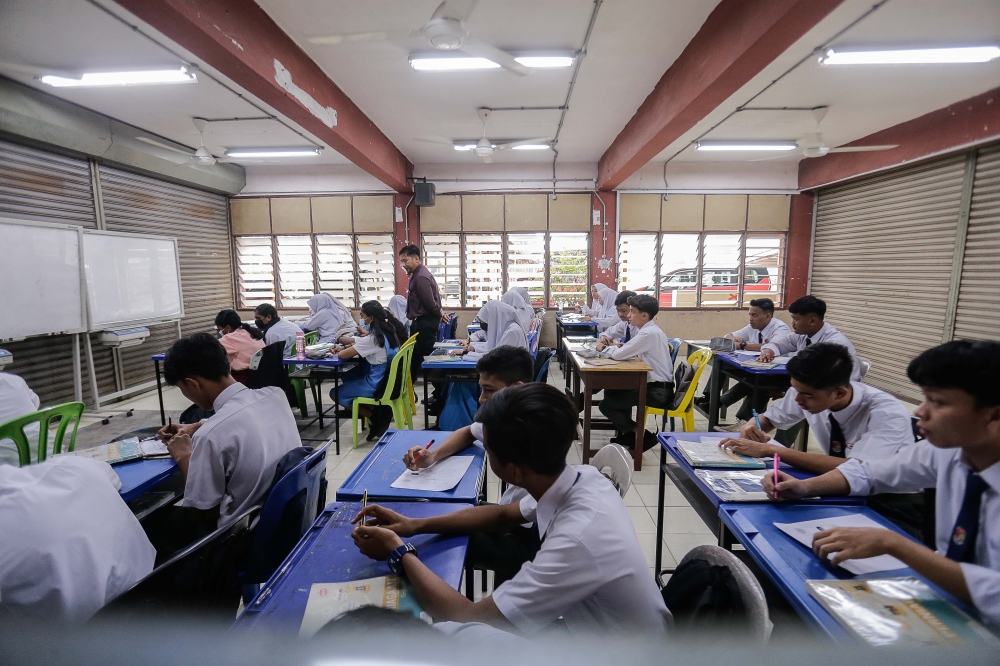
A teacher and students are seen during class at Sekolah Menengah Kebangsaan Jalan Kebun. — Picture by Sayuti Zainudin
Memorisation, in fact, is an apt symbol for our attitude towards formal education i.e. it’s safe and it’s effective. How can there be a downside?
That’s why millions of Malaysians use the method.
Likewise, “scoring well in school” is seen as the non-negotiable trajectory all parents want their kids to be on. If our kids do well in school, it’s good for morale, it promises a bright future — what could possibly be wrong with that?
But, ay, there’s the rub.
As anyone who’s ever thought hard about learning knows, memorisation isn’t merely an inferior way to learn — it also prevents us from adopting something better.
It’s like, if you’ve been using a QWERTY keyboard all your life, suddenly being asked to use the DVORAK or COLEMAK format is going to be torture.
Or, if you’ve been reading slooooow-ly, line by line, for the past 30 years, attempting to speed read is going to make your eyes feel like popping out.
Ditto with memorisation.
The method forces and freezes (?) your mind to react in a particular way on cue. It’s a form of mental behaviourism.
Remember Pavlov and his dog? Pavlov saw that his dogs would drool each time he brought them food.
Then he noticed that his mutts would salivate by the mere sight of him entering the room even without food. It’s conditioning, and this is what the education system (at least the Malaysian one) does to students.
It’s like, each time Form 5-ers see the word “exam” or “learn” or “education”, they go into “how many pages of which topic do I have to upload into my memory before downloading into an exam answer sheet?” mode (see note 1).
And that’s just, uh, sub-par. Memorisation inhibits holistic and authentic learning.
It’s also counter to teamwork and co-operation (surely one of the most important skills in modern corporations).
This is why management guru Tom Peters declared in public that students scoring CGPA 4.0 shouldn’t be hired because that usually suggests they’ve been using a very restricted kind of learning and are inflexible when it comes to “real world” issues.
So how do we get kids off memorisation and rote-learning entirely?
This is really a separate question but here’s one option to think about: Open book exams.
In one stroke, the need to commit large chunks of textbook pages to our internal RAM is out the window.
Students, all of a sudden, won’t have this “hammer” available anymore to treat everything like a nail.
Hence, they’ll be forced to trawl their internal toolbox for something else, for something better.
Note 1: Strictly speaking, there is nothing wrong with conditioning itself. Nicol David is blessedly “conditioned” to trash her opponents in squash. Alas, I think Malaysian kids — especially those who excel — are “conditioned” to memorise.
KioskNews shows a cleaned-up reading view extracted from the publisher’s page — the original always lives on their site, not ours.