New York Times’ framing of Israel-Hamas war ‘imbalanced,’ lacked Israeli perspectives: study
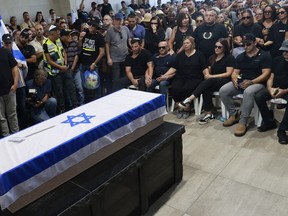
The New York Times’ framing of the Israel-Hamas war is “imbalanced” with “sparse” reporting of Israeli casualties or Israeli suffering after October 7, according to a new study.
Sign In or Create an Account
“I was not surprised by the direction of the findings but rather the magnitudes,” the study’s author Edieal Pinker told National Post in a written statement.
“For example, the fact that Israeli military casualties were mentioned so infrequently and were not regularly tracked as part of the basic context of the reporting was a bit shocking to me. Likewise, the fact that two out of every three days had an article that mentioned a personal story of a Palestinian or Lebanese civilian suffering was more than I had anticipated.”
The study, How the New York Times Framed the War Between Israel and Hamas, was published on Sept. 7 in the journal Studies in Conflict & Terrorism. Pinker, a Yale School of Management professor, analyzed 1,559 news articles from Oct. 7, 2023 — when Hamas sparked a war by killing 1,200 people in Israel, including those at the Nova music festival, and taking 251 hostages — until June 7, 2024.

Columnist Jesse Kline keeps you up to date with what’s happening in Israel and the effects of antisemitism on life here in Canada. Friday mornings.
By signing up you consent to receive the above newsletter from Postmedia Network Inc.
A welcome email is on its way. If you don't see it, please check your junk folder.
The next issue of Channel Israel will soon be in your inbox.
We encountered an issue signing you up. Please try again
He told National Post that as a consumer of both U.S. and Israeli news, he was “struck by the difference in the perception of the war.” In particular, he noted how the “human element of the Israeli experience was missing in the mainstream U.S. media.”
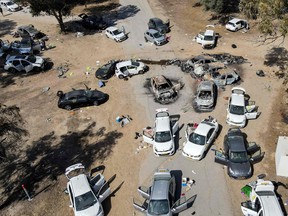
In the study, he writes that the imbalances in coverage “create sympathy for the Palestinian people while at the same time diminishing Hamas’ responsibility for their situation and the continuation of the war.”
The Times largely depicts Israel as being the “sole aggressor” following the October 7 attack.
“Palestinians are portrayed as passive victims whose suffering grows daily as they are relentlessly attacked by the Israeli military,” writes Pinker, adding that framing the war in this context “offers a distorted view of the conflict.”
Of the articles identified as having to do with the conflict in the Middle East most directly, the study found less than four per cent had an “account of an Israeli’s struggles post October 7.”
“Only 52 articles overall (out of 1,559) make any reference to some dimension of Israeli suffering among the population that are not direct victims of October 7,” according to the study.
The study does not downplay the devastation in Gaza, noting the tens of thousands of deaths and “widespread destruction of housing and critical infrastructure and the internal displacement of large proportions of the Gazan population.”
However, Pinker maintains that the media plays a role in how people view the war and news stories shape public opinion. Thus, the framing carries weight and can sway how the public believes the matter should be solved.

The Times’ framing of the war during the time period analyzed led readers to view the solution to the war as getting Israel to stop or greatly reduce its military operation in Gaza.
Conversely, another narrative would be to view Hamas as the problem.
The terrorist organization has “the capability and intent to launch both large-scale rocket attacks on Israel’s population centers and large-scale cross border raids into Israeli towns on the Gaza border.” Therefore, the remedy in this case would be to support Israel’s mission to eradicate Hamas.
Pinker wrote that his goal is “not to prove or disprove the legitimacy of either of these framings,” but to demonstrate and document that the “former framing fits” the Times’ coverage.
“This is important because, whether intentional or not, reinforcement of a specific framing of the war by prominent and respected news media can shape public opinion in a way that could interfere with conflict resolution,” the study says.
“I hope readers become more aware that ‘accuracy’ in reporting has multiple dimensions. It is not just about the facts being correct, it is also about what facts are mentioned and how frequently,” he told the Post.
“I also want readers to be more aware of the Hamas agency in the conduct and prolonging of this horrible war.”
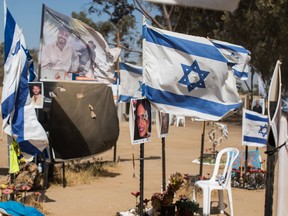
The Times did not immediately respond to National Post’s request for comment.
The author used research database ProQuest to find the articles, tagged and labelled them, and then organized them into categories.
He noted limitations of the study were the eight-month timeframe and that the criteria for identifying articles “almost certainly excluded some relevant” pieces, but it would likely not have changed the reported statistics.
Our website is the place for the latest breaking news, exclusive scoops, longreads and provocative commentary. Please bookmark nationalpost.com and sign up for our newsletters here.
Join the Conversation
This website uses cookies to personalize your content (including ads), and allows us to analyze our traffic. Read more about cookies here. By continuing to use our site, you agree to our Terms of Use and Privacy Policy.
KioskNews shows a cleaned-up reading view extracted from the publisher’s page — the original always lives on their site, not ours.