BILINGUAL STORY 雙語故事
By Nigel P. Daly / Translator: Cynthia Chen 陳昕妤


★ Bilingual Story is a fictionalized account. 雙語故事部分內容純屬虛構。
Campaign flags hung beneath Taipei’s arcades. Men handed out leaflets, candidates gave speeches and small crowds stopped to argue about who deserved their vote. The streets were lively and bustling. Inside a cloth shop, A-cheng polished his boss’s black shoes while voters passed on their way to the polling station.
A leaflet beside the cash box promised, among other things, a school for apprentices. A-cheng had left school young. He had read that line many times.
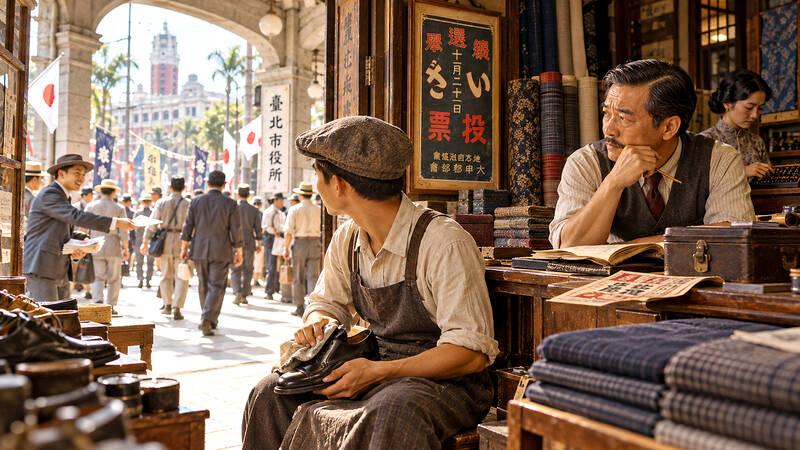
Photo: AI 照片:人工智慧
“You should vote,” he told Mr Lin. His boss barely looked up from the accounts. “One vote won’t change much.” A-cheng was old enough and worked every day, but he did not pay the five yen in tax required to qualify. From the back room came the clicks of Mrs Lin’s abacus. She helped keep the shop’s accounts, yet she could not vote either.
“You might be right,” A-cheng said, “but at least you have a say.” It was Nov. 22, 1935, the day of Taiwan’s first official local election.
Near noon, Mr Lin closed the account book. He put on the shoes A-cheng had polished and reached for his hat. “Watch the shop.” A-cheng glanced at the cash box. The campaign leaflet was gone.
競選旗幟懸掛在台北的騎樓下。男人們發放著傳單,候選人發表演說,一群群民眾駐足爭論著究竟該把票投給誰。街頭熱鬧非凡、人來人往。在一家布莊裡,阿成一邊替老闆擦拭著黑色皮鞋,一邊看著選民走過店門口前往投票所。
收銀箱旁放著一張傳單,上面承諾的政見之一,是要為學徒興建一所學校。阿成很早就輟學了,那行字他已反覆讀過好幾遍。
「您應該去投票。」他對林老闆說。他的老闆頭也不抬,繼續看著帳本。「一張票改變不了什麼。」阿成已經到了可以投票的年紀,而且每天都在工作,但他沒有繳納取得投票資格所需的五日圓稅金。後面的房間裡傳來林太太撥算盤的喀答聲。她幫忙管理店裡的帳目,卻同樣沒有投票權。
「您說的或許沒錯。」阿成說「但至少您還有發聲的機會。」這天是1935年11月22日,台灣舉行第一次正式地方選舉的日子。
接近中午時,林先生闔上帳本,穿上阿成剛擦亮的皮鞋,伸手拿起帽子。「幫我顧一下店。」阿成看了一眼收銀箱。那張競選傳單已經不見了。
Epilogue 故事討論
The price of a vote was five yen. After years of demands for greater local autonomy, Japanese colonial authorities introduced limited local elections in 1935. Voters had to be men aged at least 25 who met residency and financial requirements and paid at least five yen in specified taxes. Women could not vote, fewer than one-fifth of Taiwanese men qualified, and only half of the local representatives were elected. Yet election day was bustling: campaign flags lined the streets, candidates canvassed door to door, leaflets circulated and speeches drew crowds. About 95 percent of eligible voters cast a ballot.[1]
Local elections remained part of Taiwan’s political life even after World War II. Under Chinese Nationalist Party (KMT) rule and martial law, national political competition was heavily restricted, but county and city council elections became regular from 1950, followed by direct elections for county commissioners and city mayors. Taiwan is now a full democracy, and on Nov. 28 this year, voters will once again go to the polls in local elections. Across very different political systems, local elections have remained a recurring and lively part in Taiwan’s history and a way for people to make their voices heard.
五圓,是取得投票資格的門檻。經過多年對擴大地方自治的訴求,日本殖民當局於1935年實施了有限度的地方選舉。選民必須是年滿25歲、符合居住與財產條件,且至少繳納五日圓指定稅金的男性,女性則沒有投票權。符合資格的臺灣男性不到五分之一,而地方代表也只有半數席次是由選舉產生的。即便如此,投票日當天依舊盛況空前。競選旗幟飄揚於大街小巷,候選人挨家挨戶拉票,傳單四處分發,演講吸引無數民眾圍觀。約有95%的合格選民實際投下選票。
即使在第二次世界大戰結束後,地方選舉依然是臺灣政治生活的一部分。在國民黨統治與戒嚴時期,全國性的政治競爭受到嚴格限制,但自1950年起,縣市議員選舉成為常態,隨後更實現了縣市長的直接選舉。如今,臺灣已是一個成熟的民主國家,而在2026年11月28日,選民將再次於地方選舉中投下神聖的一票。歷經截然不同的政治體制,地方選舉一直是臺灣歷史中不斷延續且充滿活力的一環,也是人民表達心聲的重要途徑。
Idioms 相關成語
1. have a say 有發聲的機會
2. make your voice heard 表達心聲
3. cast a ballot 投下選票(ballot 選票)
4. lively and bustling 熱鬧
Vocabulary 單字片語
1 vote 投票(voter 選民)
2. election 選舉(local election 地方選舉)
3. candidate 候選人
4. campaign 競選
5. polling station 投票所
6. leaflet (折頁)傳單
7. polish 擦亮
8. promise 承諾
9. apprentice 學徒
10. qualify 使具資格、有權
Nigel P. Daly is a writer with a language learning newsletter called Chin-glish bilingual lab (https://ndaly.substack.com).
Cynthia Chen is a translator and writer specializing in blogs, scripts and articles.
KioskNews shows a cleaned-up reading view extracted from the publisher’s page — the original always lives on their site, not ours.