Rob Breakenridge: Rejecting Alberta separatism today is only the first step
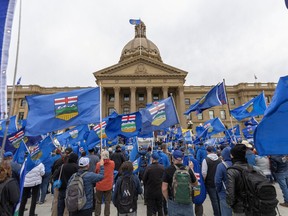
Monday is an opportunity for Alberta to close the book on the disruptive and divisive debate about breaking up the country. It’s unfortunate that this book was even opened in the first place.
Sign In or Create an Account
But while it should mark the end of that debate, it may prove to be just the end of the beginning. A Pandora’s Box has been opened, one that isn’t likely to be closed any time soon.
It never made sense to embark down this road, and having now done so, it’s difficult to see the exit ramp. One can only hope that Monday’s referendum on whether to pursue a true independence vote, offers enough of a rebuke of this fantastical idea and its devoted adherents that restoring their influence will be a longer-term reconstruction project.

Columnist Jesse Kline keeps you up to date with what’s happening in Israel and the effects of antisemitism on life here in Canada. Friday mornings.
By signing up you consent to receive the above newsletter from Postmedia Network Inc.
A welcome email is on its way. If you don't see it, please check your junk folder.
The next issue of Channel Israel will soon be in your inbox.
We encountered an issue signing you up. Please try again
Premier Danielle Smith didn’t invent Alberta separatism or dupe anyone into supporting the cause. In fact, the Alberta premier has come out strongly in support of Alberta’s continued existence as a province of Canada — much to the chagrin of those championing separation.
The premier, though, can be reasonably faulted for leaning on and drawing these elements into the party as she sought the leadership of the UCP. She allowed this internal vulnerability to build to the point where her own political survival hinged on pandering to separatists.
The rules were tinkered with multiple times to allow the separatists to proceed and succeed with their referendum petition. And when the courts blocked that petition, Smith’s government appealed and the premier ensured that a question would be on the ballot.
Again, this didn’t necessarily birth new separatists, but Smith’s decisions have helped to normalize the movement, as well as the means by which to achieve independence. Separatism always lurked in the background, but the referendum process has incorporated it into the fabric of Alberta politics.
A byproduct of this debate has at least been the emergence of a much clearer picture of what a national divorce looks like. Alberta exists within a functioning, albeit imperfect, federation.
Yes, Alberta has been taken for granted far too often. It’s outsized contributions to Confederation have frequently been paired with a rather undersized voice in the direction of the country. But it’s also true that no province has thrived and prospered to the extent that Alberta has.
The resulting report painted a bleak picture of what Alberta’s departure from Confederation would entail. Even a best-case scenario envisions massive short term costs, whereas the worst-case scenario of a prolonged and arduous separation would mean a significant GDP contraction, plunging employment levels and wages, and the new nation of Alberta saddled with a massive debt of well over $400-billion.
A separate and subsequent analysis released by the Calgary Chamber of Commerce similarly forecasts a shrinking Alberta economy, employment disruption and job losses, costly new trade barriers, and substantial and ongoing structural deficit.
Acknowledging those enormous costs does not mean that there aren’t legitimate concerns and grievances in Alberta, just as opposing separation does not constitute a defence of the status quo. It’s a matter of factoring in both the dramatic cost and difficulty of a complete tear-down, versus the more realistic path of maintaining and improving Confederation.
The status quo is not status quo, as evidenced by the past 18 months or even the past eighteen years, for that matter.
Prime minister Mark Carney deserves credit for taking meaningful steps to wind back policies — and attitudes — that have fueled frustration and discontent in Alberta. Through partnership with Alberta’s premier, we’re also now setting the stage for the sort of meaningful projects and developments that both highlight the benefits of our federation and that Albertans feel have been stymied for too long.
Furthermore, Stephen Harper, who’s emerged as an important voice for Canada, faced nothing approaching a separatist crisis in Alberta during his tenure as prime minister. Then again, no previous Alberta premier was inclined to allow such a question to go to a direct vote.
But it is fair to point out that there is no shortage of blame to go around here, beyond just the person responsible for greenlighting this referendum. Again, Danielle Smith may have fed the beast but she didn’t create it.
And yes, it’s fair to lay much blame at the feet of Mark Carney’s predecessor. Justin Trudeau’s policies, attitudes, and values increasingly seemed very much at odds with most Albertans. If Trudeau had somehow escaped his deserved political fate and clung to power last year, separatist sentiment could burning much hotter right now in Alberta.
Some of that blame goes further back, to the previous prime ministers who took Alberta for granted and implemented policies that were to the detriment of Alberta — including, notably, another prime minister named Trudeau.
But still, through it all, Albertans have remained proud Canadians, bonded by our shared history and our shared values. There are likely those drawn to or tempted by the separatist option that deep down still feel that way, but sense that the Canada they knew has become much harder to see — or that it can’t be seen at all.
That’s been exacerbated over the last decade where many Albertans were increasingly at odds with Ottawa’s direction and priorities, but felt powerless to stop or change anything.
But that sentiment didn’t exist in the decade prior, and arguably much is changing now. That political pressure isn’t just coming from Alberta; there’s a real and encouraging national consensus around the need for a new direction. In that lies an appreciation amongst Canadians for what Alberta brings to the table as far as Canada’s strengths go.
It makes far more sense to seize and build upon that opportunity than to squander it all and plunge into a dark uncertainty.
The separatist option should be rejected on its merits. The idea of separation as a permanently entrenched political fixture and tactic deserves repudiation, too.
Rob Breakenridge is a Calgary-based podcaster and writer. He can be found at robbreakenridge.ca and reached at rob.breakenridge@gmail.com.
Join the Conversation
This website uses cookies to personalize your content (including ads), and allows us to analyze our traffic. Read more about cookies here. By continuing to use our site, you agree to our Terms of Use and Privacy Policy.
KioskNews shows a cleaned-up reading view extracted from the publisher’s page — the original always lives on their site, not ours.