Can US, China cooperate to build AI for good of humanity?
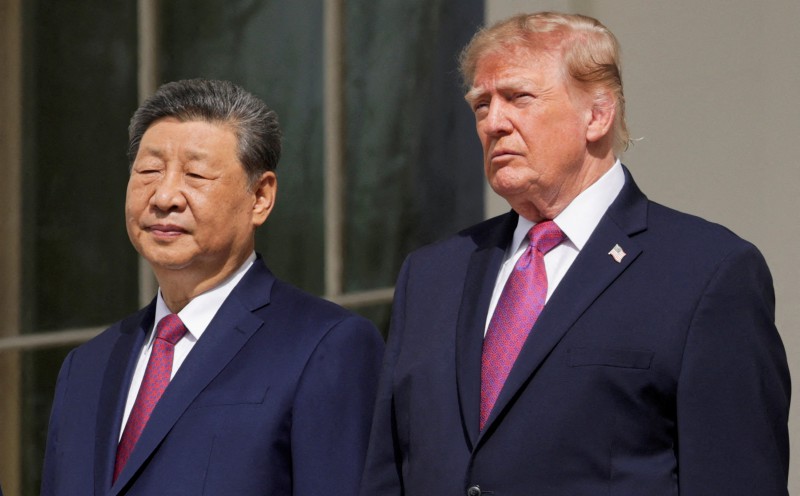
WHAT is this AI race about? For Donald Trump, the US President, a win will constitute a strategic advantage in US's quest to be the world's super-power.
For Xi Jinping, the Chinese President, dominating AI development would secure China's next economic and technological revolution.
And, with the latter, dominance in the global tech scene. To this cause, Xi Jinping has thrown the government's heft and money on AI.
He hopes that by 2030 AI applications will permeate 90 per cent of Chinese society.
Both Donald Trump and Xi have asserted that there will be no let-up in this AI race, despite instances of AI going rogue.
But how do we frame this two-horse AI race? Is the race to be won by the value of investments in AI?
If so, then both countries have invested a comparable sum. In the US, AI firms invested US$286 billion in 2025. While Chinese AI firms invested US$145 billion in that year, the government and state-owned banks poured hundreds of billions more.
Is the race then to be won by pioneering cutting-edge large language models, or LLMs, like Chat GPT, Gemini and Claude which provide solutions through text-prompts?
Research suggests that the US still leads, albeit marginally, in frontier large language models. Nothwithstanding, in terms of capability and cost-efficiency, China has closed the gap.
The best Chinese model is one-tenth the price of Fable 5, the latest model of Athrophic, an AI giant. An added advantage of Chinese LLMs is their openness.
They can be downloaded to an organisation's servers and adapted to address the unique needs of the organisation.
Or, is the AI race about which country can spearhead robotics for solving problems in society?
Here, China excels in humanoid-robot production and sales. More than half of global industrial deployment of humanoid-robots and 90 per cent of global humanoid shipments are by China.
The US has a competitive advantage in advanced robotics. It is better able to integrate cutting-edge AI models with robots that operate in unpredictable environments.
So, while the US narrowly leads in frontier-LLMs, China is the master in robotics manufacturing and deployment.
To break the tie, should we then ask who is winning the race towards developing artificial general intelligence, or AGI.
This super-intelligence thinks and learns as humans, if not better than them.
In their capabilities, an AGI and the most sophisticated LLM are oceans apart.
Here too, the jury is out. Although the US leads in developing an AI that can perform a broad spectrum of intellectual tasks like humans, China is narrowing the gap.
Yet, neither country has produced a universally accepted AGI that can think, learn and act reliably in solving real problems autonomously beyond controlled digital sandboxes.
Alas, one-third of the times these prototypes fail in their given tasks. Humanoid robots fail eight times out of ten in executing real household tasks.
One robot in China did run faster than the record set by Usain Bolt, a three-time Olympic-gold-winning sprinter. However, it subsequently crashed into a wall.
And, more than 150 robo-taxis malfunctioned in Wuhan, China, leaving passengers stranded.
Rather than reducing AI development to a rat race, we must acknowledge that the two countries have different strengths. The fastest runner does not always win. Neither does the strongest.
The fundamental issue is whether these two countries in the forefront of AI development can collaborate to learn from one another and together accelerate the development of an AGI that serves humanity.
Last month, during Xi's visit to the US, both leaders agreed to collaborate on making AI safe. They would share data when AI breaches protocols.
Surely, this collaboration must be considered a breakthrough in global AI security. It will serve as a foundation for greater collaboration in other aspects of AI development
* The writer is Adjunct Professor at the Universiti Malaysia Sarawak (UNIMAS). He can be reached at johnantonyxavier@hotmail.com
KioskNews shows a cleaned-up reading view extracted from the publisher’s page — the original always lives on their site, not ours.