Families of ‘desaparecidos’ honor missing kin on All Souls’ Day
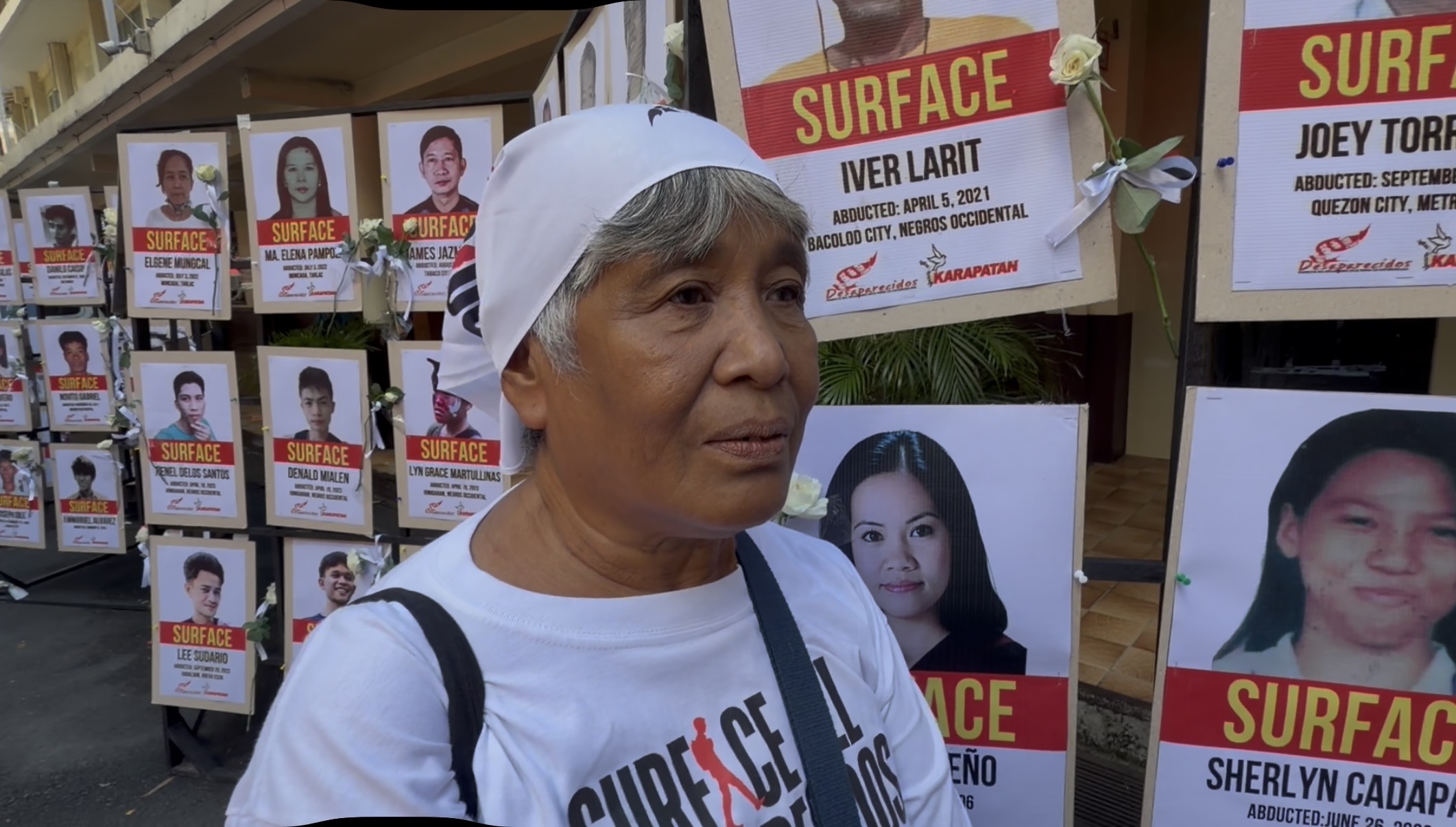

MANILA, Philippines—Abner Hizarsa was on his way to his daughter’s school in Subic, Zambales, to bring her lunch when he was abducted by unidentified armed men in a van without a license plate on March 21, 2007.
Until today, his common-law wife, Cresencia dela Cruz, and his three children have yet to find out where Hizarsa was taken.
“All the places where we could find him… nearby hospitals in case someone wounded or dead was brought there, we asked for him. Up to here, in Manila. In Camp [Tolentino] in Bataan, Camp Aguinaldo, Camp Crame. We searched all of those places,” she told the Inquirer in Filipino.
Article continues after this advertisement
“But all of them, they are in denial. They don’t know anything,” she added.
FEATURED STORIES
NEWSINFO
NEWSINFO
NEWSINFO

Hizarsa is just one of nearly 1,900 “desaparecidos,” the spanish word for “disappeared” used to describe those who are victims of enforced disappearances, whose families gathered at Claret School Chapel in Quezon City to remember their loved ones on All Souls’ Day.
READ: Desaparecidos’ kin urged to continue loved ones’ fight for justice
Unlike most families who are able to visit the final restong place of their departed relatives, families of desaparecidos remain unaware if their loved ones are still alive or where their remains are.
They could only offer white roses to photos of their missing kin during a brief program held on Monday, which is part of a yearly gathering meant to voice out their continuing call for justice.
Article continues after this advertisement
“Of course, there’s always the hope that victims of enforced disappearances are still alive. This [event] is a way for families to come together and create that kind of hope and to also voice out our demand to surface all victims of enforced disappearances,” Cristina Guevarra, spokesperson for the human rights group Karapatan, told the Inquirer.
“As said in a poem, ‘at least give them the ruined body or even just bones, just so they have somewhere to light a candle or offer flowers,’” she added.
Article continues after this advertisement
While no one has come forward and admitted to abducting Hizarsa, Dela Cruz noted that he had previously worked as the spokesperson of the National Democratic Front of the Philippines (NDFP)-Bataan.
She said that because of his role in the NDFP, Hizarsa has also been imprisoned four times before his abduction.
He was first detained in 1978, before being released and imprisoned again in 1981, 1987 and 1990.
Among those most affected by Hizarsa’s disappearance was his daughter, who was only nine years old at the time of his disappearance.
Dela Cruz noted that their daughter, the youngest of their three children, had also been the one “closest” to Hizarsa.
“She still asks questions, until today. She cries when we talk about it,” said Dela Cruz.
Even now, almost 20 years later, Dela Cruz said her family rarely talks about what happened to Hizarsa.
READ: CA grants writs of habeas data, amparo to wife of desaparecido
But amid her painful experience, Dela Cruz said she is able to find strength to keep searching for justice through these yearly gatherings with other families of desaparecidos.
“I always look forward to these gatherings of other families with missing kin, because this is where we draw my strength from. Of course, for other families, there is closure. For us, there is none. That’s why we get our strength from these gatherings,” said Dela Cruz.

Guevarra noted that under the administration of President Ferdinand R. Marcos Jr., there are already 15 victims of enforced disappearances, with the most recent one being Gerald Gestole who was abducted in Laguna in 2024.
Since the term of then – President Ferdinand E. Marcos Sr., she said there are already over 1,900 victims of enforced disappearances.
She noted, however, that these numbers refer to only those who were documented, and could be even higher.
“We are seriously lagging behind in terms of finding their remains or finding out what happened to them,” she said.
Guevarra called out the government for failing to implement the Anti-Enforced or Involuntary Disappearance Act of 2012, stressing that not a single perpetrator of enforced disappearances has been held accountable.
“The law is nothing right now for the victims, so we are also calling for a review of the law and make it useful for the victims and their families,” she said. /gsg
Photo captions:
Your subscription could not be saved. Please try again.
Your subscription has been successful.
Desaparecidos2: Cresencia dela Cruz speaks to the Inquirer about the disappearance of Hizarsa.(Photo by Gillian Villanueva)Desaparecidos3: White roses are taped to photos of the “desaparecidos,” or victims of enforced disappearances, including Abner Hizarsa. (Photo by Gillian Villanueva)
KioskNews shows a cleaned-up reading view extracted from the publisher’s page — the original always lives on their site, not ours.