Trump ignored intel on China’s Nvidia spy to protect company’s stock, report says
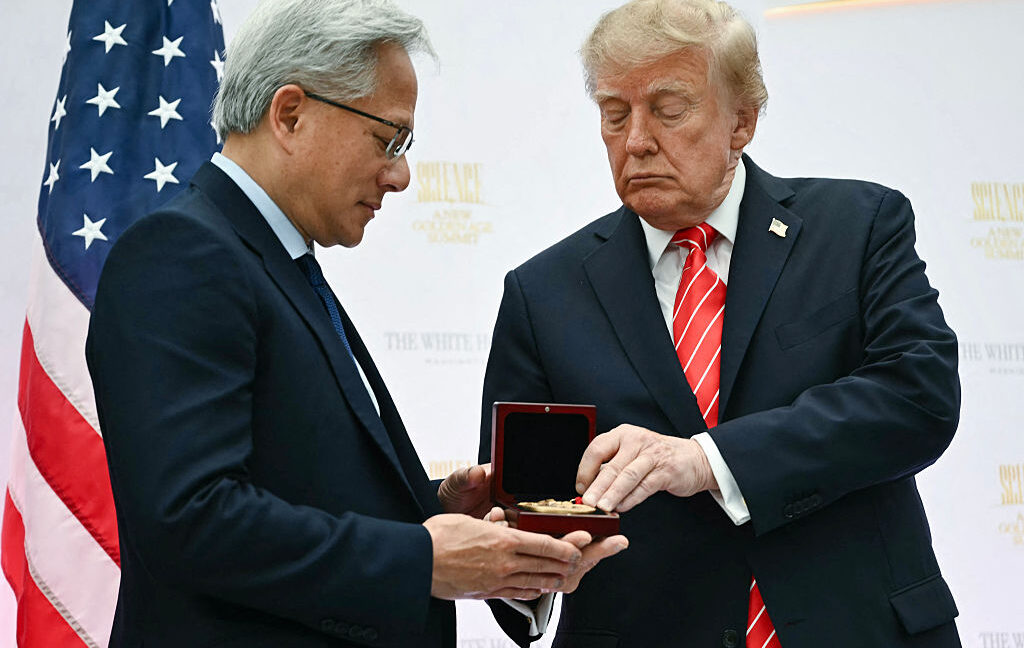
Donald Trump apparently is so aligned with Nvidia CEO Jensen Huang—who has become the president’s key advisor on AI—that he ignored intelligence indicating that Huang was the target of a “Chinese spy plot,” and did so partly to protect Nvidia’s stock.
The New York Times spoke with people briefed on US intelligence agencies’ surveillance and granted them anonymity to discuss findings drawn from “classified intelligence.” According to sources, about a year ago, Trump was briefed that “Beijing was getting reports from someone with direct access” to Huang. That “someone” was Alice Huang, or Huang Le, a Chinese citizen and former top executive at a Singapore cloud company called Megaspeed.
According to sources, the US had already suspected that Alice Huang—who is not related to Jensen Huang—was helping China evade export controls to gain access to high-end Nvidia chips through Megaspeed. But it alarmed investigators to discover that she may have used her role at Megaspeed to gain direct access to Jensen Huang. It’s now believed she may have leveraged that closeness to feed China intel not only on one of America’s leading AI companies, but also to influence Trump’s thinking on AI. As Treasury Secretary Scott Bessent noted last month ahead of Trump’s AI talks with China President Xi Jinping, “the president is completely aligned with Jensen Huang, the CEO of Nvidia.”
At least partly due to fears that US action against the alleged spying could hobble Nvidia chip sales or disrupt the delicate US-China trade truce, Trump “chose not to do anything with the information,” sources said.
Soon after US scrutiny increased, Alice Huang’s name was removed from Megaspeed corporate documents. At this stage, it’s unclear “how closely she is still connected to Megaspeed,” NYT reported.
Liu Chang, the spokesperson for the Chinese Embassy in Washington, DC, told NYT that the US accusations against Alice Huang are baseless. He accused the US of pursuing a campaign of “groundless smears and slanders” against China.
No warning to Nvidia CEO
It’s not clear which agencies were investigating Alice Huang or what triggered their suspicions, NYT reported. Sources also could not explain what information she may have shared with Beijing.
Nvidia has denied that she would have had access to any trade secrets, but it seems notable that Jensen Huang did not receive a defensive briefing that Americans sometimes get when they’re targets of foreign spying. Some senior officials think it’s unlikely that Jensen Huang would have “remained unaware” of Alice Huang’s alleged intelligence-gathering for the entire duration of their professional relationship, although Trump was told Jensen Huang had no knowledge at the time of his briefing. It seems possible that Jensen Huang got no briefing because US agencies worried that he might tip her off that “she was being watched,” the NYT reported.
Trump’s deep ties with tech leaders have been criticized throughout his administration, but Jensen Huang’s influence increasingly stands out. To critics, the political friendship appears to be largely based on growing his business in China. Since cozying up to Trump, the Nvidia CEO has gotten export controls relaxed and even struck a controversial deal giving the US a 25 percent cut of some chip sales so he could try to sell more chips in China. Sources told NYT that “some investigations and proposed trade sanctions involving China or Nvidia” have “ground to a halt within the Commerce Department” due to Jensen Huang’s influence.
No one’s sure when Jensen Huang met Alice Huang, but NYT found social media photos that predated her role arranging a Megaspeed purchase of $2 billion in chips over the next year. If those chips ended up in China, the US worried they “could help adversaries like China develop new weapons, surveil dissidents, and leap ahead of the United States in AI development,” NYT reported. To US agencies, it’s particularly concerning that Megaspeed may be doing China’s bidding by supplying chips to giant data centers in Malaysia and Indonesia “that appear to remotely serve customers in China,” NYT reported earlier this month.
Sources told the NYT that US intelligence agencies conducted electronic surveillance of Alice Huang and found that “she was in contact with an American citizen.” Since agencies could not legally surveil the American citizen without a court order, they sought to unmask the citizen by showing a “need for information.”
“In this case, the unmasking process identified Mr. Huang as the US citizen,” NYT reported.
NYT probes Megaspeed offices for clues
Megaspeed is an Nvidia customer, and Nvidia has independently investigated whether Megaspeed is funneling its chips to China. That investigation concluded that there were no signs of diversion and that Megaspeed has raised no red flags as a customer, Nvidia spokesperson John Rizzo told NYT.
Both Nvidia and Megaspeed insist that the cloud company has Singapore-based owners, but NYT visited the supposed offices and talked to anyone they could find to probe the actual business operations. Among red flags raised, NYT noted that staffers suggested “it’s not clear” what Megaspeed as a company does and confirmed that the Singapore director, James Tan, lives in China and is “never present.” (NYT’s review of corporate ownership documents showed Tan owns the shell company that owns Megaspeed.)
In that story published earlier this month, NYT detailed how Alice Huang was seemingly growing increasingly close to Jensen Huang, citing several photos of them together. That includes a photo at an event where she reportedly bragged, “I bet you guys I can get Jensen here,” and then he arrived in his trademark leather jacket to take whiskey shots.
Rizzo said that it was common for Nvidia’s CEO to attend parties with customers and partners, where he discussed “updates on the market.” One source told NYT that Jensen Huang had always planned to attend that party.
“Jensen’s interactions with Ms. Huang are not unusual or unexpected,” Rizzo said. “Meetings with customers are part of a CEO’s job; Jensen talks with thousands of customer executives every year.”
However, the US government has been investigating Megaspeed since 2024, and they’ve found suspicious boxes of Nvidia equipment that seem to be ready to ship out, rather than installed. Earlier this year, the Department of Justice took over the Commerce Department’s investigation, and Megaspeed remains under scrutiny even though Nvidia’s probes uncovered no evidence the company was helping China dodge export curb violations.
Aaron Bartnick, an assistant director for technology security and governance under the Biden administration, told NYT that Megaspeed raised “many red flags.” Among them are the company’s “ownership claims and possible ties to sanctioned entities, that should have made Nvidia’s executives question whether they should have permitted the company to have access to its AI chips.”
“It’s hard to see a justification for taking that risk,” Bartnick said.

Ashley is a senior policy reporter for Ars Technica, dedicated to tracking social impacts of emerging policies and new technologies. She is a Chicago-based journalist with 20 years of experience.
KioskNews shows a cleaned-up reading view extracted from the publisher’s page — the original always lives on their site, not ours.