Blood of My Blood review – gripping ghost story is a reckoning with slavery

Joy Nesbitt’s fantastically chilling play is both a ghost story and a reckoning with the undocumented history of enslaved people. It takes us from present-day America into the past, towards the exact moment when slavery was abolished.
A white couple has turned their South Carolina plantation into a holiday rental. People come for celebrations and weddings, we hear. It is tantamount to slave-plantation tourism, says Talulah (Jodie Campbell), a Black British woman who has traced her family line to this spot. Talulah is trying to channel her descendant Ginnie (Ronkẹ Adékọluẹ́jọ) through the ritual practice of “conjuring” – making contact is a way to fill in the gaps of her family’s enslaved past.
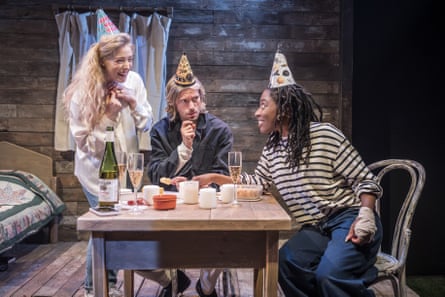
Under Tatenda Shamiso’s direction, the play never feels like a history lesson and deftly covers the uneasy waters between comedy, race drama and gothic horror, with passing similarities to Marlon James’s The Book of Night Women and Jordan Peele’s psychological terror. One world physically crosses another on stage as the unresolved past exerts itself in the present. As far-fetched as the central concept sounds – a meeting between a dead enslaved person and her living relative – it carries dramatic and emotional charge.
The supernatural territory takes us back to the complicated reality of Ginnie’s life and how it is entwined with the Irish confederate enslaver John Good (Patrick Vaill). White liberal guilt is satirised through the over-accommodating figure of Nora (Hannah Morrish), who runs the plantation in the present day and tries to give it a homely decorative spin.
Her husband, James (also Vaill), a direct descendent of Good and an academic of Irish history, is less comic, more defensive (“That was the way,” he says of his forefathers). Debates on confronting such a past come through prickly argument between James and Talulah.
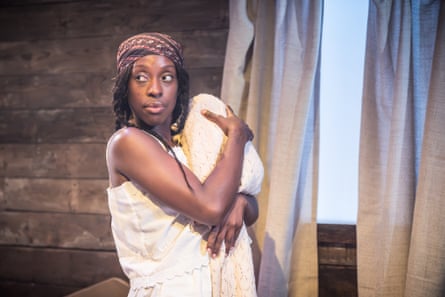
The set comprises the cabin and tree outside it. Both cast shadows and gloom but also, it seems, sparks of magic. Simisola Majekodunmi’s lighting delineates the past and present; Kayodeine’s thudding, dread sounds raise suspense. The earthy tufts of plantation land extend across the auditorium, felt beneath our feet as we watch. It is a subtle way of suggesting that there is no clean cut-off point. This past is indeed nestling, alive, among us.
Nesbitt’s gripping writing is accompanied by some excellent acting. Vaill’s doubling is demanding and navigated spectacularly. Adékọluẹ́jọ is excellent as Ginnie, full of quiet strength. Complicated plotting brings multiple pregnancies and family trees. There is an unconvincing scene in which James and Nora spend New Year’s Eve with Talulah, and a Black American character pops up briefly to deliver a clunky treatise on historical legacies. But these contrivances are forgivable in a play that treats its subject matter with such innovation. It grips, moves and raises hairs.
KioskNews shows a cleaned-up reading view extracted from the publisher’s page — the original always lives on their site, not ours.