What happens when prisons get bomb threat? No evacuation, only staggered searches
Early November 3, the police headquarters in Gandhinagar received a message: One of the state’s 32 prisons and the state police chief’s office would be “blown up”. The threat mail, however, did not specify which prison.
Such threats have become regular over the past two years. The targets are usually schools, courts, civic body buildings, stadiums and even events like concerts and international summits, which can be evacuated. But not prisons.
Prisons here house gangsters such as Lawrence Bishnoi, convicts of the 2008 serial bombings, gangsters accused under the older terror laws and self-styled godman Narayan Sai.
While other premises can be immediately evacuated—schoolchildren can be sent off home, courts can be adjourned, and government buildings can be emptied, checked and then declared safe—prisons cannot be evacuated, unless in the most extreme circumstances.
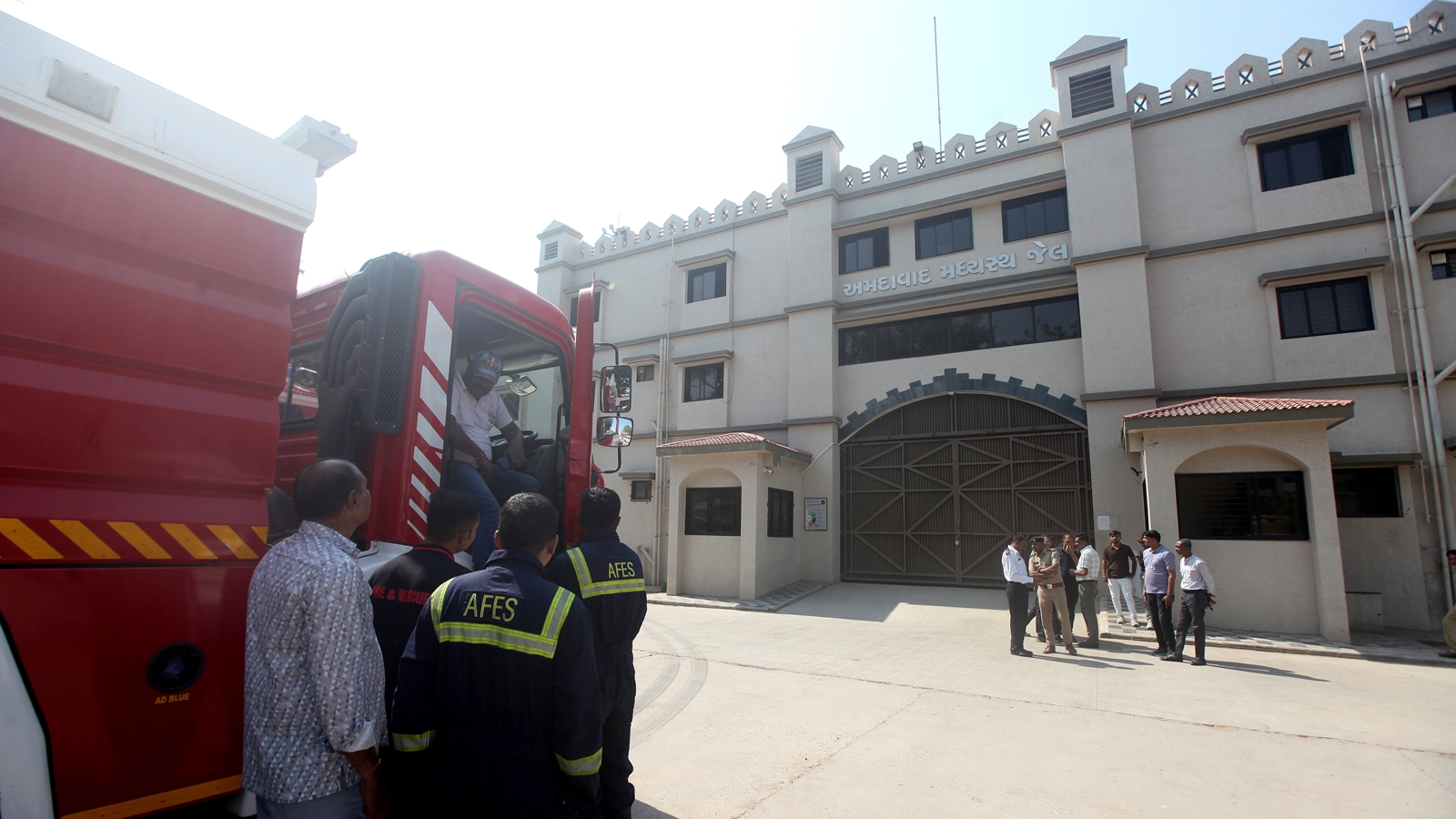
At Sabarmati Central Jail in Ahmedabad, the largest correctional facility in Gujarat that has Bishnoi among the 4,300-plus inmates, teams of the bomb and doq squad and the anti-terror arm— the Special Operations Group (SOG)—were deployed, along with three vehicles of the Ahmedabad Fire and Emergency Services (AFES), on Tuesday.
A senior official said, “The key places that had to be checked were those where visitors come, such as the front offices, the administration area, and where visitors meet prisoners.”
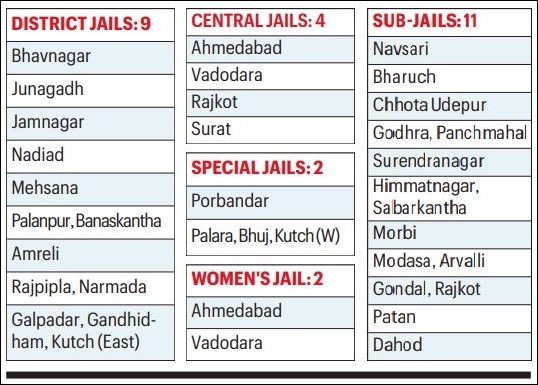 Prisons in Gujarat
Also, there are spots between the barracks and the main gate that are accessed by several people. An officer in South Gujarat said, “While we have stringent security measures in place, there are areas where items and products arrive from outside. These include canteens, food storage units, medical facilities, clothing stores and visitors’ rooms.”
Story continues below this ad
In some cases, there may be secondary structures abutting the prison premises, such as a temple in Lajpore Central Jail in Surat where Narayan Sai is lodged.
The state houses more than 18,500 prisoners lodged in its 32 prisons and 50 other holding facilities. The 32 prisons include four Central Jails in Ahmedabad, Surat, Rajkot and Vadodara; nine district jails; two special jails; four open jails; 11 sub-jails and two women’s jails.
How was the sweep done
Officials say it is easier to sweep a high-security area in a central prison since it is mainly built of concrete, has low occupancy, and is checked frequently.
Apart from prison guards, the State Reserve Police Force (SRPF) personnel were also deployed in central prisons where they patrolled the perimeter even as the bomb squad swept through the boundary walls.
Story continues below this ad
“Despite these bomb threats being so generic and having become a scare tactic, we have taken it in our stride and are making sure every corner of the prison is checked and access control is maintained”, said a police officer at another major prison. Timings for the sweep were staggered.
A field officer from the Special Operations Group team that checked one of the prisons said, “The Quick Response Team (QRT) reached the jail first to secure the area, followed by the BDDS (Bomb Disposal and Dog Squad) team. We first checked the front offices, administration areas, visitors and the perimeter of the prison. Every team requires permission to enter the interior areas of the prison. Their names are noted down, their phones taken away and they are accompanied by a member of the prison staff at all times.”
A bomb disposal squad officer said: “The interior of a prison is checked sector by sector. Prisoners are moved to another area temporarily while we conduct the search. That’s how we go through various areas; it is a highly time-consuming exercise.”
A prison officer who supervised the check on Tuesday said, “Most of the staff are not allowed to take phones inside the prison premises. The same applies to everyone else, except in special circumstances such as judges.”
Visiting hours vs bomb threat
Story continues below this ad
After guards’ shifts change around 6 am, prisoners are allowed to go to the yards of their specific barracks. By 9 am, visitors begin filling out access forms before they can meet an inmate. The morning visiting hours end at 12 pm.
Tuesday’s sweep took place when the visitors were meeting inmates. However, considering the “low threat perception” and the nearing Diwali festival, the prisons were not put on lockdown.
“We didn’t stop the visitors. Instead, we carried out extra checking of the people entering the premises,” said the superintendent of a jail in Saurashtra.
At a prison in Central Gujarat, an officer said, “We had the visitors double-checked. Police carried out anti-sabotage checks of vehicles, so we didn’t need to turn them away.”
Story continues below this ad
Rakesh Barot, the Inspector General (IG) of Gujarat Prisons, told The Indian Express: “In light of the bomb threat to prisons received by the DGP office, we asked officials at all jails to carry out thorough checks. Apart from the BDDS teams, the SRPF teams are also patrolling the perimeters; prison staff are conducting their own checks of the premises.”
“The morning meeting time is between 9 am and 12 pm, and the evening meeting time is 4 to 6 pm. We decided not to send any of the visitors back from the prison during these checks.”
The challenge, said Barot, was to make sure that the premises were checked thoroughly, inside and out.
Since the bomb threat was received at the Director General of Police’s office in Gandhinagar, the FIR is likely to be filed at a police station in the Gandhinagar jurisdiction.
Story continues below this ad
The Indian Express also found that the bomb disposal teams checked several major pilgrimage sites, including the Somnath Temple in Gir-Somnath, Dwarkadhish Temple in Devbhoomi Dwarka district, Ambaji Temple in Banaskantha, Pavagadh Temple in the Panchmahals, and the Akshardham Temple in Gandhinagar, the last of which had been the site of a deadly terror attack in September 2002.
KioskNews shows a cleaned-up reading view extracted from the publisher’s page — the original always lives on their site, not ours.