Don’t make sugar a treat –or hide the broccoli: top chefs on how to make your kids happy eaters

I’m fairly certain every child is a picky eater. People who tell you their kids happily tuck into beetroot and feta salads? I don’t buy it. The majority of children are selective, and you just have to navigate it. If they see you eating vegetables often enough, eventually they come round.
Acey is 10, lifts weights and is seriously into rugby; he’s already training with boys older than him. He’s constantly burning energy, so my job is to get food into him before he realises he’s hungry. If I wait for him to ask, all he’ll want is whatever comes in the brightest wrapper.
He eats loads of meat and fish, loves cheese and salami, and we’ll make omelettes, burgers or cheese toasties with cured meat. He’s started making his own smoothies, too, blitzing frozen mango and pineapple with a mixture of coconut and cow’s milk. He’d never choose fruit, but if I put a chopped apple in front of him, he’ll eat it. This is also true of breakfast; he’ll say he’s not hungry, but if I put yoghurt, honey and granola in front of him, it’ll disappear.
Vegetables are still a work in progress. Sweetcorn, peas and carrots are fine, but anything greener needs a bit of encouragement. That’s where the old chef’s tricks come in. A tomato sauce packed with blended vegetables, a bolognese or stew cooked low and slow, or getting him to thread peppers on to kebabs or build his own pizza. If he’s involved, he’s more likely to eat it.
We don’t eat together enough during the week because of my work hours, but weekends are different. The barbecue goes on, everything gets dumped in the middle of the table – burgers, chicken, pitta, hummus, salad – and everyone helps themselves. He dodges the salad, but he’ll happily mop up the olive oil with warm bread, and that’s a start.
Tom Kerridge is a TV chef and founder of five restaurants including The Hand & Flowers in Marlow, Buckinghamshire.
Meera Sodha
Arya, 9, and Yogi, 6
As a mixed-race family, we cook boldly and eat widely. I cook from everywhere east of India and my husband, Hugh, loves Nigel Slater. That said, our children don’t automatically eat boldly, although they did both choose to be vegetarian.
Our eldest, Arya, only ate beige food until she was about six. Now she’ll out-eat all of us on the chilli front and that’s become her thing, it’s almost an identity. She even has a T-shirt with a bottle of sriracha on it (she first tried it age seven with some tofu nuggets I was experimenting with). Meanwhile, Yogi is becoming more open-minded; six to 12 months ago, she’d sometimes burst into tears if I put something new on the table. Now she eats most things, but I tend to have a backup – like fried eggs or bread and cheese.
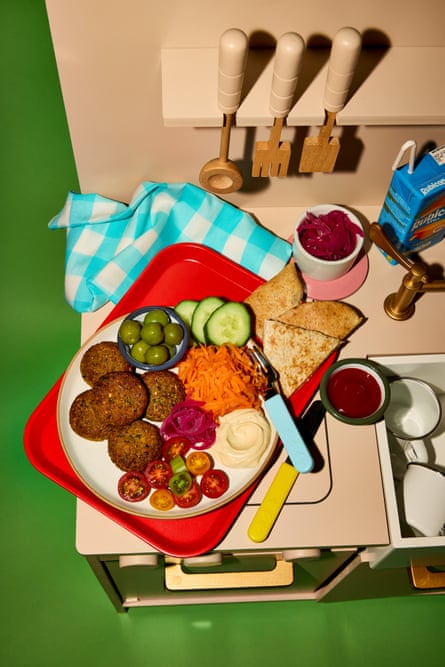
Falafel is one of our go-to meals – I always keep some ready-made in the freezer. Everyone customises their own – with gherkins, pickled beetroot and chillies, hummus, cucumber, cherry tomatoes, grated carrot, mayonnaise, sriracha, cabbage, tahini and even mango chutney – which they find empowering. Egg fried rice was one of the first things we ate together and remains a favourite. We all love katsu curry, most dals, paneer in any form, and tofu, either in nuggets, or in a homespun poke bowl or, surprisingly, the silken kind with rice and a sweet and salty sesame sauce.
I’ve always found it works to introduce something new alongside something familiar. When I first made them my sticky mango and lime paneer naans, I explained they both loved all its ingredients – paneer, mango, naan. I’ve introduced spices gradually, too, making mild versions and then adding a quarter of a teaspoon more each time I make it.
I was labelled a fussy eater as a child, but I think I just had incredibly sensitive taste buds. We underestimate how differently kids experience flavour; a cumin seed can seem explosively bitter, and something like kimchi can be overwhelming. The biggest lesson for me has been not to label children. If you keep calling them fussy, they start believing that’s who they are. I used to tell Arya, “Just try one cherry tomato every year and see what happens.” The other day, she ate not one, but three.
Meera Sodha is a cook, author of four cookbooks and Guardian Feast columnist.
Helen Goh
Sam, 15, and Jude, 11
I’ve got two very different children, in temperament and in the way they eat. I’ve realised over time that the best way to tackle it is to find different ways to prepare the same thing.
Sam says he hates roast chicken, but what he actually doesn’t like is the fatty, “slimy” skin. If I slice up the breast and wrap it in a flour tortilla, he’s delighted. Jude, meanwhile, wants the chicken leg, skin and all. The same goes for broccoli. Sam likes it crisp and crunchy; Jude likes it cooked a minute longer until it’s soft. Once I started asking why they didn’t like something, instead of writing it off, feeding them became much easier.
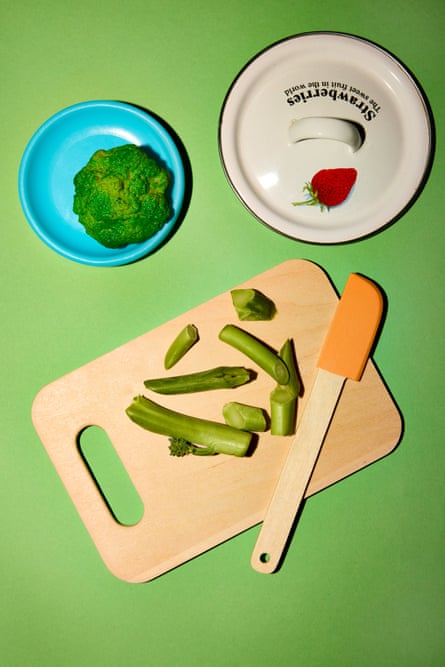
They’ve always loved tuna macaroni, which I originally made with lots of sweetcorn. Over time, I’ve slowly built in more flavours – I’ll cook down onions, carrots and celery into a really delicious base, then grate in courgette until it melts away like butter, or finely slice green beans so they disappear into noodles. I’m wary of hiding vegetables, though. I tell them what’s in there because I don’t want food to become a trick. I’d rather they thought, “Actually, grated courgette is what makes this taste so good.”
When the boys were little, I couldn’t work out why they devoured my mum’s congee and omelettes but barely touched mine. Mum laughed and said, “Salt and sugar”, each of which she adds a pinch of when she cooks. As a new mother I was so focused on doing everything “right”, whereas she was focused on making it delicious.
They love chilli con carne and poke bowls. For the poke, I briefly marinate cubed salmon in mayo, soy, maple syrup, lemon and, more recently, wasabi. Grill it for two minutes and then put that on top of a rice bowl with edamame, corn and, if I’m feeling fancy, a pineapple and mango salsa. We also love ants climbing a tree, a Sichuan Chinese dish with glass noodles and minced pork.
Sometimes I think we put too much pressure on ourselves to produce the perfect balanced plate. The other night I was rushing out and just put prosciutto, halloumi, avocado and cucumber on the table. Sam texted me afterwards saying, “More of this, please.” It made me realise that a meal doesn’t have to look worthy to be balanced.
Helen Goh is a pastry chef and the author of Baking and the Meaning of Life. She co-writes the Sweet Spot column in Guardian Feast.
Anna Jones
Dylan, 10, and Esca, 3
My eldest, Dylan, is 10 now and a brilliant eater, but it took a long time to get here. He always liked fruit and raw vegetables, which reassured me, but meals with sauces or lots of mixed flavours just weren’t his thing.
The big shift came when he was about six or seven and became obsessed with ninjas. All the stories featured ramen shops, gyoza and bowls of noodles, and I realised that food had become part of his imagination. We started making ramen at home, recreating the little trays of udon, vegetables and tofu he’d seen. Once Japanese food felt familiar through stories, it gave him the confidence to try other flavours, too.
Our younger son, Esca, is three, and he’s in his buttered toast and plain pasta era. We offer him a little of whatever we’re eating every night and most evenings he ignores it. I’ve tried not making alternatives, but I spend my life cooking to nourish people. I can’t send my child to bed hungry!
Having two boys at such different ages has made me much more relaxed. I know tastes change because I’ve watched it happen. In the meantime, I look for small wins. Smoothies packed with yoghurt, nut butter and seeds frozen into ice lollies have been a life-saver this summer. I think about protein in small ways, too, adding extra eggs and ground almonds to pancakes.
More than anything, I think children need ownership. Dylan loves tasting recipes I’ve been working on and giving me a verdict, but he’s just as inspired by seeing other children cook. He loves the Buddy Oliver and What’s Cooking Omari? shows on TV, and has been enjoying some of my old childhood recipe books – vintage Jane Asher and Jenny Chandler. It’s become a genuine interest.
Anna Jones is an award-winning food writer, author of four books about vegetarian home cooking.
Easy family ramen
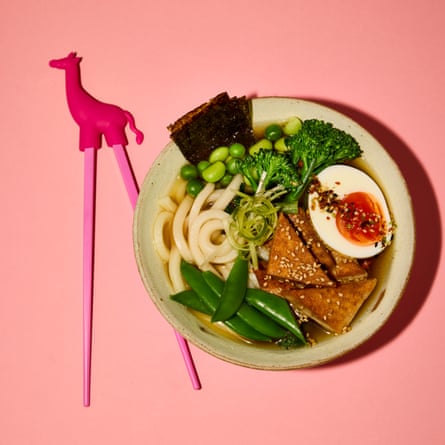
This is a very long way from authentic ramen and is something I make with staple ingredients that my kids like to eat.
I cook the noodles separately as I find cooking them in the broth does not work. If you are using ready-to-cook noodles you can pop them straight in, though. I often use coconut aminos instead of soy sauce here as it adds umami with less salt; you can buy it from most supermarkets. I use a range of green veg, whatever I have to hand: broccoli, peas, edamame and sugar snaps all seem to go down well. I get extra points if I roast the broccoli.
Serves 2, small(ish) kids and 2 adults
For the quick broth
A couple of coins of ginger
A bunch of spring onions
1-2 tbsp white miso
1-2 tbsp veg stock powder
1 tsp soy sauce or coconut aminos
200g pack of udon noodles (you can also use ramen noodles or the straight-to-wok, ready-to-eat kind)
For the tofu
Oil
400g block of firm tofu, chopped
2 tbsp sesame seeds
1 tbsp maple syrup
1 tbsp soy sauce or coconut aminos
4 big handfuls of green veg (broccoli, greens, sugar snaps, peas, edamame)
To serve (add as desired)
Crumbled-up seaweed snacks, gomashio, furikake
Put the ginger and the green tops of the spring onions into a deep pan and add a litre of cold water and bring to boil and simmer for a few minutes. Finely slice the white part of the spring onions.
In a separate pan, cook your noodles in boiling water according to packet instructions then drain and run under cold water. If any of your veg needs cooking (broccoli, frozen peas etc) you can add it for the relevant number of minutes with the noodles. Then drain and cool the lot.
Put a frying pan on the heat, add a little oil and the chopped tofu, and cook for a few minutes until it’s crisp and golden on all edges. Add the sesame seeds and cook for another few minutes until the seeds are toasted, turn off the heat and add the tablespoon of soy or coconut aminos and the tablespoon of maple syrup, and toss in the pan to coat.
Stir the miso and stock into the broth.
Put the noodles into the bottom of four bowls, with enough room for your veg, tofu and broth. Put the broth into a jug and the tofu, vegetables and toppings into little bowls on the table so everyone can help themselves – little ones may need help with the warm broth. Slurp.
Marie Mitchell
Marcie, 5
Weaning was such fun because Marcie ate everything. I probably drove myself mad trying to expose her to as much variety as possible. She’d be having adventurous home-cooked food while we were eating takeaway. Then she started nursery and the fussiness crept in.
I’ve never put pressure on what she has to eat. We decide what goes on the table, but once it’s there it’s up to her. If we give her agency, she’s more likely to try things. We’re quite strict about not making alternatives, though we always make sure there’s something she’ll enjoy. Usually that’s fruit.
I don’t like creating hierarchies around food. I don’t want food to become about rewards and punishments. I’m also not a fan of hiding vegetables. If she doesn’t know she’s eating something, she won’t know it’s something that she likes.
Family dinner isn’t always relaxing. But we still eat together almost every night because it’s an important pause in the day. Our classic meal is a slow‑cooked tomato sauce with lots of garlic, paprika and a little bit of sugar – that can go on pasta but I’ll often serve it with prawns. She’ll also eat tofu in any form – loves the stuff – and corn on the cob, crispy kale and any fish that isn’t breaded, which I serve with homemade chips. We get her involved, too – setting the table or perhaps rolling her own roti, if that’s what we’re having. I think children respond well when you don’t infantilise them. They’ll often surprise you.
Marie Mitchell is a cook and the author of the award‑winning Caribbean cookbook, Kin.
Ravneet Gill
Donnie, 2.5, and Roman, newborn
People are always telling me what a good eater Donnie is, but he’s only two and a half, so I know that could all change. I was such a fussy eater as a child – eating Indian food at home was non-negotiable, but I’d eat chips and a KitKat at school for lunch every day. Then I snapped out of it; when you learn about food and try some of the best produce, you can’t not love it. That’s what I’m trying to do for Donnie.
When we started weaning, I bought baby food pouches, probably out of fear of getting it wrong. Then I remember looking at them in the supermarket and thinking, “Hang on, I know how to cook.” So I started giving him bits of whatever we were eating – a lamb chop, a piece of salmon, a spoonful of rice. I’ve never really skimped on seasoning, either. He grew up eating cumin, coriander and proper home cooking; it’s only chilli he isn’t keen on.
We don’t make separate meals or “healthy” snacks. If we’re eating steak and chips, beef shin ragu or rotis, that’s what he’ll have. If we’re at the restaurant, I’ll let him have ice-cream or chocolate cake. I’ve tried not to frame sugar as a treat because I think that’s where things went wrong for me. Donnie knows he’s allowed it, so he doesn’t pine for it.
Of course, there are days when he barely touches a vegetable, and then the next he’ll eat a bowl of prawns or happily munch asparagus. I don’t fixate on it. The important thing is that food is around, we eat together, and he sees us enjoying it, too. That’s how I learned to love food, and I hope it’ll be the same for him.
Ravneet Gill is a pastry chef, food broadcaster and co‑owner of Gina restaurant in Chingford, London E4.
Jackson Boxer
Roma, 13, Ruscha, 9, Marlowe, 6, and Ilya, 3
The difficulty with feeding four children is that there aren’t many points on the Venn diagram where all of their likes overlap. Just when you discover something they all eat, one of them decides they no longer like it. There are a few constants, though. A good ragu bolognese can usually carry the week. I’ll make a huge batch, then serve it with pasta one night, folded into tacos the next, over rice after that. I’m forever making chicken stock, too. Pasta is cooked in it, rice is cooked in it. It’s the easiest way I know to smuggle a bit of vitality into food in a form they find irresistible.
Beyond that, feeding children is much less a culinary challenge than a psychological one. They each cultivate their own impossible preferences. Breakfast is a perfect example: two insist on thick American-style pancakes, the other two will only eat crepes. I make one batter, then dilute half of it.
I used to take it personally. Eventually I realised that refusing food is one of the few forms of power children have. In a family where cooking matters, they understand that saying “Mum’s a better cook than you” lands exactly where it hurts.
I grew up surrounded by wonderful cooks and didn’t appreciate any of it because it was all I knew. That’s the great misfortune of childhood: you don’t value your parents’ cooking until you’re deprived of it. So I try not to take the ingratitude too seriously; it’s almost a happy inheritance.
Jackson Boxer is chef/owner of Brunswick House, Vesper and Dove, all in London, and culinary director of Cowley Manor near Cheltenham and Henri in London.
Rosie Birkett
Aurelie, 4, and Edwyn, 2
I don’t think of my kids as fussy eaters – but that wasn’t always the case. With my eldest, Aurelie, I took every rejection personally. I’d put something in front of her that she’d happily eaten a fortnight earlier and suddenly she’d refuse it. By the time Edwyn came along, I knew that if you keep exposing them to things, they often come back around. Pickiness is almost always a phase.
Being a food writer probably made it harder. I was trying to apply everything I know about making food exciting, when children often want the opposite: simple things. I’ll spend hours making something complex, only for them to reject it in favour of buttered pasta. I’ve had to separate my ego from what they’re asking for.
We’ve learned what meals work for us. They love slow-cooked food: chicken noodle soup, braised beef shin, lamb, pasta cooked in chicken stock, smoked fish chowder with sweetcorn, dal with spinach and cauliflower chopped up small. I usually try to introduce new things alongside foods they know, say aubergine or mushrooms with chicken and roast potatoes. We ask them to try it, applaud them for doing so, and offer it again another day if they don’t like it. If I’m introducing a new rice or pasta dish, I will usually hold back a couple of plain portions, to serve with butter or olive oil. The backup plan is always carbs and fat! Sometimes on holiday they’ll try something from my plate in a restaurant because it feels like a privilege rather than an obligation.
My expectations were too high in the beginning. Now I know it’s the pattern over weeks and months that counts. If all else fails, there’s always Greek yoghurt with fruit after dinner – and a glass of milk before bed.
Rosie Birkett is a food writer and cookbook author. She has a weekly Substack newsletter, A Lot on Her Plate.
Margot Henderson
Hector, 33, Owen, 30, and Frances, 27
I’ve been thinking a lot about the meals my kids grew up on recently – I’m working on a project about family food. The three of them always seemed to be eating, so I took the approach that if they didn’t eat one meal they weren’t going to starve.
We mostly gave them what we were eating. They loved pasta, roast chicken, brown rice, stir‑fries with broccoli, chard and Chinese vegetables, which they were used to because in those days we lived near Chinatown. We’d make rice balls, frittatas full of vegetables, tortellini with spinach, roast pumpkin. Apart from giving them the odd chicken bone to suck on, I kept them vegetarian until they were about two because I wanted to encourage a love of vegetables and for them to eat widely. It mostly worked, although none of them ever really took to fennel!
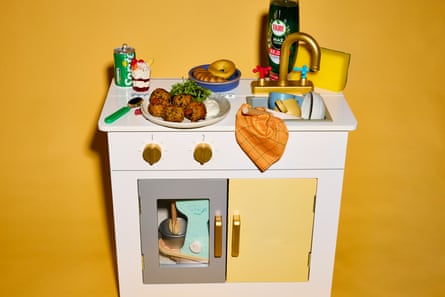
But they weren’t angels about food. Green vegetables were usually tricky, although they always loved peas. There was plenty of tomato pasta – I often say they were virtually made of the stuff – and we gave them fish fingers, too, which I’m rather against now, given the state of the oceans. I also used to make them “crusties”, just like my mum made for me. When our brown loaves were a few days old, I’d slice them thinly, spread them with butter and honey or Marmite, then pop them in a low oven until crisp. Perfect for packed lunches, and intriguing to the other kids.
The important thing was that food was always enjoyable. They grew up in restaurants – as babies they’d sleep under the tables, or join us in high chairs. Ours was a social house, people always coming for lunch or supper, so they were in an environment where food was a joyous, social thing. I don’t underestimate the power of that.
Margot Henderson is chef-patron of Rochelle Canteen, London E2.
Brown rice and pumpkin balls
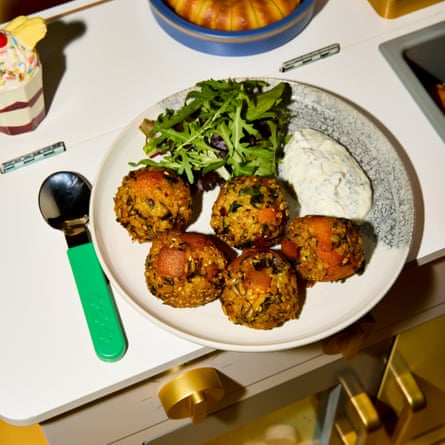
I once had a business making rice balls, and when I became a mum they became a go-to snack for my kids.
Makes about 14 balls
220g short-grain brown rice
500ml water
100g pumpkin, chopped up into 2cm pieces
1 tbsp wholemeal flour (optional)
2 tbsp sunflower seeds
2 tbsp sesame seeds
¼ cup flat parsley, roughly chopped
¼ cup coriander, leaves roughly chopped, stalks finely chopped
2 bunches of spring onions, finely chopped
A pinch sea salt
1 tbsp soy sauce or tamari
1.5 litres of plain oil (rapeseed or sunflower)
Wash the rice several times until the water runs clear, cover in water and leave to soak for 30 minutes. Drain. You will need a saucepan big enough to hold the rice and water, with a tight-fitting lid. To this, add the rice, water and salt, and cover with the lid.
Place the pot over a high heat and bring to the boil; when you see steam coming out the side or hear the pan bubbling, turn the heat right down to very low and then cook for 45 minutes. Don’t take the lid off. Set aside for at least 15 minutes.
While the rice is cooking, prepare the other ingredients. The rice should have absorbed all the water and come together into a lovely sticky consistency. You should be able to squish it flat easily.
Once the rice has cooled down, mix in the rest of the ingredients with the exception of the oil. It should be a good sticky consistency and come together when squeezed. You can add the flour to help with the binding if needed. Roll into ping‑pong-sized balls.
In another deep pan, heat the oil to 180C. Drop the balls in and fry for three to five minutes, until golden brown. Once cooked, place on a plate lined with kitchen paper. Cook in batches so the oil temperature doesn’t drop too low.
There you have it! They can be eaten hot or cold. A minty yoghurt dip would be nice alongside.
KioskNews shows a cleaned-up reading view extracted from the publisher’s page — the original always lives on their site, not ours.