Airline calls for more flexibility to set ticket prices
By Shelley Shan / Staff reporter


A domestic airline yesterday urged the government to allow it to adopt a more flexible, market-driven flight ticket pricing system, with the underlying cost framework dating back to 1999.
Airlines set ticket prices for domestic routes based on 14 cost-related factors submitted by the carriers and reviewed by the Civil Aviation Administration (CAA), which determines the minimum and maximum fares permitted on each route.
Since 2014, the CAA has allowed carriers to adjust ticket prices whenever the aviation fuel price — one of 14 cost-related factors — reaches a legal threshold.
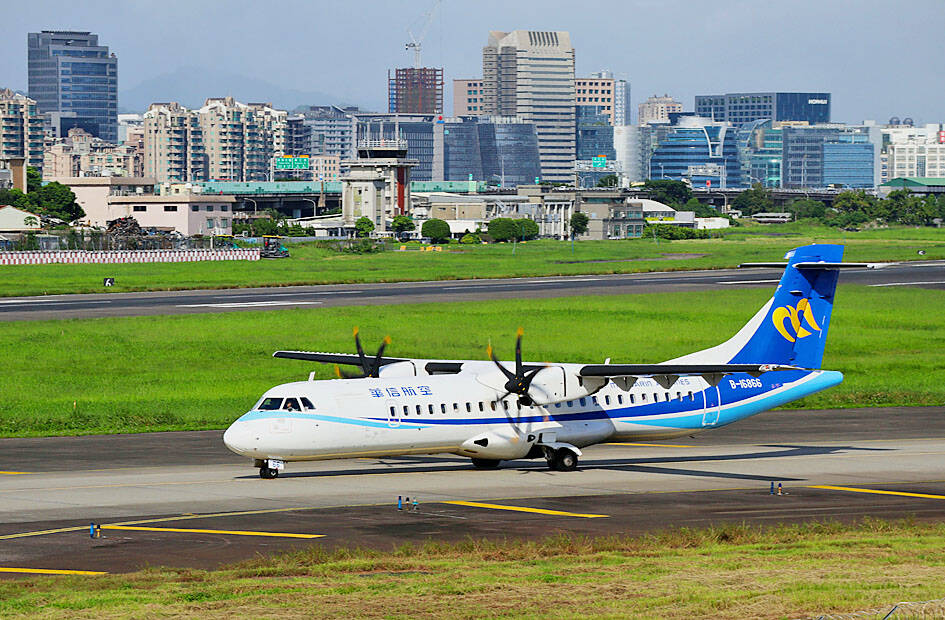
A Mandarin Airlines plane is pictured at Taipei International Airport (Songshan airport) yesterday.
Photo: Huang Yi-ching, Taipei Times
Last year, Mandarin Airlines and Uni Air requested permission from the CAA to increase ticket prices in response to rising costs. The CAA is reviewing the requests.
Mandarin Airlines chairman Chen Ta-chun (陳大鈞) told reporters on the sidelines of the Taiwan International Aviation Safety Management Summit in Taipei yesterday that it would be better if domestic flight ticket prices could be determined based on market demand.
“We also understand that it might be difficult for the government to do so, but it can begin by allowing carriers to adjust cargo rates,” Chen said.
Mandarin Airlines president Bryant Chuang (莊明哲) said that revenue from domestic cargo services accounts for only 10 percent of the airline’s domestic route revenue.
For example, the airline charges NT$18 per kilogram for cargo delivered to Kinmen County, while the rate for transporting cargo over a similar distance on an international flight could reach NT$100 per kilogram, Chuang said.
The government should reconsider its policy of giving passengers aged 65 or older a 50 percent discount on railway and domestic flight tickets, he added.
“We will see a substantial increase in the number of discounted tickets purchased by elderly passengers in the future, which would in turn raise carriers’ operating costs,” he said, citing demographic changes.
The government could consider limiting the number of discounted tickets available to elderly passengers to seven per flight, he said.
Mandarin Airlines in the first quarter this year proposed changing cargo delivery rates, Chuang said, adding that the proposal is still being reviewed by the CAA.
Meanwhile, the Ministry of Transportation and Communications said it is to extend measures to stabilize domestic airfares by having CPC Corp, Taiwan absorb increases in aviation fuel costs, keeping the three-month average price below NT$27.25 per liter to avoid triggering the fare adjustment threshold.
The ministry would budget to reimburse the company for the measure.
Department of Aviation and Navigation Director Han Chen-hua (韓振華) said the measure would remain in place as long as current conditions persist, with the timing of their termination depending on fuel price changes.
KioskNews shows a cleaned-up reading view extracted from the publisher’s page — the original always lives on their site, not ours.