Basketweavers get in a twist over Alexander Skarsgård’s Wicker Husband
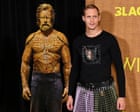
Hollywood heart-throbs are known for their good looks and charisma. But in a classic plot twist, the latest big-screen dreamboat causing viewers to get hot and bothered isn’t even human.
Alexander Skarsgård’s Wicker Husband character in the romcom Wicker has sent the internet into a frenzy.
“Never looking at my patio furniture the same again,” says one Instagram comment. Meanwhile, Ikea captioned a picture of its wicker furniture with the term “husband material”.
The basketweaving community, however, is getting hot under the collar for very different reasons. The fact the Wicker Husband isn’t made of willow, and he appears to be plaited rather than woven, has angered some makers.
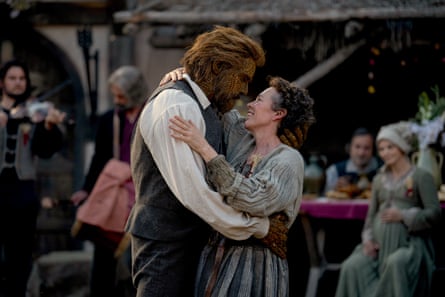
Deborah Needleman, former editor of New York Times’s T magazine turned basket maker, was one of the first to question it. Writing on Instagram, she said: “I’m excited that the basketweaving community now has our own hot, woven leading man, but I’ve also got issues. Why is a dude woven in an English fishing village not made of willow – or even rush?!” Over a 100 fellow basket makers have since weighed in.
The Oxford English dictionary defines wicker as “thin sticks of wood twisted together to make baskets, furniture etc.”
Eleanor Morgan, trade adviser to The Worshipful Company of Basketmakers in London, says that while willow has commonly been used to denote wicker, it is less popular today. “Historically wicker could have meant any pliant twig or osier,” she says.
Joe Dunckley, a prosthetic designer at Wētā workshop, the special effects studio in New Zealand that created the upper body of the Wicker Husband, says it was a “big challenge” to create a costume for a character that is sentient but made of wicker. “Most prosthetic materials are soft to mimic skin. But he’s not flesh and bone.”
To get the wicker effect, Dunckley and his team of 80 specialists created 50 interlocking body pieces for Skarsgård to wear. Using a rubber-like thermoplastic elastomer, they were able to 3D print a bespoke weave coded by the studio that was then attached to a spandex suit. During the 18-month process they also created 10 facial appliances.
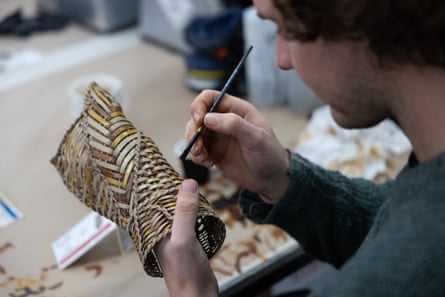
Dunckley says willow wasn’t a viable option for what they needed the suit to be able to do. “It is a similar reason to why, in film, we don’t make armour out of actual steel or use real swords. This is a fantasy film.”
Lewis Prosser, a basket maker from Cardiff, says every maker is thinking about how they would have approached the task. “It certainly isn’t the way I would have done it, but that doesn’t mean that it is bad,” he says.
Prosser says his understanding of wicker is that it is “an object that is woven but one that is specifically not textile”, adding that “some will disagree with me”. Some basket makers, including Needleman, argue that wicker refers to a type of weave rather than a material.
Prosser, who creates wicker costumes using techniques traditionally found in Wales and the south-west of England, says there are three main ways to make a basket. Coiling, where threads of plant materials are wound together in a spiral, braiding, or stake and stand basketry whereby vertical rods are woven through horizontal strands. “What we would traditionally call ‘wicker items’ would usually have that latter aspect,” Prosser says. The Wicker Husband does not.
Although actor Oliver Colman and her fellow villagers in the film speak in a range of British dialects, the film is not set in England. Dunckley suggests Dinklage’s basket maker character has travelled the world, learning skills from other makers.
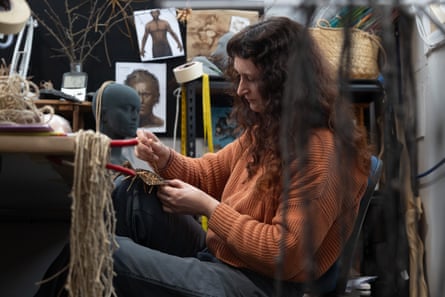
Prosser says if the film had been set in a specific location, it would be more authentic for the costume to reflect the plants that grow there. In the UK, willow would be apt, whereas in Spain, Esparto grass would be fitting.
Dunckley and his team worked using a 3D cast of Skarsgård to ensure the “audience would be able to recognise Alexander in basket form”. Key to this is what Dunckley calls the “Skarsgård smoulder”, which they captured by ensuring the weave could furrow at the brow. His hair, beard and lashes were made from muka, fibres from New Zealand flax.
Describing the interest and critique from the weaving community as “really cool”, Dunckley says: “I don’t blame anyone. True artists of the craft have dedicated years to it. I would expect them to look at a fantasy version of their art form and see failings in it.”
For the willow purists, Morgan says “there is no lack of osier-related eye candy” in the film, pointing to a plethora of basket scenes. Prosser says he is thrilled the film has drawn attention to basket making, especially as some skills and traditional techniques are now endangered. TikTok is rife with wicker costume making guides, including nipple tutorials which Skarsgård has said was the “best part” of his suit. He gave his own pair to the TV host Graham Norton describing them as “extraordinary craftsmanship.”
KioskNews shows a cleaned-up reading view extracted from the publisher’s page — the original always lives on their site, not ours.