Kuma Academy calls for improving societal resilience
By Chen Chi-cheng and Hollie Younger / Staff reporter, with staff writer


The Kuma Academy yesterday urged local candidates to propose policies that would improve resilience and the whole-of-society defense system, as Taiwan faces increasing “gray zone” harassment and the threat of “war-related disaster.”
Taiwan’s disaster-preparedness should incorporate the compound threat of natural disasters as well as “gray zone” tactics and a possible Taiwan contingency, the group told a news conference.
It urged local candidates in November’s elections to propose policies that would protect critical infrastructure — including communications, energy and stockpiles of supplies — and strengthen grassroots civil defense capabilities.
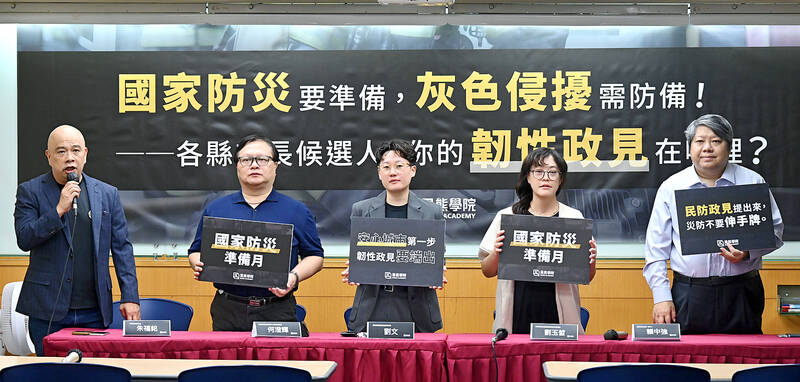
Members of the Kuma Academy hold a news conference in Taipei yesterday.
Photo: George Tsorng, Taipei Times
Taiwan’s 14 undersea cables are concentrated at eight landing stations, making them vulnerable to physical damage, cyberattacks or cognitive warfare to spread false information, Taiwan National Security Institute deputy secretary-general and Kuma Academy cofounder Ho Cheng-hui (何澄輝) said.
He urged local governments to set up backup noncommercial communications systems that could stabilize public sentiment in a crisis.
To counter energy and supplies vulnerabilities, they should also promote community microgrids and backup power supplies, he said.
Ho further suggested planning a “civil defense fund” and working with convenience stores and logistics operators to increase stockpiles of supplies by 20 to 30 percent.
Kuma Academy chairman Liu Wen (劉文) said that local governments should make use of village and community committee systems to build grassroots defense capabilities.
Liu suggested building “model resilient communities” with incentives to improve.
Moreover, they should deepen cooperation with Taiwan’s strong network of disaster-response nongovernmental organizations, links that could also be incorporated into drills, she said.
Presidential Office Whole-of-Society Defense Resilience Committee member Liu Yu-hsi (劉玉皙) said that the Ministry of Labor and the labor affairs authorities of local governments should jointly formulate provisions to protect small businesses in the event of a crisis, such as work suspension guidelines and regulations governing attendance and wages to avoid labor disputes.
Local governments should also establish reporting channels for industries highly dependent on energy, such as precision manufacturing, to report power and water outages and receive information on service restoration, she said.
Local government funding has increased from NT$433.8 billion (US$13.6 billion) to NT$848.7 billion this year and NT$933.6 billion next year, Taiwan Economic Democracy Union convener Lai Chung-chiang (賴中強) said.
He called on the next local governments to immediately produce a three-year analysis of civil defense budgets covering last year to next year and substantially increase civil defense budgets.
They should submit supplementary budgets on a rolling basis in line with the growth rate of centrally allocated tax revenues, he added.
KioskNews shows a cleaned-up reading view extracted from the publisher’s page — the original always lives on their site, not ours.