[Editorial] When it comes to troop deployments, too much caution is never enough
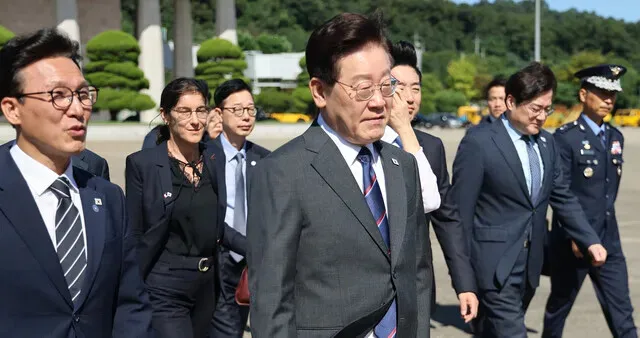
Democratic Party leader Kim Min-seok (left) speaks to President Lee Jae Myung while seeing him off at Seoul Air Base in Seongnam as he departs for a state visit to France on Sept. 6, 2026. (Yonhap)
The Blue House’s official acknowledgment that it is considering sending troops to the Strait of Hormuz is becoming a source of growing controversy.
To be sure, the pressure from US President Donald Trump has been intensifying by the day, and Seoul is bound to consider matters of trade and security negotiations with Washington.
Even so, troop deployments are an issue where the Korean public’s lives are on the line. Seoul needs to remember that when it comes to the matter of troop deployments, too much caution is never enough.
On Friday, a senior Blue House official said that in terms of deployments, South Korea “could operate within a scope that does not severely compromise the Korean Peninsula readiness posture.”
The message, which suggested that it could send military assets to the Strait of Hormuz, was met with an intensifying backlash at home and abroad.
Right away, it triggered a warning from a senior Iranian official, who said the same day that “any South Korean involvement against Iran in the Strait of Hormuz would amount to direct military participation in the aggression and war against Iran.”
An outcry also erupted from the ruling Democratic Party and other progressive parties.
In a post on Facebook, Rep. Lee Ki-heon of the Democratic Party stressed, “We cannot force our public and troops into a war without a plan.”
Rep. Kim Joon-hyung, the floor leader of the Rebuilding Korea Party, issued a statement asking, “Why on Earth should the Republic of Korea be considering sending troops into this illegal war of aggression?”
The reason that the administration has been considering troop deployments — despite knowing how sensitive the issue is — can be traced to the mounting pressure coming from Trump.
On Aug. 16, Trump recalled recently asking Korean President Lee Jae Myung whether he would be willing to participate in the pressure to denuclearize Iran and receiving a reply of “No thanks.”
He has expressed discontent on numerous occasions since then. On Friday, he brought up the topic of support to Ukraine again, sharing a column on his social media that argued that South Korea should sell its Cheongung-II surface-to-air missiles to Ukraine.
Last month, the US unilaterally downscaled its joint military exercises with South Korea, and no headway has been made in security negotiations on the topics of uranium enrichment and nuclear submarines. Meanwhile, the threat of tariffs continues to loom. For an administration that has to comprehensively consider the national interest, the troop deployment demands were not something that could simply be ignored.
At the same time, sending troops to the Strait of Hormuz stands a chance of destroying Seoul’s relations with Tehran and endangering not only the troops themselves but also Koreans living overseas. It is also in violation of the Constitution, which repudiates wars of aggression.
Another risk is that it could cause the kinds of sharp divisions in public opinion that occurred when troops were deployed to Iraq during the Roh Moo-hyun administration. Seoul needs to carry on to the bitter end with efforts to convince Washington that it would be better off providing non-military contributions such as humanitarian assistance, rather than troop deployments.
KioskNews shows a cleaned-up reading view extracted from the publisher’s page — the original always lives on their site, not ours.