Trump’s defeat in the midterms will reshape Asean and East Asia — Phar Kim Beng
NOVEMBER 5 — The sweeping defeat of President Donald Trump’s Republican Party in the November 3, 2026, midterm elections is not merely an American political event. It is a strategic turning point with potentially profound consequences for Asean and East Asia.
With Democrats capturing both the House of Representatives and the Senate, Trump faces a political environment fundamentally different from the one that enabled his administration to pursue aggressive tariffs, military confrontation with Iran and highly transactional diplomacy.
The election results reflect growing American frustration over the cost of living, economic uncertainty and the prolonged war with Iran.
Yet Asean and East Asia should not assume that Trump’s electoral defeat will automatically produce a more predictable United States.
Indeed, the opposite may occur.
A weakened Trump may become more conciliatory. Equally, he may become more confrontational internationally to compensate for his diminished authority domestically.
For Asean and East Asia, five strategic consequences deserve particular attention.
First, Trump’s political defeat does not mean the immediate disappearance of Trumpism.
Trump remains President until January 2029. His constitutional powers over foreign affairs, military deployments and executive decision-making remain considerable.
Even with Democrats controlling Congress from January 2027, reversing Trump’s tariffs or compelling an immediate withdrawal from military operations against Iran will remain difficult.
Trump can veto legislation. Overriding that veto requires a two-thirds majority in both chambers.
Consequently, Asean governments must distinguish between the weakening of Trump’s political legitimacy and the continuing strength of the American presidency.
The distinction is essential.
A president who has lost control of Congress can still inflict considerable economic and strategic uncertainty on the international system.
Second, Asean and East Asia must prepare for prolonged uncertainty in American trade policy.
Trump’s tariffs have already disrupted trade calculations across Southeast Asia.
Export-oriented economies such as Vietnam, Malaysia, Thailand and Indonesia have been forced to reassess their exposure to the American market.
Japan and South Korea, despite their longstanding alliances with Washington, have similarly discovered that strategic friendship offers no automatic protection from American economic nationalism.
The Democratic victory could generate stronger congressional scrutiny of tariffs and encourage Republicans who favour international trade to challenge Trump’s policies.
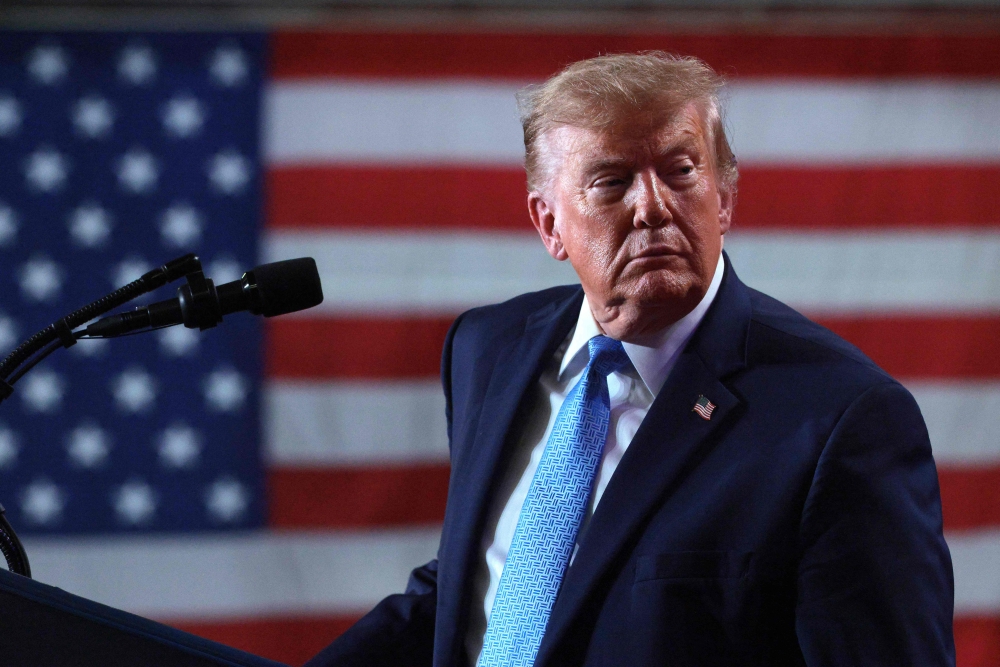
Donald Trump can veto legislation. Overriding that veto requires a two-thirds majority in both chambers.— AFP pic
Nevertheless, immediate tariff relief is far from guaranteed.
Asean should therefore broaden and deepen its economic partnerships rather than wait for Washington to recover its commitment to predictable international trade.
The Regional Comprehensive Economic Partnership must become more than an agreement that exists largely on paper.
It should become an increasingly important foundation of regional economic resilience.
The same applies to Asean’s economic engagement with China, Japan, South Korea, India, the European Union and the Gulf countries.
Economic diversification is no longer merely desirable.
It has become a strategic necessity.
Third, the war with Iran has demonstrated that American foreign policy can generate severe economic consequences far beyond the Middle East.
The prolonged disruption of the Strait of Hormuz has exposed the vulnerability of Asian economies to energy insecurity.
Japan and South Korea remain heavily dependent on imported energy.
China, despite its extensive investments in renewable energy and alternative supply routes, is not immune to disruptions in Gulf oil shipments.
Asean faces equally serious challenges.
The Philippines has experienced acute energy insecurity, while several Southeast Asian governments have faced mounting subsidy burdens and pressure on public finances.
For Malaysia, higher energy prices may benefit certain petroleum revenues while simultaneously increasing the costs of subsidies, transportation, manufacturing and household consumption.
The Democratic victory reflects, in part, American dissatisfaction with the economic consequences of the Iran war.
However, congressional investigations and criticism of the administration will not necessarily produce an immediate ceasefire.
Asean and East Asia must therefore become more active diplomatic stakeholders in efforts to stabilise the Middle East.
Malaysia should continue supporting negotiations involving Iran, the Gulf states and the countries associated with the Mecca Pact.
Japan, China and South Korea should also recognise that their economic interests increasingly converge around the restoration of secure maritime energy routes.
Energy security cannot remain divorced from diplomacy.
Fourth, Trump’s weakened presidency could complicate rather than simplify relations between Washington and Beijing.
This is perhaps the most consequential strategic uncertainty confronting East Asia.
Trump has demonstrated a willingness to negotiate directly with President Xi Jinping, even while maintaining economic and technological pressure on China.
A Democratic-controlled Congress, however, is unlikely to become substantially softer towards Beijing.
Indeed, bipartisan concerns over Chinese technological capabilities, advanced semiconductors, artificial intelligence and military modernisation could generate even stronger legislative restrictions.
Analysts have already identified the possibility of tougher congressional scrutiny of Trump’s dealings with China.
This creates an unusual strategic contradiction.
Trump may seek a transactional understanding with Xi, while Congress pushes for a more restrictive technological and security relationship.
Japan, South Korea and Taiwan could consequently find themselves caught between competing American approaches towards China.
For Asean, the dangers are equally substantial.
The region must resist being drawn into an increasingly rigid division between American and Chinese technological ecosystems.
Artificial intelligence, semiconductor supply chains, data governance and digital infrastructure should not become instruments of compulsory geopolitical alignment.
Asean must pursue digital sovereignty while broadening and deepening its partnerships with all major technological powers.
The objective should be strategic autonomy without strategic isolation.
Fifth, Trump’s defeat creates an opportunity for Asean and East Asia to demonstrate greater collective diplomatic leadership.
For decades, East Asian regionalism has operated within a strategic environment shaped heavily by American military power and economic influence.
That reality will not disappear.
Yet the midterm elections demonstrate the extent to which American foreign policy can be constrained, redirected or destabilised by domestic political struggles.
Japan cannot assume that Washington will always provide consistent strategic leadership.
South Korea must prepare for further uncertainty concerning American security commitments and trade arrangements.
China must recognise that an increasingly divided United States may produce contradictory policies rather than a coherent long-term strategy.
Asean, meanwhile, cannot afford to remain merely reactive.
The Philippines, as Asean Chair in 2026, has an important opportunity to strengthen regional coordination before handing over the chairmanship.
More fundamentally, Asean Plus Three should be revitalised as a practical framework for cooperation on energy security, supply chains, financial stability and technological governance.
China, Japan and South Korea possess enormous industrial, financial and technological capabilities.
Asean provides a regional diplomatic platform that can help these three powers cooperate despite their historical and strategic differences.
This is where the Asean will must replace excessive diplomatic caution.
The region should not simply wait for the United States to determine the direction of Asian security.
It must increasingly shape that direction itself.
There is also a deeper lesson from Trump’s electoral defeat.
American voters have demonstrated that economic grievances cannot indefinitely be displaced by political spectacle, nationalist rhetoric or foreign military adventures.
The cost-of-living matters.
The price of energy matters.
The affordability of food, housing and transportation matters.
These concerns are equally relevant across Asean and East Asia.
Governments that fail to recognise the relationship between geopolitical decisions and household economic security risk discovering the political consequences at the ballot box.
Trump’s defeat is therefore more than a warning to American Republicans.
It is a reminder that foreign policy must ultimately serve the economic well-being and security of ordinary citizens.
For Asean and East Asia, the immediate challenge is not to celebrate Trump’s political difficulties.
Nor should the region assume that the Democrats will necessarily restore the American internationalism of earlier decades.
The challenge is to recognise that American political uncertainty has become a structural feature of the international system.
Trump may choose confrontation with the Democrats. He may equally choose accommodation to preserve what remains of his political legacy.
Either way, Asean and East Asia must not allow their strategic futures to depend excessively on the political calculations of one American president.
The most important consequence of the 2026 midterms may therefore be the acceleration of an Asian realisation: regional stability, economic resilience and diplomatic initiative must increasingly be generated within Asia itself.
Trump has lost control of Congress. But Asean and East Asia must not lose control of their own strategic destinies.
That is the larger lesson of November 3, 2026.
* Phar Kim Beng, PhD is the Professor of Asean Studies at International Islamic University of Malaysia and Director of Institute of International and Asean Studies (IINTAS).
** This is the personal opinion of the writer or publication and does not necessarily represent the views of Malay Mail.
KioskNews shows a cleaned-up reading view extracted from the publisher’s page — the original always lives on their site, not ours.