China elevates a military general to the Politburo and seeks to strengthen party discipline
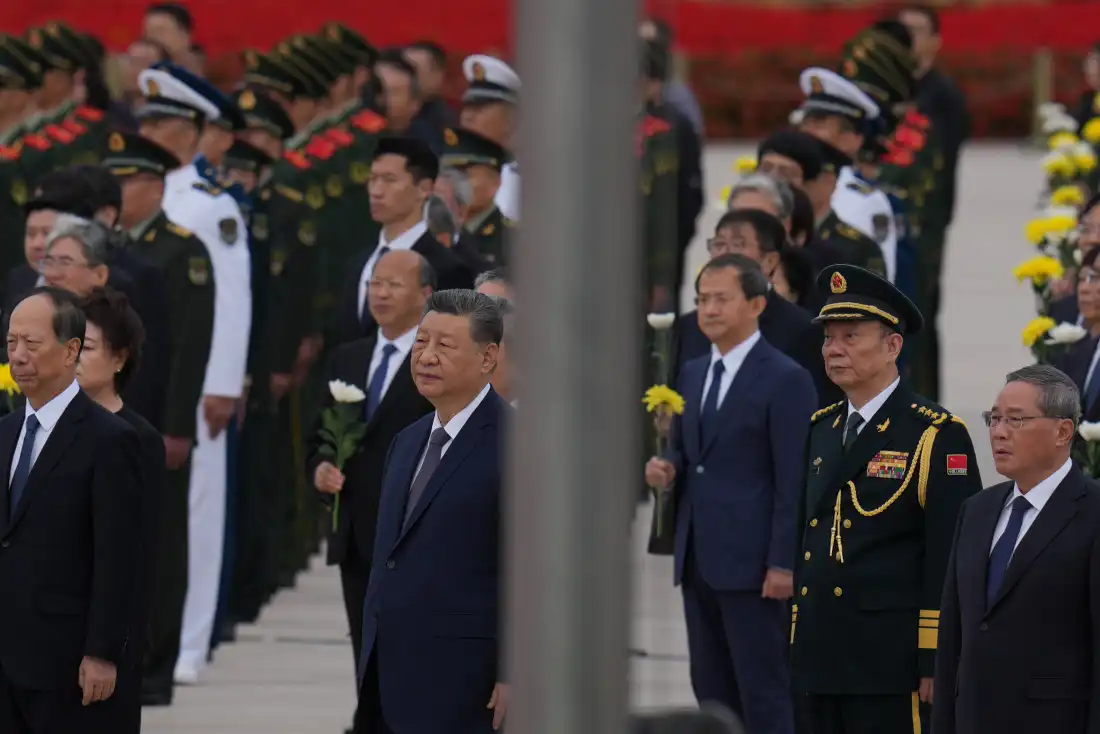
Chinese President Xi Jinping, center left and Zhang Shengmin, Vice Chairman of the Central Military Commission second from right attend a ceremony in honor of fallen national heroes at the Monument to the People's Heroes to mark Martyrs' Day at Tiananmen Square in Beijing, Wednesday, Sept. 30, 2026. Ng Han Guan/AP hide caption
Ng Han Guan/AP
BANGKOK — China's top leaders on Thursday elevated the only remaining general on the commission that oversees the country's military to the Politburo, the top governing body of the Communist Party.
The leaders also adopted a resolution on strengthening self-governance, discipline and anti-corruption in the party, as they seek to extend their grip on power.
During a four-day closed-door meeting, top Communist Party leaders deliberated on and adopted resolutions that will guide the party in the coming years. The meeting comes about a year before President Xi Jinping is widely expected to secure his fourth five-year term as the party's leader.
The party elected Gen. Zhang Shengmin, who currently serves as vice chairman of the Central Military Commission, to the Politburo. Xi had earlier purged two of China's top generals, leaving Zhang as the commission's only member besides Xi himself. It also left the Politburo without any representatives from the People's Liberation Army.
Zhang also holds a position overseeing internal discipline for the military, serving as deputy secretary of the CMC Commission for Discipline Inspection.
The party said in a summary of the resolution that the tasks facing it were "increasingly arduous," such as "uniting and leading the people to safeguard national sovereignty, security, and development interests."
It said it must step up its self-governance, which involves rooting out corruption and maintaining ideological purity.
The party should, "with an eye on enhancing its long-term governance capacity, maintain its progressive nature and purity, and its close, flesh-and-blood ties with the people," according to a summary of the resolution from the official Xinhua News Agency.
Xi has championed anti-corruption since coming to power in 2012, and has sustained a crackdown on officials for more than a decade. However, analysts say the focus now also includes underperforming officials.
Party members also reviewed the earlier purges of top members and military officials, confirming the personnel changes.
The plenum meeting revealed wider-than-expected purges, according to analysis by Neil Thomas, a senior fellow at Asia Policy who studies Chinese politics. He calculated an attendance rate of 74 percent, the lowest since the times of former leader Mao Zedong, who ran political purges regularly.
KioskNews shows a cleaned-up reading view extracted from the publisher’s page — the original always lives on their site, not ours.