Rom-com or sib-com?
Sisterhood rules in a 21st-century take on ‘Sense and Sensibility’
It is a truth universally acknowledged, as somebody once wrote, that a Jane Austen novel is a precursor to the modern rom-com.
And so we find ourselves, in a new adaptation of Sense and Sensibility starring Daisy Edgar-Jones, rooting for one thing: a kiss. A simple kiss, to break through the miscues and misunderstandings and finally release all that romantic tension.
Of course, we get it. Elinor locks lips with her Edward, out there in the grassy Devon fields, just as Bridget Jones did with Mark Darcy, in the snowy London streets. It’s a lovely kiss, and worth the wait.
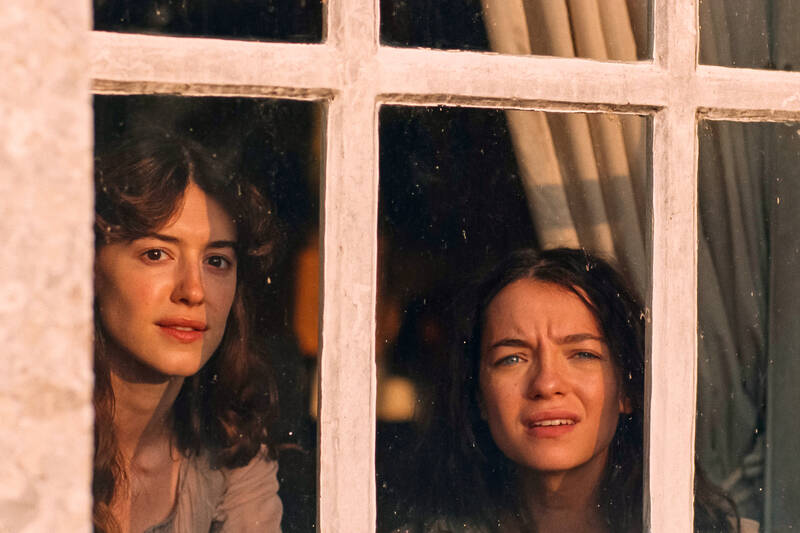
Daisy Edgar-Jones, left, and Esme Creed-Miles in a scene from Sense and Sensibility.
Photo: AP
But then … we get something better: A hug, between sisters, even more joyful. And that’s what we remember as the credits roll.
Sisters. They’re not exactly “doing it for themselves” in this new version directed by Georgia Oakley — we’re still in 18th-century England, after all, and young women need to find husbands.
But Oakley, seeking a 21st-century approach to the Austen classic, finds a way to subtly shift the weight from romantic chemistry to the more profound chemistry between no-nonsense Elinor (Edgar-Jones, in the “sense” role) and turbulent Marianne (Esme Creed-Miles, in the “sensibility” role.) And this alone — well, and two killer dance scenes — seems reason enough to revisit the story, three decades since Ang Lee’s (李安) 1995 version won Emma Thompson a screenplay Oscar.

Daisy Edgar-Jones, left, and George MacKay in a scene from Sense and Sensibility
Photo: AP
Oakley also brings a welcome naturalistic feel to a script by Diana Reid, with a strong sense of nature itself but also the reality of economic hardship — or what stands for economic hardship in an Austen novel. When Elinor and her mother (Caitriona Balfe) and sisters are relegated to a small cottage upon their father’s death, they’re hardly starving — they still have a servant, after all. But they share clothes, their hair is unkempt, they perform country chores. Their dresses are even stained.
We begin with some bad news. Marianne is lying in the grass, with the caterpillars, waiting for the day’s letters. Soon, the Dashwoods are in tears. Their father has left his wealth to a son from a previous marriage, meaning John Dashwood and his insufferable wife Fanny (Stacy Martin, amusing) will be moving into their sprawling country estate.
Mom and sisters soon decamp to a much smaller cottage — only one servant — in Devon, thanks to the help of Mrs. Jennings, “mother of your mother’s cousin’s cousin’s wife,” as she announces herself (a delightful Fiona Shaw).
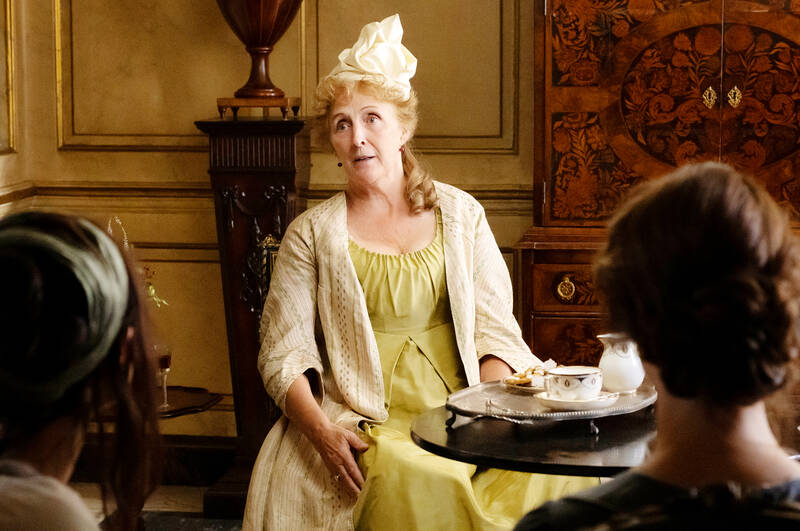
Fiona Shaw in a scene from Sense and Sensibility.
Photo: AP
But not before Elinor has fallen in love with Edward Ferrars (George MacKay), Fanny’s handsome and upstanding brother, during a family visit.
It seems these two are perfect for each other, both honorable and sensible but also just a little sexy underneath — Edgar-Jones and MacKay are well-matched here.
Complications arise, though — duh, this is an Austen novel! Ferrars is, well, otherwise engaged, literally. Elinor learns this on a trip to London, from the fiancee herself. It will take the rest of the movie for this to be ironed out. Meanwhile, Marianne is going through her own romantic journey.

Daisy Edgar-Jones, left, and George MacKay in a scene from Sense and Sensibility.
Photo: AP
There’s no need to count the times Marianne is tasked with explaining here that she’s the passionate one, more in touch with her turbulent emotions, and expects the same from a partner. A few too many, anyway.
But Creed-Miles, whose mother, Samantha Morton, is having a scene-stealing moment herself in The Odyssey, gives an exhilarating turn as the sister who, yes, seems to wear it all on her sleeve, making it totally believable when she screams into the rain or laughs with delirium. Or falls head-over-heels with Willoughby, a handsome rake (deliciously played by Frank Dillane) who swoops in to save her when she turns her ankle on a beach.
These two, also, seem perfect for each other — especially when dancing. Kudos to choreographer Holly Blakey, who makes the most of two social dance scenes: the exuberant “hop” in the countryside (what fun the actors seem to be having), and the more refined but still creative London ball.
But Willoughby, as Austen’s readers know, will prove an even more elusive catch than Ferrars. Meanwhile, waiting in the wings is a man of few words — and initially, few feelings, or so thinks Marianne — the steadfast Colonel Brandon (Herbert Nordrum).
Will he find a way to her heart? It’s hardly a spoiler to reveal the end of a novel published centuries ago, but more importantly, we know how all rom-coms end — with the “rom” part working out, somehow.
We’re happy for the sisters, of course. They landed a couple of nice guys.
KioskNews shows a cleaned-up reading view extracted from the publisher’s page — the original always lives on their site, not ours.