From 'Return Her' To 'Extradite Her': Bangladesh's Shifting Sheikh Hasina Stance
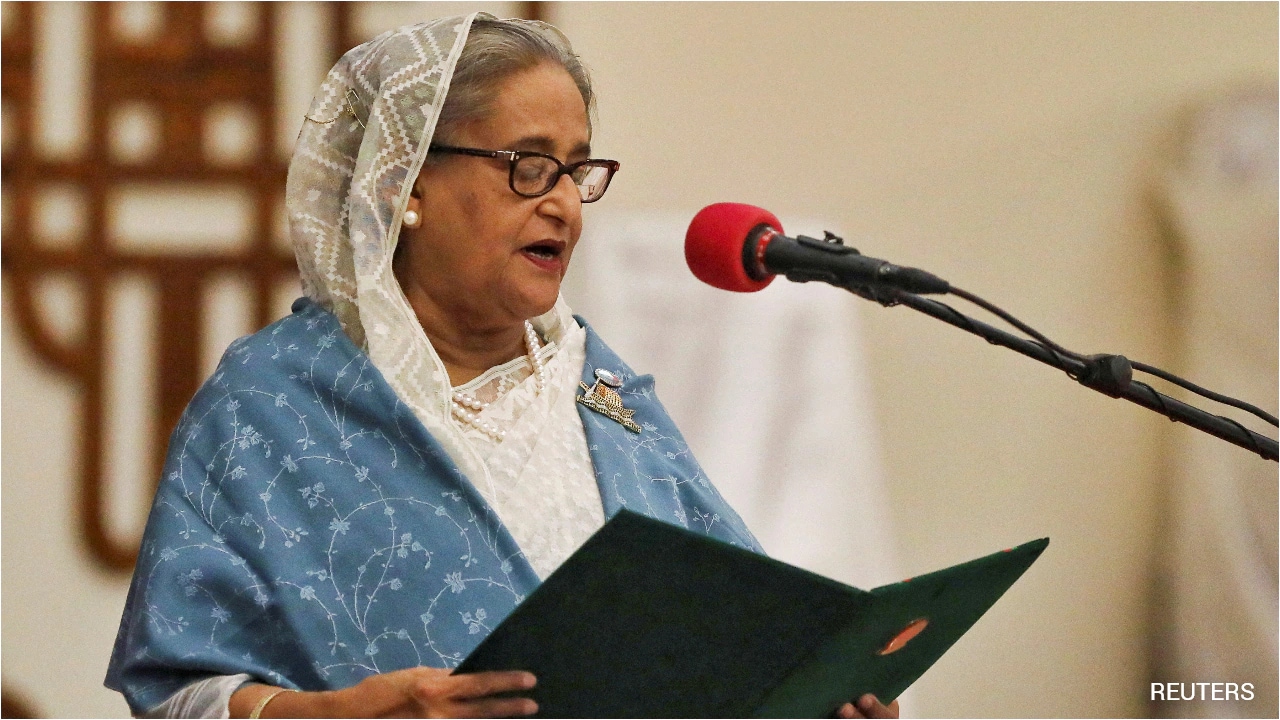
Ousted Bangladesh Prime Minister Sheikh Hasina's announcement that she will return to Bangladesh on December 16, along with her request for travel documents like a passport and arrangements for her return on flag carrier Biman Bangladesh Airlines, has led to a political storm in Bangladesh.
On August 5, 2024, as a mob advanced towards her official residence, Sheikh Hasina was evacuated by helicopter on the orders of the Bangladesh Army Chief. A Bangladesh Air Force C-130J aircraft, flown by Bangladesh Air Force pilots, then flew Sheikh Hasina to the Hindon Air Base, near New Delhi. Later that afternoon, Bangladesh's Army Chief, General Waker-uz-Zaman, speaking on state television, told the nation that Hasina, 76, had resigned and that an interim government would be formed.
Now that Sheikh Hasina has announced her return, Bangladesh is calling it a 'bluff'. After holding India responsible for sheltering her, Bangladesh now says that she must be extradited if she wants to return. From 'return her' to 'she can only be extradited' is being seen as a shifting of the goalposts, even by Hasina's sharpest critics. When the request was made for her to come to India, she was the Prime Minister of Bangladesh and was still in office. Ministry of External Affairs spokesperson Randhir Jaiswal has maintained that the extradition request is a legal issue being processed through existing legal frameworks, but no specific timeline has been announced.
Bangladesh's Conundrum After Hasina's Statement
Soon after Sheikh Hasina's announcement, Bangladesh's State Minister for Foreign Affairs, Humaiun Kobir, made the country's position clear. Hasina can return only through extradition, effectively closing the door on her returning to her country of her own free will.
"The reality is that a terrorist will never be allowed to come back other than through extradition. The desire may be - it seems she sleeps in bed and has nightmares, seeing nightmares like, 'I'm walking back to Bangladesh,' 'I'm going back by plane.' No, she is not a regular commercial passenger. She can only be brought back in handcuffs or through strict surveillance," Humaiun Kobir told reporters when asked specifically about Hasina's request to arrange for her return on flag carrier Biman Bangladesh Airlines.
Hasina's return is likely to lead to a huge political churn in the country, and Bangladesh wants to avoid it at any cost. Bangladesh wants a quiet handover facilitated by India by invoking the extradition treaty between the two countries. But the circumstances of her departure from Bangladesh in 2024, along with questions over the fairness and validity of her trial, held in absentia without proper legal representation, make the extradition proposal uncertain and put it on shaky legal ground.
Why Is Bangladesh Putting The Onus On India?
Bangladesh has tied down bilateral relations to the Sheikh Hasina extradition issue, while India has made it clear that bilateral relations should move forward and that the Hasina issue can be decided on legal grounds.
India's High Commissioner to Bangladesh, Dinesh Trivedi, has said India "hardly had any choice" as "at that point in time, she (Hasina) was still the prime minister of Bangladesh". India, as a neighbour, had a duty to give shelter to the then Bangladesh Prime Minister Sheikh Hasina, and that is exactly what it did. Hasina's resignation, which has since been contested even by the then President of Bangladesh, was also announced by the Army Chief, well after her plane was already in Indian airspace and a decision had been taken to allow her to come to India.
"If Sheikh Hasina wants to return to Bangladesh, we will not discuss it with Sheikh Hasina. I want to reiterate this. Whether Hasina comes to Bangladesh or not is not a discussion we are having with Hasina. We will discuss this with India. One of the most dangerous and horrible criminals, along with her aides, is there with you. Sheikh Hasina is not an accused. She has been convicted. The process of law has concluded, and Sheikh Hasina has been proven guilty and sentenced," Zahed Ur Rahman, Advisor to the Prime Minister in the rank of State Minister for Cultural Affairs of Bangladesh, told reporters.
"Whether Sheikh Hasina will return or not, whether she will fly on Bangladesh Biman or their airplanes, or whether she walks into Bangladesh is a discussion we will have with India. Sheikh Hasina is trying to show she is something, but we have said this before: it is a bluff to the political people, her supporters, her party workers," Zahed Ur Rahman added.
The Significance Of December 16
Sheikh Hasina has now announced that she will return to Bangladesh on December 16, a significant date in both Bangladesh and India. In India, December 16 is celebrated as Vijay Diwas to commemorate the surrender of Pakistani forces in Dhaka on December 16, 1971, following coordinated action by the Indian Armed Forces alongside the Mukti Bahini. The campaign culminated in the surrender of around 93,000 Pakistani troops in Dhaka, with the Indian side led by Lt. Gen. Jagjit Singh Aurora and Pakistan Army's Lt Gen AAK. Niazi signing the Instrument of Surrender in Dhaka. The landmark event led to the birth of a new nation - Bangladesh.
In Bangladesh, Vijay Diwas marks the end of the 1971 Bangladesh Liberation War and is observed as a national holiday celebrating liberation from Pakistan. The day's highlight is the national holiday parade at Dhaka's National Parade Ground, hosted by the Bangladeshi armed forces. At sunrise on December 16, Bangladeshi soldiers perform a 31-gun salute, celebrating Bangladesh's independence and its emergence as a sovereign nation.
Sheikh Hasina's choice of date is seen as a political masterstroke, as it is one of the most important days in Bangladesh's official calendar. She has made it clear that she is making a political statement by announcing that she will come home on the day her nation achieved its dream of becoming an independent country - Bangladesh, after being known as East Pakistan until then.
Unrest In Bangladesh As Hasina Supporters Flex Muscles
Soon after Sheikh Hasina's departure from Bangladesh, the Muhammad Yunus-led interim government banned the Awami League, imposing a total clampdown on its political activities. Several Awami League leaders fled Bangladesh, and many more were jailed. Ordinary Awami League workers simply stayed quiet as an election was held with the party missing from the ballot. Several Awami League voters voted for the Bangladesh Nationalist Party, giving it a major victory in the elections held in February this year.
However, if Sheikh Hasina returns to Bangladesh, keeping the Awami League out of the political space may become untenable. The anti-Awami League political forces do not want the party to return, even as its position in Bangladesh politics has declined because of its politics, which also included a crackdown on political opponents.
Last week, Bangladesh Prime Minister Tarique Rahman accused deposed Prime Minister Sheikh Hasina's Awami League of conspiring to destabilise Bangladesh as he urged people to unite and give a befitting reply to those seeking to revive terrorism, killings and vote-rigging in the country.
Bangladesh deployed nearly 3,000 paramilitary troops across seven districts following incidents of arson, crude bomb explosions and vandalism, which disrupted transport services in several parts of the country.
Rahman said that the Awami League government had not only ignored the interests of the country and its people but had also served the interests of its "masters" outside the border, where its leaders fled after being ousted from power. While he did not name any country, the comment was interpreted as a veiled reference to India, a narrative that anti-India voice Nahid Islam repeated after his meeting with Tarique Rahman.
Hasina's Opponents Discuss Political Strategy, Target India
Nahid Islam, the convener of the National Citizen's Party, an offshoot of the 2024 protests in Bangladesh, met Bangladesh Prime Minister Tarique Rahman on Monday. The NCP has been critical of the Tarique Rahman government in Bangladesh, but with Awami League cadres energised and violence erupting across several areas of Bangladesh, especially Gopalganj, Sheikh Hasina's ancestral place, the political opponents of the Awami League seem to be conferring with each other while accusing India of having a role in a domestic issue - unrest arising from a re-energised Awami League facing a government clampdown on its activities.
Nahid Islam is an anti-India voice in Bangladesh and, after meeting Prime Minister Tarique Rahman, repeated the same anti-India narrative.
"So, this issue is actually not just a matter of Awami League versus BNP or NCP; rather, this has now reached a geopolitical level. And we must keep this very clearly in mind: this struggle now is not a struggle with the Awami League. We defeated the Awami League on the 5th of August. This struggle now is a struggle with Indian hegemony. Because India, the Awami League, and various of its assets, using domestic assets across the border and from inside, are trying to destabilise Bangladesh," Nahid Islam said.
KioskNews shows a cleaned-up reading view extracted from the publisher’s page — the original always lives on their site, not ours.