The 4 Most Important Zombie Movies That Define the Genre

Liam Gaughan is a film and TV writer at Collider. He has been writing film reviews and news coverage for ten years. Between relentlessly adding new titles to his watchlist and attending as many screenings as he can, Liam is always watching new movies and television shows.
In addition to reviewing, writing, and commentating on both new and old releases, Liam has interviewed talent such as Mark Wahlberg, Jesse Plemons, Sam Mendes, Billy Eichner, Dylan O'Brien, Luke Wilson, and B.J. Novak. Liam aims to get his spec scripts produced and currently writes short films and stage plays. He lives in Allentown, PA.
Zombie films are among the most popular of all the subgenres of horror, and they’ve only become more successful over time thanks to the inventive new ways to take the concept. Zombies are, at their core, a representation of something in society that has been suppressed or ignored, and thus films that focus on that existential horror can be deeply interrogative. With that being said, there is nothing to suggest that all zombie films are self-important; a lot of them are cheesy, and there’s a tone of cheap B-movies of varying quality that have reaped the benefits of what a universal concept it is. At the same time, it is also a springboard for creativity that has seen a number of filmmakers making innovative moves on a low budget where they can only rely on their inventiveness. Based on some of the gems that have been seen in the last few years, there is still a lot of room to grow in the future.
There isn’t a firm start date to when the modern zombie craze began, as some film scholars would date the origins of the concept as far back as the 1930s. Although the genre saw an explosion in popularity in the ‘80s when direct-to-video horror films lined the aisles of Blockbuster, its peak of public awareness might have been the beginning of The Walking Dead in 2010; although the show ran on for too many seasons and has now inspired multiple spinoffs, it was initially considered to be one of the greatest dramas of the prestige era. Despite typically being a genre that is reserved for adults, the post-The Walking Dead era saw zombie films that were aimed at audiences of all-ages; Paranorman was a heartfelt "introductory horror” for kids, Warm Bodies was a legitimately charming romantic comedy (or a “zom-rom-com”), and the PG-13 rated World War Z became one of the highest-grossing films of all-time. Hardcore zombie movies might be reserved for niche fanbases that analyze them for the quality of their blood and gore, but there are a few universally beloved classics that transcend and preconceived notions and stand on their own as classic works of cinema.
4 ‘Night of the Living Dead’ (1968)

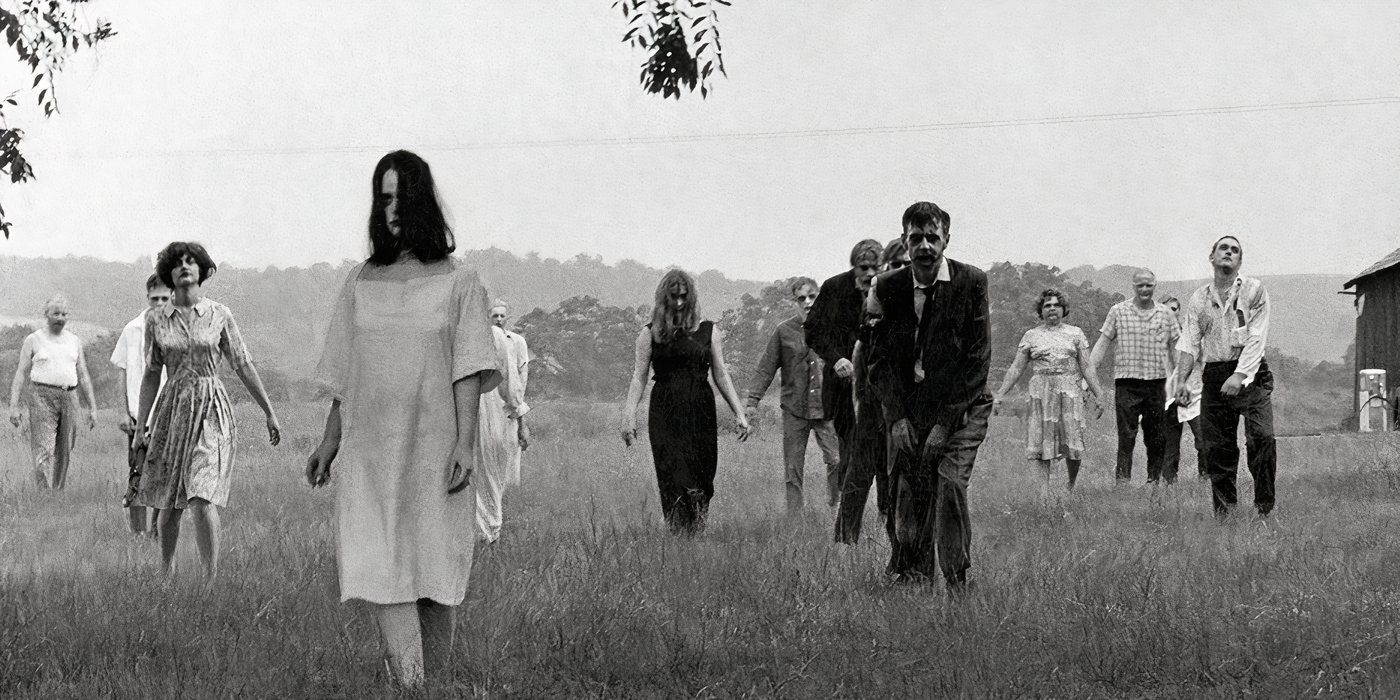
Night of the Living Dead is the first true zombie film that launched a thousand imitators, and ranks alongside Psycho and Rosemary’s Baby as being one of the most influential horror classics of the 1960s. The conversation about the great zombie director of all-time begins and ends with George Romero, whose inventive take on slow-moving, sickly creatures with mangled autonomy was the precedent for which the modern perception is based. That Night of the Living Dead was Romero’s first feature is remarkable, as he had previously only worked on industrial films and television productions. This had given him a background in the technical proficiency and workmanlike quality needed to make a horror film that felt more authentic than the stylized Hammer horror classics that had begun in the ‘50s.
Night of the Living Dead is also a deeply political film that used the collapse of society to analyze the fractured state of American politics during the Cold War, with the black-and-white imagery of the zombies themselves generating stark parallels to the wartime photography that had been captured of the conflict in Vietnam. Night of the Living Dead also positioned a tough reality for the Civil Rights era in which privilege and class would not offer an protection during an apocalyptic scenario, with the casting of Duane Jones as one of the first Black leads in an American horror film being unprecedented. It remains as harrowing as ever, and should serve as an inspiration to any up-and-coming independent filmmakers who strive to do something original on a low-budget.
3 ‘Dawn of the Dead’ (1978)

Dawn of the Dead had the challenge of coming out after there had already been dozens of Romero ripoffs, and it also had to set up an entirely new cast of characters because of the tragic ending of the original. Romero had gotten more seasoned as a filmmaker in the time since, and he was able to take the franchise in the logical next direction by showing an extreme scenario of American infrastructure collapsing on itself in the wake of a pandemic that causes mayhem and collapse. It’s fitting that a mall, the ultimate symbol of capitalism, is the place in which the survivors hide because it is the ultimate transparent abyss that has sucked out the personality or essence of their humanity. Dawn of the Dead had more advanced gore effects because of the increased budget, but it also showcased Romero’s unique sense-of-humor; it predated the more self-aware direction that the entire horror genre would go in the next decade thanks to the “splatter” films of Sam Raimi and Peter Jackson, both of whom cited Dawn of the Dead as an inspiration.
Dawn of the Dead helped to crystallize a franchise that has now gone into multiple different directions with alternative offshoots, remakes, and spinoffs due to the unusual situation involving the rights. Romero’s 1985 sequel Day of the Dead is not only the best of them all because it takes another new spin on where zombies could hide out (this time they’re underground as humanity flees the surface), but continued the sociopolitical commentary with a damning condemnation of militarism during the Ronald Reagan administration. As surprising as it might seem now when looking at his other work, Zack Snyder directed a fantastic 2004 remake of Dawn of the Dead that stripped the premise down to its core for a gritty, nasty funhouse of carnage that solidified Sarah Polley as a great lead.
Collider Exclusive · 8 Questions · 2 Minutes What Is Your Biggest Horror Nightmare? Elm Street · Chucky · Scream · The Conjuring
Four horror franchises. Four completely different ways of scaring you. One waits until you fall asleep. One makes sure nobody believes you. One is already in your group of friends. And one is in the house with your family. Answer eight quick questions about how you actually watch horror, and find out which nightmare was built for you.
😴Elm Street(Freddy Krueger)
🧸Chucky(Child's Play)
📞Scream(Ghostface)
🕯️The Conjuring(The Warren Files)
01
Which horror scene makes you cover your eyes? Four classic images. One of them is worse than the others for you.
02
You are home alone and you hear a noise. First thought? Everybody has one. It arrives before you have decided anything.
03
Which horror movie rule would you break first? Everybody thinks they would survive. Almost nobody actually does.
04
Something genuinely frightening happens. What do you do? Not in a film. In your actual living room, tonight.
05
How do you actually watch a horror film? Be honest about this one. Nobody is checking.
06
Somebody offers you serious money. Which do you still refuse? The amount does not matter. There is one on this list you are not doing.
07
Which feeling stays with you a week after the film? Good horror does not stop when the credits do.
08
Something wakes you at 3am. What is the worst possibility? Eight questions in, this is the one that decides your nightmare.
The Lights Just Went Out Your Nightmare Is…
Four franchises, four completely different ways of getting underneath your skin. This is the one built out of your particular fear, why it works so well on you, and what it would leave behind.
Elm Street
Your nightmare does not wait outside the door. It waits for you to close your eyes, which you are going to have to do eventually, because nobody has ever won that particular argument.
- Freddy is horror's cruellest idea: a threat that lives in the one place you cannot guard, cannot lock, and cannot avoid forever.
- You are the one who is fine during the film and wide awake at two in the morning. Your own head is where this does its damage.
- These films understood exhaustion as a horror engine. The kids on Elm Street do not lose because they are weak. They lose because they are tired.
- You can lock every door in the house. You still have to sleep.
Chucky
Your nightmare is not really the doll. It is the face of the person you tell, and the way they decide, very kindly, that you have imagined all of it.
- Chucky works precisely because he is absurd. That is the trap: the more accurately you describe him, the less anybody is going to believe you.
- You are the one shouting at the screen because the characters are not listening. You know that feeling from real life too.
- The franchise is at its best when the adults in the room are the real obstacle, and you have met those adults.
- By the time somebody finally believes you, you will have handled most of it on your own.
Scream
Your nightmare has your number, knows your name, and has almost certainly been inside your house before. The worst part is that you already know them.
- Scream is the only one of these where the killer takes the mask off and turns out to be somebody who was at the party.
- You are the person who calls the twist out loud before it lands. You watch people the same way you watch films.
- The franchise made the rules of horror part of the plot, which means the survivors are the ones paying attention. You would be paying attention.
- Everybody is a suspect, including the person who just offered to walk you home.
The Conjuring
Your nightmare is not really about you. It is about the people asleep down the hall, and the feeling that whatever is here is not interested in leaving.
- The Conjuring films are domestic horror. The house, the family, the perfectly ordinary room that quietly stops feeling ordinary.
- Your instinct is to get everybody into one room. Your fear is protective rather than personal, which is rarer than it sounds.
- This is the one franchise where belief is the weapon. The people who come through it are the ones who are not alone and refuse to be.
- Whatever is here did not come for you. It came for the household, and you are the one standing in the hallway.
2 ‘28 Days Later’ (2002)

28 Days Later was the reset that zombie cinema needed because Danny Boyle was the right filmmaker to experiment with the emerging format of digital technology. By creating a nearly voyeuristic, “fly-on-the-wall” visual style that gets up close and personal with England in the aftermath of the breakout of a “rage virus,” Boyle created a realistic portrayal of how society might fold. It was a sharp criticism of how isolationism, polarization, and xenophobia had taken hold of Britain in a way that was damaging to the future, and Boyle didn’t know at the time how right he would become; 28 Days Later not only presents more than a few unnerving parallels to the COVID-19 pandemic, but anticipated some of the political discourse that would fallout in the aftermath of Brexit. At the same time, 28 Days Later still works as an effective survival thriller because it presented a group of likable protagonists, including Cillian Murphy in one of his breakout roles.
28 Days Later has turned into one of the best modern horror franchises because each entry is entirely unique and attacks the same ideas from a different perspective. Although 28 Weeks Later might be the weakest because it is the only one that was not penned by Alex Garland, it does include a remarkable performance by Robert Carlyle and has one of the most terrifying opening scenes in all of contemporary horror. 28 Years Later is a masterpiece that parallels the path of post-2016 Britain, while also showing a deeply moving coming-of-age story about a young boy coming to grips with truths about his parents that he had not previously been ready to accept. While 28 Years Later: The Bone Temple has sadly not been a success at the box office, Nia DeCosta made a chilling cult thriller that is bound to be reclaimed in the years to come by the horror community, if for no other reason than its inclusion of the best needle drop of 2026.
1 ‘Shaun of the Dead’ (2004)
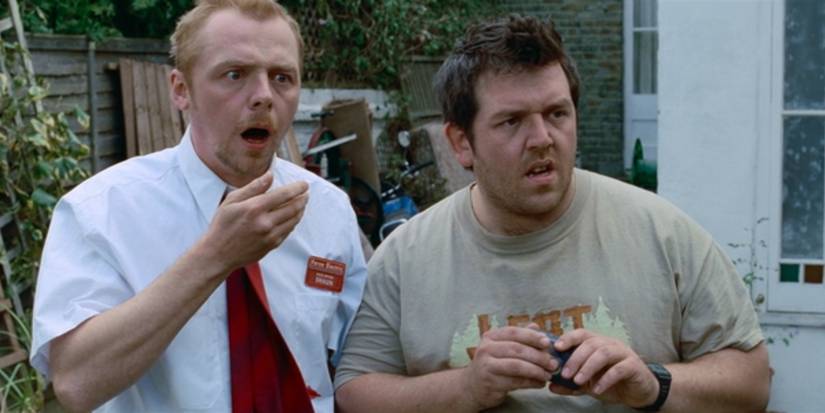
Shaun of the Dead is more than just a parody, even if it is more than obvious that Edgar Wright has a deep affinity for all things related to Romero. It’s a savvy social satire that examines how humanity has become “zombiefied” because of its self-imposed constraints, but more importantly offers a deeply affecting portrayal of friendship. Real-life best friends Simon Pegg and Nick Frost couldn’t have had better chemistry, and the same mix of popular culture references and crude humor that they had mastered with Wright on the cult television series Spaced was added perfectly into an absurdist zombie adventure. Shaun of the Dead has so many hidden jokes and allusions that it can be rewatched multiple times just to pick up them all.
Shaun of the Dead threads the needle between comedy and horror in a very sharp way that few other films of its nature have been able to master. The actual horror is legitimately upsetting, and not necessarily because of the violence; it gets into repressed emotions and acknowledged anxieties in a way that few “Oscar bait” films do. When the comedy does turn around, it’s both a cathartic way to break the tension and a charming way to drop in on characters who forge an actual connection with the audience.
KioskNews shows a cleaned-up reading view extracted from the publisher’s page — the original always lives on their site, not ours.