Car, Government job, free food: Study flags 13% ‘inclusion error’ in PM Garib Kalyan scheme
An evaluation study commissioned by the Centre has found a 13.2 per cent “inclusion error” among beneficiaries of its free foodgrain scheme, Pradhan Mantri Garib Kalyan Anna Yojana (PMGKAY), under the National Food Security Act (NFSA) 2013.
The study, conducted during the financial year 2025-26, has found that several households that do not meet the prescribed eligibility criteria set by states continue to receive free foodgrains. These include households owning assets such as houses with three or more rooms, cars and air conditioners, as well as those with family members employed in government jobs.
The study, commissioned by the Department of Food and Public Distribution (DFPD), covered 51,303 beneficiary households across rural and urban areas in all 36 states and Union Territories.
It found that the inclusion error rate — or share of those not eligible for free foodgrains — was much higher than the national mark in several states, with West Bengal topping the list (39.5 per cent), followed by Tripura (39.2 per cent) and Tamil Nadu (38.7 per cent).
In states with high inclusion errors, the study found that the top contributing factors include households having pucca houses with three or more rooms, air conditioners, motor vehicles and government jobs (see chart).
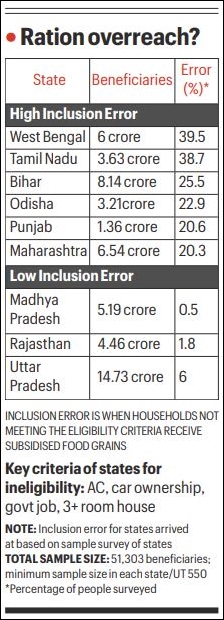
The study does not provide a state-wise break-up of the total sample size of 51,303 beneficiaries, but says that a minimum of 550 beneficiaries per state and Union Territory were selected. It defined “inclusion error” as the “households that do not meet the prescribed eligibility criteria continue to receive subsidised food grains”.
The findings are significant as the Centre’s food subsidy stood at Rs 2.28 lakh crore, almost half of the total subsidy bill of Rs 4.69 lakh crore, during the financial year 2025-26.
Story continues below this ad
The DFPD functions under the Ministry of Consumer Affairs, Food and Public Distribution, and administers the food security law. The Department did not respond to an emailed questionnaire from The Indian Express on the study’s findings.
Under the NFSA, the government provides food security to 75 per cent rural and 50 per cent urban households. In absolute terms, the maximum number of people who can be covered by the Act is about 81.35 crore, with the figure at 78.63 crore as of October 2026.
“Under NFSA, an inclusion error occurs when households that do not meet the prescribed eligibility criteria continue to receive subsidised food grains. Assessing inclusion errors is important for understanding the effectiveness of beneficiary identification systems and the extent to which programme benefits reach intended vulnerable households,” the report, which was submitted to the Food Department recently, stated.
“The concurrent evaluation estimates the overall inclusion error of 13.2% under NFSA. The analysis indicates rural-urban variation, with inclusion error rates of 12.5% in rural areas and 15.6% in urban areas, suggesting broadly consistent targeting performance across geographies. Across beneficiary categories, AAY households exhibit a slightly lower inclusion error (12.2%) than PHH households (13.4%), with a marginally higher error among PHH households in urban areas (15.7%),” it said.
Story continues below this ad
AAY households refer to families covered under the Antyodaya Anna Yojana (AAY), which constitute the poorest of the poor and are entitled to 35 kg of foodgrains per household per month. Priority Households (PHH) are entitled to 5 kg of foodgrains per person per month.
“Overall, while variation remains modest, these findings highlight the importance of strengthening beneficiary identification systems, periodic database validation, and dynamic updating mechanisms to further improve targeting efficiency under the NFSA,” it said.
The report’s findings show that eastern and northeastern states have the highest intensity of error rates. “Some states, including West Bengal (39.5%), Tamil Nadu (38.7%), Tripura (39.2%), and Meghalaya (28.5%), exhibit very high inclusion errors. These findings suggest the need for continued strengthening of eligibility validation, Aadhaar seeding, and periodic reviews of beneficiary databases,” the report said.
“States including Bihar (25.5%), Odisha (22.9%), Sikkim (21.9%), Punjab (20.6%), and Maharashtra (20.3%) show moderate-to-high inclusion errors, indicating partial system inefficiencies… States such as Madhya Pradesh (0.5%), Jammu & Kashmir (0.3%), Haryana (1.0%), Delhi (1.0%), and Rajasthan (1.8%) exhibit low inclusion errors, reflecting stronger targeting frameworks, better digitisation, and more effective beneficiary validation systems,” it said.
Story continues below this ad
“A clear regional trend emerges in eastern and north-eastern states, such as West Bengal, Tripura, and Meghalaya, which exhibit higher inclusion errors, while northern and western states (e.g., Haryana, Rajasthan, and Gujarat) perform relatively better, suggesting differences in governance capacity, data systems, and implementation rigour,” it said.
According to Section 9 of the food security law, the overall number of beneficiaries is determined by the Centre but under Section 10, the responsibility for identifying households on the ground and preparing guidelines for it lies with the states.
The beneficiary identification criteria differ from state to state. “The estimation of inclusion errors in this study is based on the eligibility criteria defined by individual States and Union Territories. While overall NFSA coverage is centrally determined, States are responsible for identifying eligible households using criteria that vary across jurisdictions. These criteria generally include income thresholds, asset ownership, landholding, employment and tax status, and other exclusion filters,” the report states.
The report attributes inclusion errors to “variations in the design, scope, and updating of eligibility criteria across States”.
Story continues below this ad
“Accordingly, a household is classified as an inclusion error if it does not meet the eligibility criteria specified by the respective State despite being included in the beneficiary list. Variations in the design, scope, and updating of eligibility criteria across States are likely to influence inclusion error rates and targeting outcomes under NFSA. Inclusion errors across rural and urban areas provide additional insights into the spatial dimensions of beneficiary targeting under NFSA,” it said.
The NFSA, introduced by the then UPA government in July 2013, entitles 67 per cent of households to food grains at a subsidised price (rice Rs 3/kg, wheat Rs 2/kg) under the Targeted Public Distribution System (TPDS). The NDA government subsequently waived the subsidised prices under PMGKAY, providing free food grains. Last year, the Centre launched an exercise flagging ration card holders who receive free food grains, but are either taxpayers, car owners or directors in companies.
KioskNews shows a cleaned-up reading view extracted from the publisher’s page — the original always lives on their site, not ours.