Who’s who in Shenzhen: the priorities revealed by Xi-Trump-Putin summit rosters
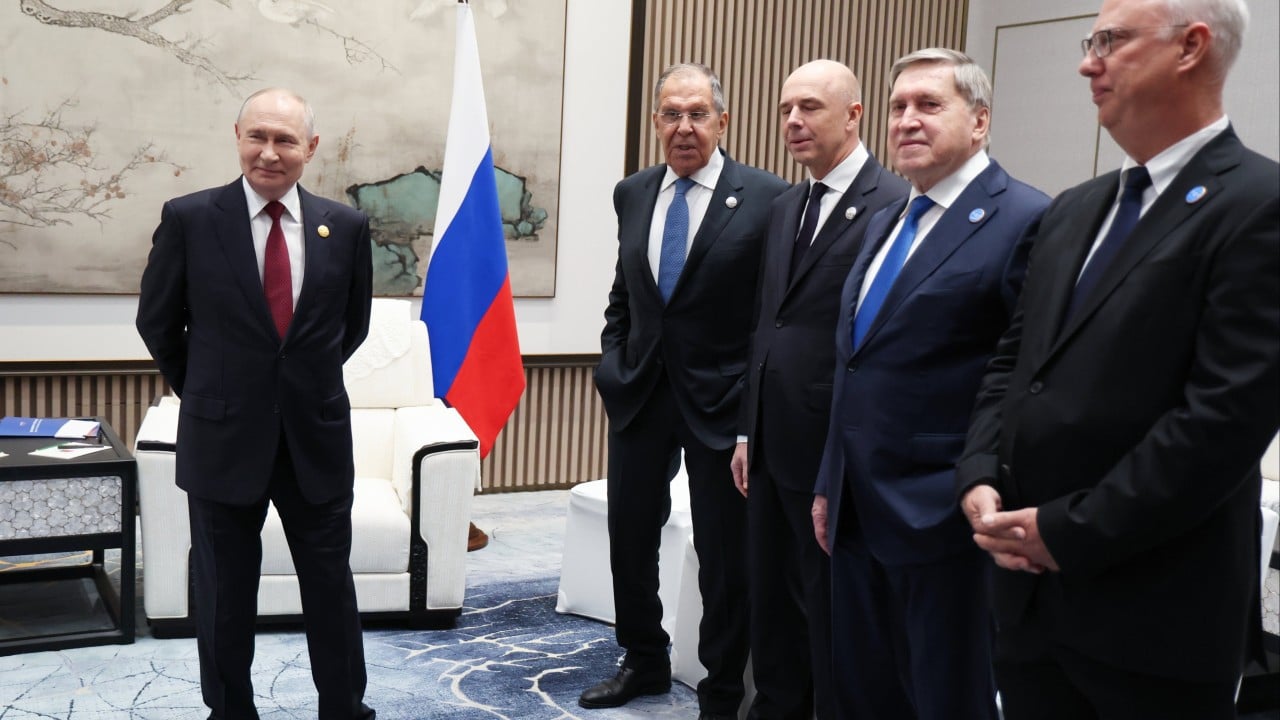
In high-stakes summitry, seating charts and delegation rosters often speak louder than boilerplate communiques.
And, as the unprecedented China-US-Russia trilateral meeting unfolds in Shenzhen, the strategic agendas of the three powers can be discerned by the security and economic tsars, top diplomatic strategists and influential technocrats flanking the three leaders.
Chinese President Xi Jinping and his counterparts Donald Trump and Vladimir Putin met on the sidelines of the Asia-Pacific Economic Cooperation leaders’ forum in southern China on Thursday.
Xi, Trump and Putin were seated at a round table for the historic meeting, with all the supporting staff in the background.
Xi was accompanied by his closest party gatekeepers, including his security apparatus chief and veteran diplomatic hands – a line-up that highlighted the multidimensional nature of the trilateral summit’s agenda.
Xi’s inner circle and policy heavyweights
According to state media outlets, in top place of the ruling Communist Party hierarchy sat Cai Qi, a member of the Politburo Standing Committee and Xi’s chief of staff – a trusted lieutenant overseeing the operation of the party’s top echelon and China’s security affairs.
Also present on the Chinese side were two Politburo members: Foreign Minister Wang Yi, China’s top diplomat, and Vice-Premier He Lifeng, Beijing’s point man on economic and trade affairs.
Earlier at Kylin Villa, the lakeside resort in Shenzhen’s northwest, Xi and Putin held more than two hours of talks on Wednesday across two distinct formats: a 13-a-side expanded session followed by a closed-door working breakfast with just two aides per leader.
02:39
Xi and Putin pledge to maintain stable ties and global order ahead of trilateral meeting with Trump
When the talks narrowed to the restricted working breakfast, Beijing’s bench was reduced to Cai and Wang, underscoring their standing as Xi’s principal domestic and diplomatic gatekeepers.
Beijing’s presidential coordination and policy deliberation units were represented at Thursday’s trilateral summit by Tang Fangyu, director of the party’s Central Policy Research Office, and Lu Luhua, secretary to the president.
Reflecting the strategic importance of economic ties among the three powers, Xi also brought a slate of financial and commercial chiefs: National Development and Reform Commission chairman Zheng Shanjie, Finance Minister Lan Foan – also chairing the Apec finance ministers’ meeting – and Commerce Minister Wang Wentao.
Rounding out the Chinese side were deputy foreign minister Ma Zhaoxu, along with Xie Feng and Zhang Hanhui, ambassadors to Washington and Moscow, respectively, and the host province’s top official – Politburo member and Guangdong party secretary Huang Kunming.
Washington trade hawks and new operations chief
The US delegation reflected a markedly different structure. Five cabinet-level foreign policy, trade and economic principals were paired with a tight-knit circle of White House operational and communications loyalists.
On the policy side, Washington’s line-up was anchored by Secretary of State and national security adviser Marco Rubio.
Putin expects ‘big potential benefits’ from meeting with Trump and Xi
Alongside him were the four heavyweight officials driving Washington’s China policy, including tariffs, industrial and macroeconomic strategy: Treasury Secretary Scott Bessent, Commerce Secretary Howard Lutnick, US Trade Representative Jamieson Greer and US ambassador to Beijing David Perdue.
Also present was a dense concentration of senior White House staff led by newly appointed assistant to the president and White House chief of staff Stephen Miller and his deputy Dan Scavino.
The remainder of the US roster serving in the background underscored the tight logistical, protocol and messaging control around the presidency.
They included Beau Harrison, who oversees operations, as well as White House communications director Steven Cheung and staff secretary Ben Moss, along with speechwriting director Ross Worthington, Oval Office operations director Walt Nauta, and director of the chief of staff’s office and deputy assistant to the president Alina Bulazel.
Also present on the working team were special assistants to the president Chris Ambrosini and Margo Martin – who also serves as a communications adviser – as well as executive assistant to the president Natalie Harp and US chief of protocol Monica Crowley.
Moscow’s security, economic technocrats
Putin fielded a calibrated delegation blending foreign policy and security veterans with the technocrats entrusted with steering Russia’s sanctions-tested economy and bilateral ties, according to presidential assistant Yuri Ushakov’s announcement on Monday.
On the diplomatic and security front, Putin was accompanied by the veteran Foreign Minister Sergey Lavrov as well as Defence Minister Andrey Belousov and foreign policy aide Ushakov.
The Kremlin’s administrative and messaging power was represented by two deputy chiefs of staff from the Presidential Executive Office: economic strategist Maxim Oreshkin and presidential press secretary Dmitry Peskov.
Economic, fiscal and energy cooperation formed the core of the ministerial contingent, led by three deputy prime ministers – Tatyana Golikova, Dmitry Chernyshenko and Anton Siluanov, who also serves as finance minister – alongside Economic Development Minister Maxim Reshetnikov and Energy Minister Sergey Tsivilev.
Moscow also signalled an emphasis on non-security exchanges by including Health Minister Mikhail Murashko, Science and Higher Education Minister Valery Falkov and Culture Minister Olga Lyubimova.
For Thursday’s closed-door working breakfast opposite Cai and Wang, Putin retained only Lavrov and Ushakov, relying on the seasoned pair to handle the most sensitive strategic discussions.
Taken together, the three rosters illustrate the dual nature of the diplomacy unfolding in Shenzhen.
While expansive economic and ministerial benches point to intensive wrangling over trade, finance and industrial policy, Washington’s reliance on an insular White House core – and the retreat by Beijing and Moscow into two-aide breakfast sessions – suggests the decisive geopolitical bargains remain tightly held at the very top.
KioskNews shows a cleaned-up reading view extracted from the publisher’s page — the original always lives on their site, not ours.