Hotter than hot: Deep-sea vent worms hold key to studying fragile human proteins
SINGAPORE – Many important human proteins are too unstable to study, as they break down easily when removed from the protective environment of a living cell.
But a team of scientists, including one from Singapore, came up with a solution by turning to hydrothermal vent worms for a clearer look at the microscopic machinery of life.
These giant tube worms do not just survive in the pitch-black depths of the Pacific Ocean, where superheated water gushes from cracks in the seafloor. They flourish.
Because their proteins are more robust and stable under extreme pressures and temperatures, the scientists used them to solve a decades-old mystery of how actin filaments form. These proteins found both in the worm and in humans build a cell’s internal framework and drive movement.
“They live in a sort of completely different world from us, where all of our energy comes from the sun. But theirs comes from under the earth and from the sulphur compounds there. Because of their unusual lifestyle, they’ve adapted their own bodies, their biochemistry to live in hot water,” explained Adam Claridge-Chang, an associate professor with the Signature Research Programme in Neuroscience and Behavioural Disorders at the Duke-NUS Medical School.
This made them valuable as models in the study of human proteins because “they are complex animals, unlike heat-loving bacteria, which are single-celled microbes that lack the many complex systems found in humans”.
Claridge-Chang said the worms bridge the gap between the two because their proteins stay stable and functional under extreme heat, crushing pressure and toxic conditions.
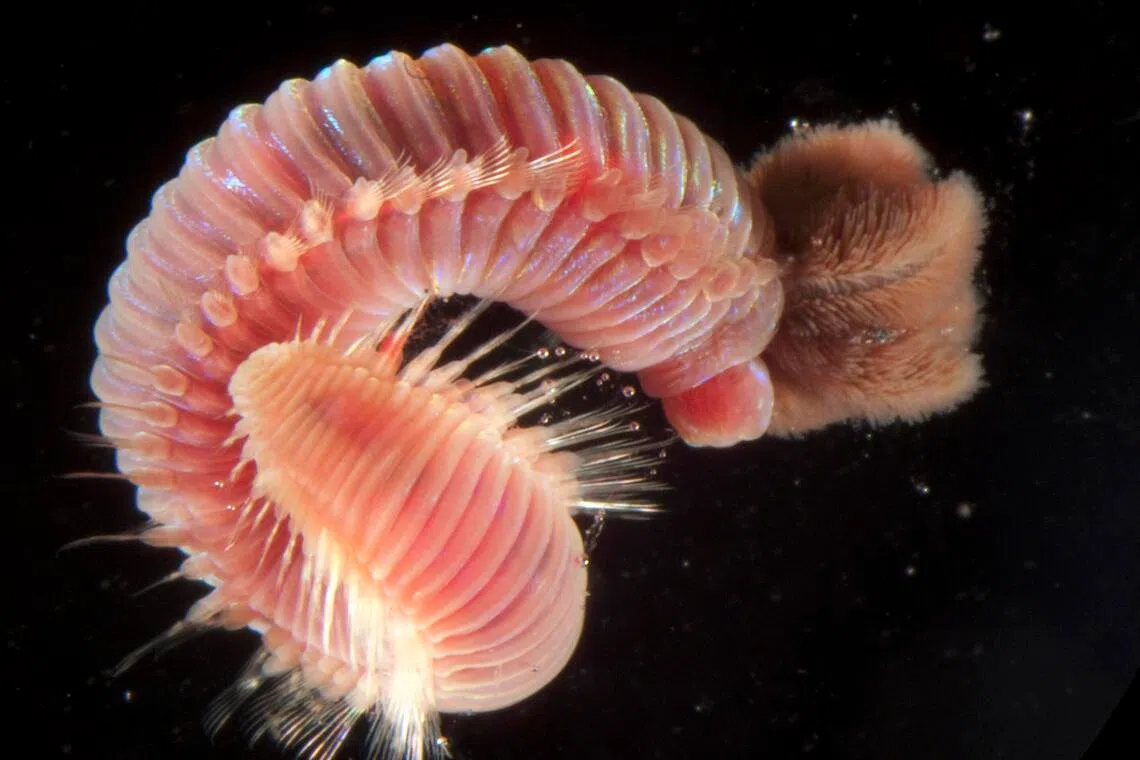
A hot vent worm, a deep-sea marine worm that lives and flourishes near hydrothermal vents on the dark ocean floor.
PHOTO: GEOFFREY DILLY, CALIFORNIA STATE UNIVERSITY CHANNEL ISLANDS
“(Biochemists) tend also to carry out experiments in the cold room. They try to bring the ambient temperature down to a point where the protein becomes stable. It is sort of like butter. At room temperature, butter melts, but in the fridge, it is firm. Proteins are a little bit like that.
“The problem here is that sometimes even a cold room is not cold enough to stabilise the protein, and should you want to go below 4 degrees, then water starts freezing, making it very difficult to do anything,” he said.
“So I thought some years ago that if there are thermophilic bacteria and thermophilic yeast, surely there is a thermophilic animal which the biomedical research community really wants to study without having to be in freezing conditions.”
Claridge-Chang collaborated with a team of marine biologists and genomicists – scientists who study an organism’s genome. They include chief expedition scientist Nadine Le Bris from Paris-Sorbonne University, who harvested and provided the specimens for the 2025 genome study of the hydrothermal vent worm.
The research team relied on deep-sea submersibles equipped with robotic manipulator arms and specialised pressurised or thermally insulated collection chambers to harvest these worms.
Claridge-Chang told The Straits Times that the worms live about 2,500m below the surface on the walls of scalding underwater chimneys, which means no humans could dive under to collect them.
“During the expeditions, a manned submersible was deployed to the vent sites along the East Pacific Rise and the pilots used the articulated robotic claws to carefully scrape or pluck chunks of worm tubes directly off the mineral walls of the active chimneys,” he said.
But only the smaller worms were harvested because the extreme decompression, loss of toxic vent chemical and thermal shock would rapidly kill the larger mature ones.
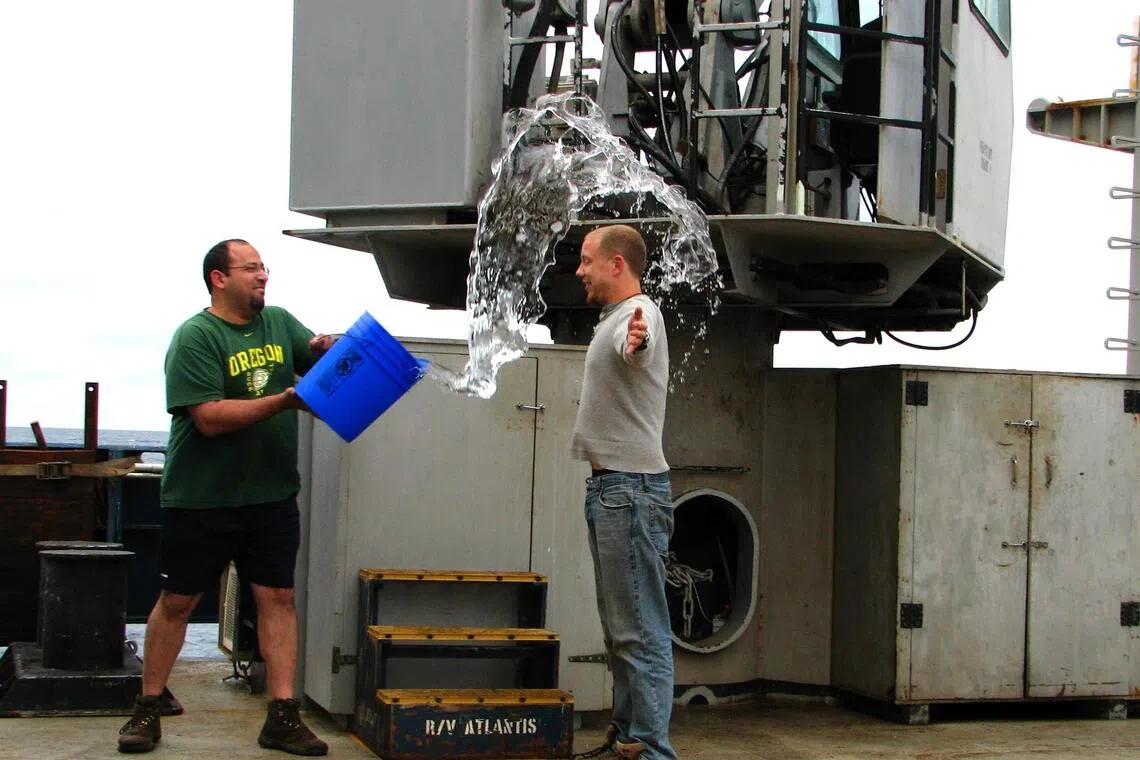
Marine ecophysiologist Geoffrey Dilly was "baptised" on his first dive in the Pacific Ocean.
PHOTO: GEOFFREY DILLY, CALIFORNIA STATE UNIVERSITY CHANNEL ISLANDS
To prevent the vent worms from dying from the massive shifts in temperature and pressure, they were placed by the robotic arm into sealed, thermally insulated “bioboxes” on the submersible to shield them from temperature shock during the ascent.
The worms were kept alive inside a high-pressure chamber directly on the seafloor to maintain their native deep-sea pressure until they reach the ship’s lab.
Claridge-Chang said one of the things that was not known was how a monomer, a small molecule, actually forms into a polymer or a bigger molecule.
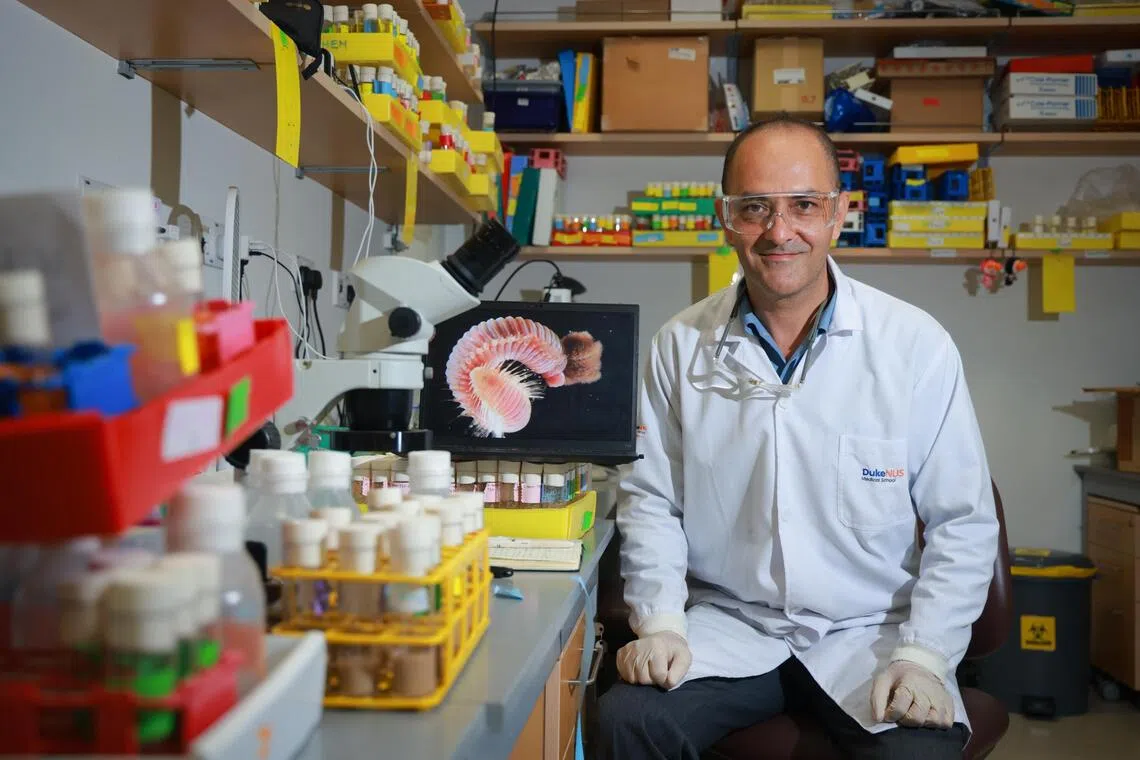
Adam Claridge-Chang said scientists will be able to look into the slowing of age-related degeneration and controlling abnormal cell growth in cancer.
ST PHOTO: JASON QUAH
By sequencing deep-sea vent worms and using their proteins for a structural study, an international, cross-institutional team of scientists was able to discover and capture the first detailed picture of how actin, a key structural fibre inside all animal and plant cells, gets built.
Supported by a Human Frontiers Science Programme grant, the team published two complementary papers in 2025 on the hot vent worms living at the bottom of the Pacific Ocean, showing the understanding of both extreme life and fundamental processes in animal proteins.
“The process of actin nucleation has been a decades-long mystery because it was too unstable to observe until now. Since then, we have unravelled how a single, brand-new filament of actin first starts.
“And with the valuable insights provided by the worms, we will soon be able to look into the slowing of age-related degeneration and controlling abnormal cell growth in cancer,” Claridge-Chang said.
KioskNews shows a cleaned-up reading view extracted from the publisher’s page — the original always lives on their site, not ours.