India wins Women’s Asian Champions Trophy, but poor organisation leaves a sour aftertaste
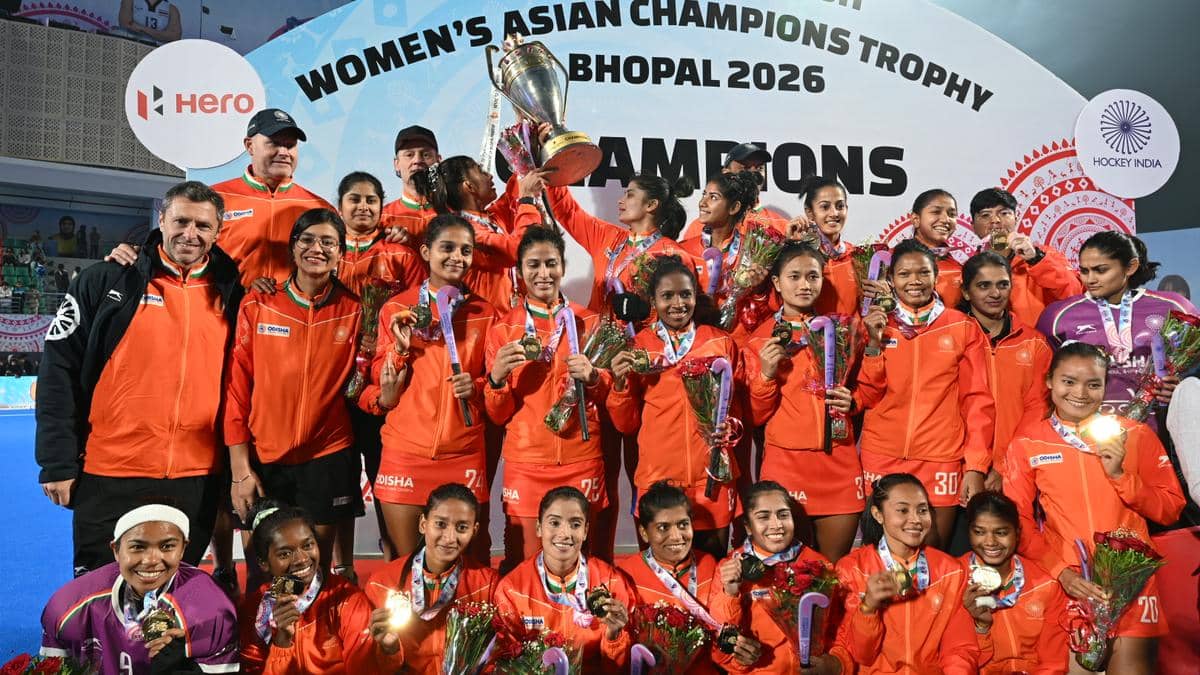

Winning the Women’s Asian Champions Trophy was the perfect end to the calendar year as India climbed up to fourth in the world rankings – its best-ever position. | Photo Credit: Special Arrangement

Winning the Women’s Asian Champions Trophy was the perfect end to the calendar year as India climbed up to fourth in the world rankings – its best-ever position. | Photo Credit: Special Arrangement
After the confetti had settled and the fireworks had faded, the victorious Indian women’s team were mobbed by enthusiastic locals on the pitch, who wanted to make the most of the opportunity to get closer to their heroes. They scrambled to find any possible belongings – phone cases, pieces of paper, shirts and, in some cases, even their hands – hoping to get an autograph from the newly crowned Asian Champions Trophy (ACT) winners.
While the coaching staff will have several key areas to assess and take stock of following the tournament, these final moments of adulation may well prove to be the enduring memories for several players of this team.
The likes of Sakshi Rana, Ishika, Lalthantluangi, Puja Sahoo and Bansari Solanki all played their first senior international tournament on home soil in front of capacity crowds at the new International Sports Complex. Throughout the tournament, they received the reception of rockstars, and they played like them, too.
Following its Asian Games gold last month, this was an opportunity for the Indian team to build on its newfound status as a top team and show it wasn’t a one-off success. Not only did it prove that it could sustain its momentum, extending its winning streak to 15 matches, but it did so with authority. It was the perfect end to the calendar year as India climbed up to fourth in the world rankings – its best-ever position.
Admittedly, the ACT did not have the strongest field in terms of competition – China rested all but one of its 20-member Asian Games roster. Yet, India still needed to get the job done as the host. According to Sjoerd Marijne, coming in with the top billing brought its own pressure.
Still, it stayed perfect in all the seven matches, scoring 32 while conceding just seven. In those seven games, it trailed just twice, once in the opener for 42 seconds and then in the final for 12 minutes.
The results were accentuated by the team’s scintillating attacking brand of hockey at high intensity. The performances were also a remarkable testament to their fitness levels, considering that at least 11 players have featured in five tournaments this year, spread across five countries.
India, too, fielded an experimental squad with several new faces added to the mix, including Mumtaz Khan, Jyoti Singh, Puja and Solanki. Although Marijne retained the core of his Asiad-winning squad, six of them still had fewer than 50 international caps.

Nineteen-year-old Puja has emerged as a drag-flick candidate, scoring on her debut and coming close in other matches. | Photo Credit: Special Arrangement
For Marijne, the key objectives were to increase squad depth and build a multi-dimensional playing group with a focus on player versatility. More importantly, he wanted to test these methods in a tournament setting.
Ishika and Rutuja Pisal adapted well to their new midfield roles; Sakshi slotted into a deeper midfield position in the absence of Neha Goyal in the opening two matches. Meanwhile, the senior pro Nikki Pradhan switched over to defence to aid the newcomers as their guiding voice at the back.
In attack, Deepika’s form from penalty corners since the Asian Games continues to be a source of encouragement. The forward has scored 30 goals from short corners in her last 14 games, which is more than what she managed (25) in her previous 75 outings.
Puja, 19, has also emerged as a drag-flick candidate, scoring on her debut and coming close in other matches. But what will please Marijne even more is her passing range from deeper areas, particularly with her aerials and slap passes, which can prove valuable in breaking lines and bypassing the opposition press. Her passing was key to India earning the short corners in the third quarter in the final against China, which were both converted by Deepika.

Deepika (middle) has scored 30 goals from short corners in her last 14 games, which is more than what she managed (25) in her previous 75 outings. | Photo Credit: Special Arrangement
For Marijne, it was important that his team reacted strongly in front of an expectant and over-eager home crowd, who were seeking any possible vantage point to catch a glimpse of the action. “I saw crazy Indian things, like when people climbed onto the other side [roof] and behind the goal. That’s what makes it crazy,” he said with a smile.
While such scenes highlighted the interest in top-level sport, they also brought to attention one of the sore points of the tournament due to the poor organisation and lack of security arrangements in place. Fearing a lack of interest, the Madhya Pradesh government and Hockey India announced free entry for the entire duration of the tournament.
That decision, however, contributed to severe overcrowding in the stands for the last five matchdays, with little regulations in place to check the flow of supporters into the complex. The title decider narrowly avoided a stampede situation in the vomitories, while in the stands, supporters were seen perilously hanging by the railings.

Free entry for the matches meant that there was severe overcrowding in the stands for the last five matchdays. | Photo Credit: A.M. Faruqui
“We did not expect so many people to come so far away from the city,” an official from the tournament said on Wednesday, yet they couldn’t come up with better planning for the day of the final.
At times, it appeared as if the tournament organisers’ priorities lay more in using the competition as a vehicle for scoring political points rather than in celebrating the sport itself. While they went into overdrive with the promotional activities, Salima Tete and her team have largely been ignored in them. The city’s multiple promotional posters and cutouts featured political figures and a concert, rather than the key protagonists – the athletes.
Perhaps that’s why what happened at the end of the final hooter mattered. When the confetti had settled, it was the Indian players who were sought after by the supporters.
Published on Nov 29, 2026
Latest on Sportstar
Live Blog 2026-11-29T03:00:00+05:30
India vs New Zealand, 2nd Test Day 3 LIVE score: Conway, Ravindra stabilise; NZ 84/2 (27), leads by 194 runs- India wins Women’s Asian Champions Trophy, but poor organisation leaves a sour aftertaste
- Elche vs Atletico Madrid player ratings — Alvarez grabs winner as Los Rojiblancos sit second in La Liga
KioskNews shows a cleaned-up reading view extracted from the publisher’s page — the original always lives on their site, not ours.