Switzerland votes to reject ‘perpetual and armed’ neutrality: What it means
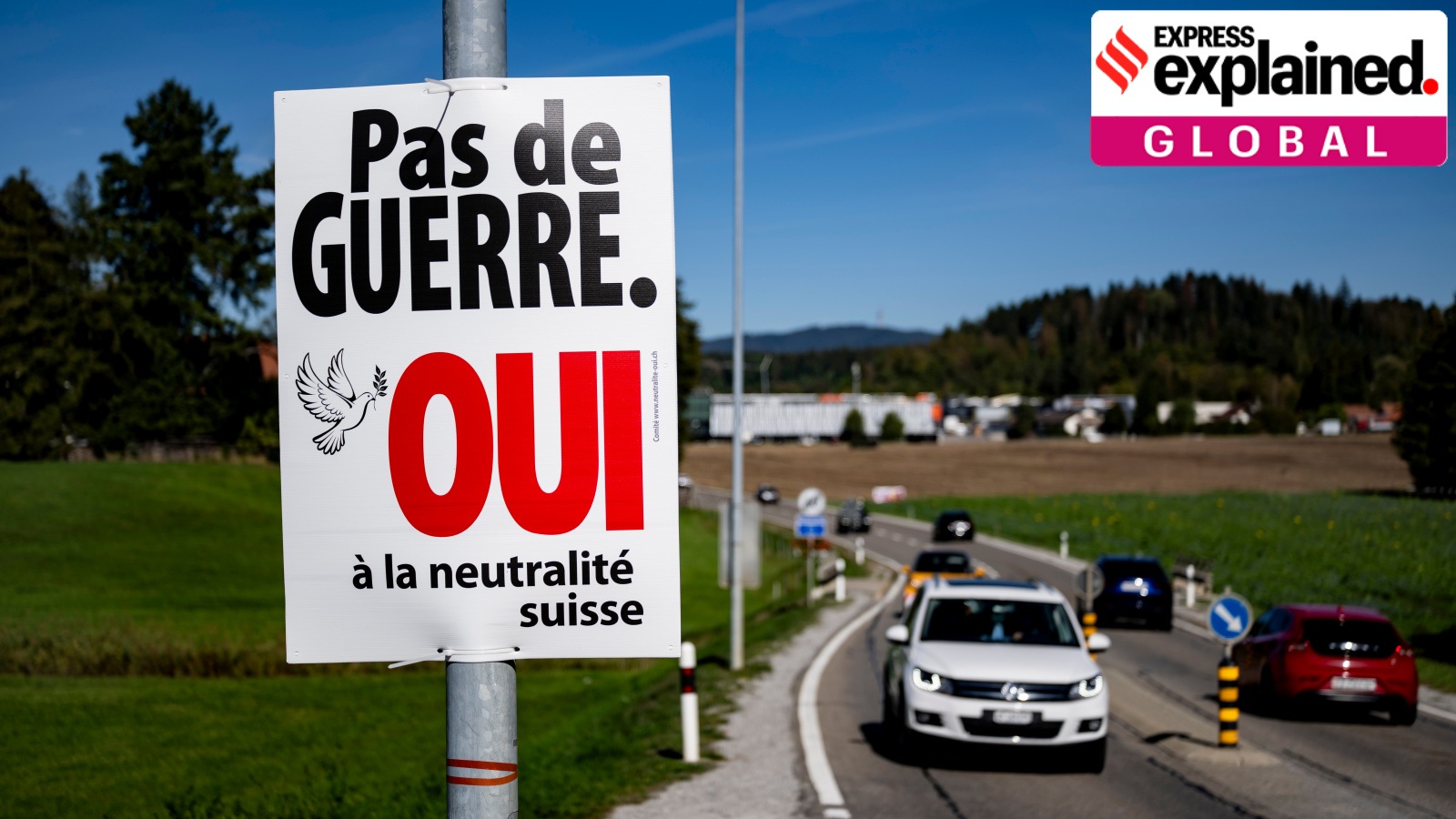
On September 27 (Sunday), voters in Switzerland rejected a proposal — referred to as the ‘Neutrality Initiative’ — that advocated for a stricter definition of Swiss neutrality. The referendum asked whether the country wished to support the insertion of an article into its Federal Constitution that would require a stricter practice of neutrality.
All 26 cantons (administrative divisions in Switzerland) rejected the proposal. The turnout for the national referendum was 47.06%, of which 70.15% of the voters were against the initiative, according to the Financial Times.
What were the changes the initiative proposed and how would that have affected the flexibility the country has historically afforded its neutral status? We explain.
First, how does one understand Swiss neutrality?
The Battle of Marignano (1515) concluded with the Swiss confederacy at the time, suffering a humiliating defeat at the hands of the French. This led to their retreat from greater power politics in the region.
Centuries later, the Act of the Swiss Confederation at the Congress of Vienna in 1815 guaranteed the inviolability of Swiss territory. The rules governing neutrality, however, were codified during the Hague Conventions of 1907. Under international law, a neutral state had to adhere to the following during an armed conflict:
- It cannot engage in military conflicts between other states.
- It cannot supply state-owned military aid or troops to warring nations. However, under the Hague Conventions, a neutral state is not required to ban private arms manufacturers from exporting weapons, provided the government applies any export restrictions equally to all warring parties.
- It must not allow its territory, airspace or waters to be used by foreign armies for transit.
Today, the country has adjusted its neutrality — much like the movements of an accordion — in response to changing geopolitical circumstances globally. Switzerland’s approach to economic sanctions provides a fascinating example.
In the interwar period, it participated in the League of Nations’ collective sanctions against Italy after its invasion of Ethiopia, before later moving towards a more restrictive interpretation of neutrality.
Story continues below this ad
More recently, Switzerland joined the United Nations in 2002 and has adopted sanctions against countries including Russia, while continuing to describe itself as a neutral state.
So, what did the Neutrality Initiative propose?
Conceived by former Federal Councillor Christoph Blocher, the ‘Neutrality Initiative’ sought to add a new article to Switzerland’s Federal Constitution that would further define how the country should exercise its neutrality.
Among other provisions, the initiative proposed that:
- Swiss neutrality would be “perpetual and armed”.
- Switzerland would refrain from joining or extending military or defence cooperation with other countries, unless it was itself under attack.
- Switzerland would not participate in armed conflicts between other countries and would refrain from imposing sanctions on belligerent states, except where such sanctions were decided by the United Nations.
- Switzerland would use its neutrality to strengthen its role as a mediator in international conflicts.
The Federal Council and Swiss Parliament opposed the initiative, arguing that several of its provisions largely reflected Switzerland’s existing practice. They also argued that incorporating the proposed rules into the Constitution would make the country’s neutrality less flexible.
The government cited three broad concerns.
- First, a more rigid constitutional definition could restrict Switzerland’s ability to adapt its neutrality to changing international circumstances.
- Second, it could impede security cooperation with other countries, since Switzerland may need to cooperate with partners before a crisis or attack occurs rather than waiting until an emergency has already begun.
- Third, restrictions on sanctions could weaken an important instrument for responding to violations of international law.
According to the text of the initiative, existing sanctions against belligerent states would have to be lifted — such as the ones levied against Russia. The text, however, gives little clarification as to which forms of cooperation with NATO or other partners would still be permissible.
Does the rejection mean Switzerland is no longer neutral?
Story continues below this ad
No. The result also does not mean that Swiss neutrality has been abandoned. The Federal Council repeatedly emphasised during the campaign that the referendum was not a vote on whether Switzerland should remain neutral.
The question was whether neutrality should be given a more restrictive constitutional definition. The vote therefore leaves the Swiss government with room to interpret and apply its neutrality as circumstances change across the globe.
What made Russia and Ukraine a part of the debate?
The question of what neutrality permits became particularly contentious after Russia launched its full-scale invasion of Ukraine in February 2022.
Story continues below this ad
Later that month, the Swiss Federal Council adopted the EU’s sanctions against Russia. The government maintained that doing so was compatible with neutrality because neutrality does not require Switzerland to remain passive in the face of violations of international law.
For supporters of the Neutrality Initiative, however, the decision represented precisely the kind of departure from traditional neutrality that the constitutional amendment was intended to prevent. The issue was therefore, not simply whether Switzerland should remain neutral. It was whether a neutral country could impose economic measures against a belligerent state without compromising that neutrality.
The initiative accordingly sought to put restrictions on sanctions directly into the Constitution.
The proposal to not participate in sanctions was one of its most consequential changes. Under the wording, Switzerland would generally have been barred from imposing sanctions on belligerent states, except for measures decided by the UN and measures intended to prevent sanctions evasion.
Story continues below this ad
The issue was therefore not simply whether Switzerland should remain neutral. It was whether a neutral country could impose economic measures against a belligerent state without compromising that neutrality.
How Swiss security might have been affected
Switzerland is not a member of NATO, and joining the alliance would conflict with its neutrality because NATO members are committed to collective defence. A policy of neutrality, however, has not prevented Switzerland from cooperating with NATO and other countries in more limited ways.
In the past, Switzerland has joined NATO’s Partnership for Peace programme (1996). It has also participated in international peacebuilding efforts and, since joining the UN in 2002, has become more actively involved in multilateral affairs.
The initiative would not simply have prohibited NATO membership — something Switzerland already does not have. It would also have restricted cooperation with military or defence alliances, unless Switzerland was under attack or an attack was being prepared.
KioskNews shows a cleaned-up reading view extracted from the publisher’s page — the original always lives on their site, not ours.