The two shipwrecked Spaniards who changed the history of Yucatán
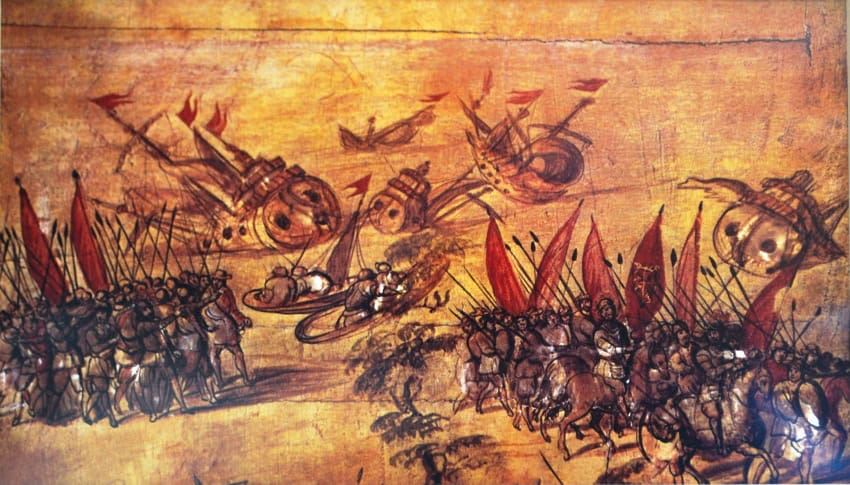
On Feb. 18, 1519, Hernán Cortés departed from Cuba on the great adventure that would end with the destruction of the Mexica Empire. By March, his small fleet sailed along the Yucatán coast, shores still uncharted by any Spaniard.
While on the island of Cozumel, he heard of a “bearded man” who lived some distance away. Excited that this sounded like a fellow Spaniard, he found villagers willing to take a message to this mysterious person.
Although the original letter has been lost, it was copied at the time, and we can be reasonably confident of its content:
“Noble sirs: Those of the island have assured me that there are in the country five or six men with beards and resembling us in all things. They are unable to give or tell me other indications, but from these I conjecture and hold certain that you are Spaniards. I and these gentlemen who go with me to settle and discover these lands urge that within six days from receiving this you come to us, without making further delay or excuse. If you shall come we will make due acknowledgment, and reward the good offices which this armada shall receive from you. I send a brigantine that you may come in it, and two boats for safety.”
A strange encounter off Cozumel
Unsure if the messengers would return, if the man they spoke of was still alive, or if he had even existed, Cortés continued his journey.
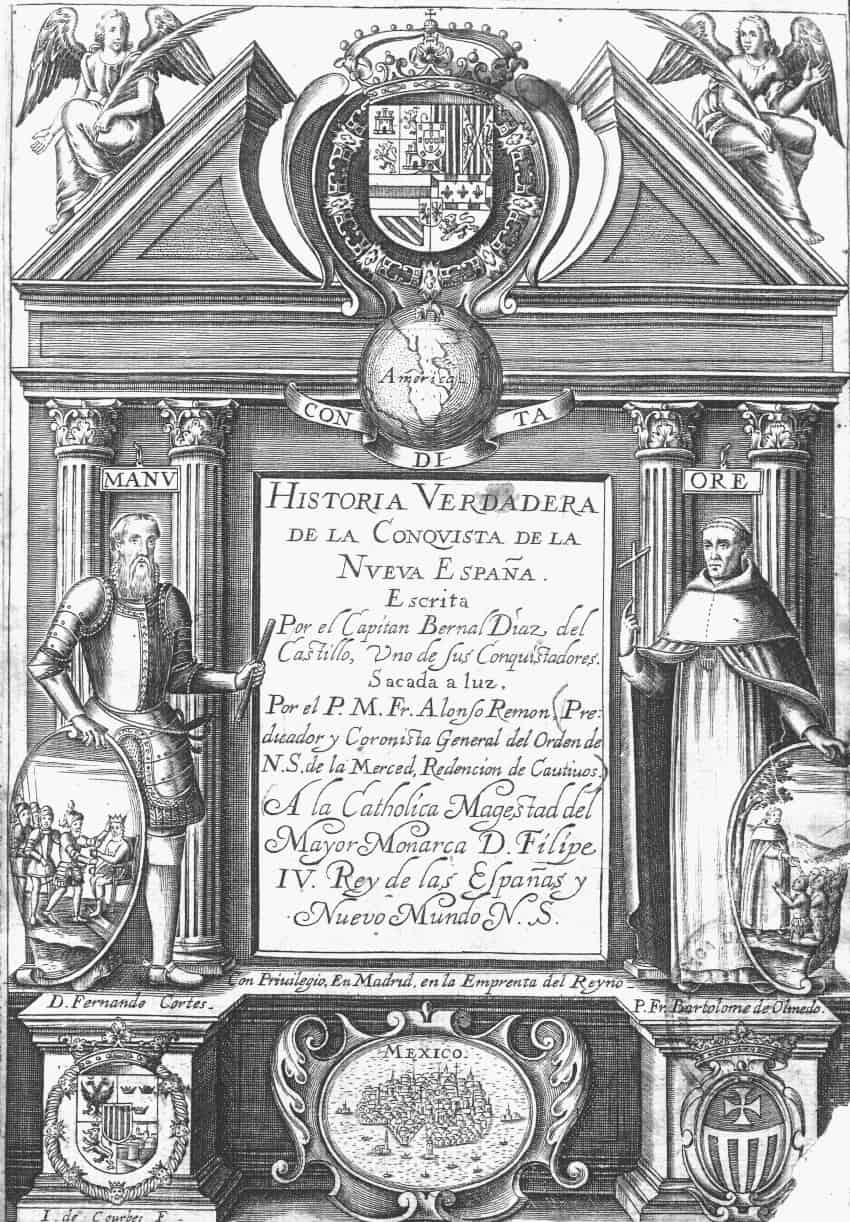
By chance, a leaking ship forced his return to Cozumel, and while repairs were underway, native canoes arrived from the mainland. Bernal Díaz del Castillo left a firsthand account of this encounter in his book, “The True History of the Conquest of New Spain.”
Aztec and Mexica are not synonyms: Here’s the difference

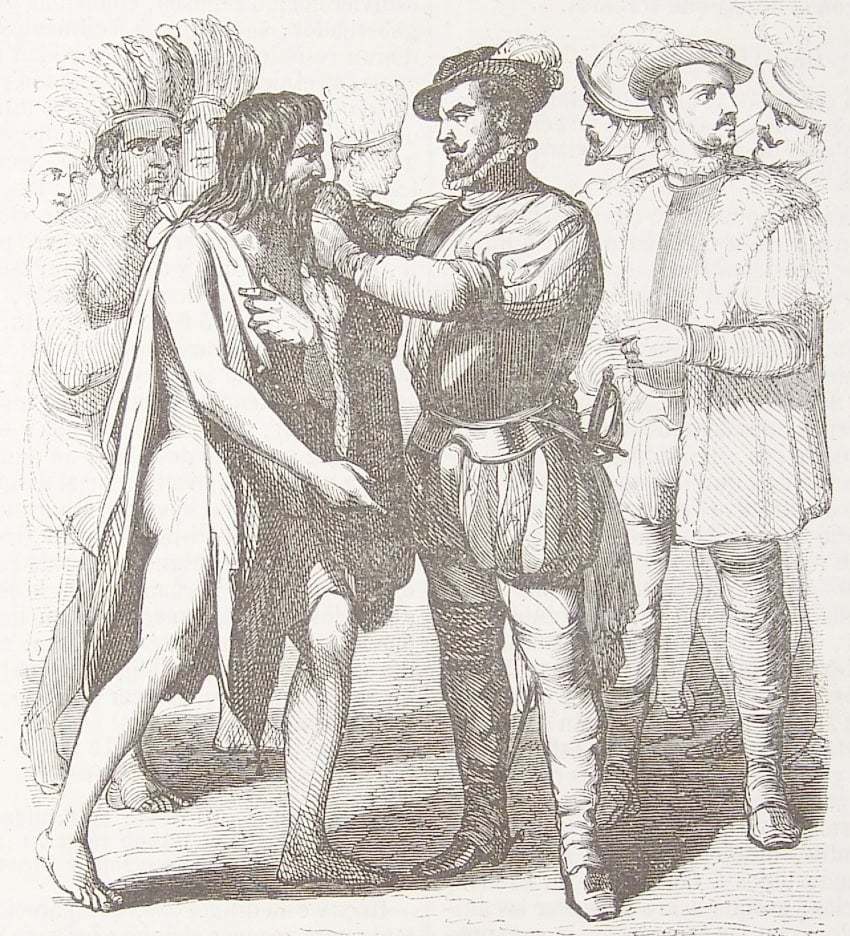
The canoes were greeted by a group of conquistadores out hunting, and one of their new arrivals stepped forward to greet them. The visitor was not immediately recognized as Spanish, for, as Díaz del Castillo writes, “they could not distinguish him from an Indian as he was naturally brown and he had his hair shorn like an Indian slave, and carried a paddle on his shoulder, he wore one old sandal and the other was tied to his belt, he had on a ragged old coat, and a worse loincloth with which he covered his nakedness.”
The man identified himself by shouting “God and Holy Mary and Seville!” in Spanish, and was immediately brought to Cortés.
The story of Gerónimo de Aguilar
Here, he introduced himself as Gerónimo de Aguilar.
Back in 1511, he had been aboard the Spanish caravel Santa María de la Barca, which had sunk in a storm while sailing from Darién to Santo Domingo. A dozen or so people had escaped the sinking vessel by clambering into a small boat. Without a sail, and with only minimal food and water, they drifted for 13 days on the open sea. The survivors had finally been washed ashore along the Yucatán coast, where they were captured by a Maya chief identified as Waymil.
Aguilar described how some of the survivors were immediately sacrificed and eaten by their captors, while he and a few others were caged “to be fattened” for the next festival.
This part of the story is doubtful, for while Maya society certainly made human sacrifices, there is no evidence of cannibalism. Similarly, no details are offered as to how Aguilar, along with a fellow prisoner, Gonzalo Guerrero, escaped from captivity. The most likely explanation is that they were passed on from their initial captors as a gift to a greater chieftain.
Two paths in captivity
The two survivors were separated and forced into slavery. Gerónimo de Aguilar was a religious man who refused all temptations to take a Maya wife, and he impressed Cortés by producing a worn prayer book that he had protected all those years. He saw Cortés as his long-awaited savior and happily joined the expedition as guide and translator.
Aguilar explained that his late arrival in Cozumel was due to trying to contact Gonzalo Guerrero. However, Guerrero, who lived some distance away, had declined to join him as he was “married and had three sons, and that his face was tattooed and his ears and lower lip were pierced.”
Aguilar served Cortés well and, after the conquest, settled in Mexico City, where he was granted land and slaves. He died in the city in 1531. He should not, it must be noted, be confused with Francisco de Aguilar, who later wrote “Brief Record of the Conquest of New Spain,” in which he also gave a passing mention of Cortés encountering a marooned Spaniard while on Cozumel.
A new attempt at conquest
A decade after Cortés had subdued the Mexica, the Maya remained stubbornly independent, but eventually Spain once again set her eyes on this world of dry scrub and thorny forests.
With this, our story switches from Hernán Cortés to Francisco de Montejo.
At this point, Montejo was in his 50s and had spent much of his adult life in the Americas. He had sailed with Cortés, for which he had been rewarded with mines and haciendas. Having been granted a charter by Charles V to “explore, conquer and colonize the islands of Cozumel and the Yucatán,” he reached Cozumel in September 1527. From there the party crossed the channel to the mainland, where they established a small settlement.
The Yucatán, however, would not be an easy conquest, and sickness, the lack of water and natives on the defensive saw the colony collapse. This was the start of a protracted struggle that would bring the Spaniards numerous setbacks, and it would be 170 years before the last independent Maya state finally fell.
The renegade Spaniard
When Montejo heard of a renegade Spaniard living with the Maya, he correctly assumed this was Gonzalo Guerrero, with whom Aguilar had been shipwrecked 16 years earlier.
While Gerónimo de Aguilar had been a priest, Guerrero was a soldier with experience from Spain’s numerous wars against the Moors and in Italy. Unlike the pious Aguilar, Guerrero had been more willing to make the best of his situation.
After 16 years with the Maya people, he was not only still alive but had used his military experience to reach a position of authority in his adopted home.
Frustrated at their lack of progress, and anxious to seek local expertise, Montejo sent Guerrero a letter reminding him of his Christian faith, and offering his friendship and a complete pardon if he would join them. Guerrero replied by writing on the back of the letter that he could not leave his lord because he was enslaved, “even though I am married and have a wife and children. I remember God, and you, Sir, and the Spaniards have a good friend in me.”
Historical accounts and condemnation
The use of the word “slave” has been questioned, as Guerrero seems to have achieved a high military rank, but there is no reason he could not have gained promotion while remaining the property of his lord.
For an account of this part of the story, we rely on the writings of Gonzalo Fernández de Oviedo y Valdés. After spending much of his life in the Americas, Oviedo returned to Spain, where he wrote “La Natural Historia de las Indias” in 1526 and “Historia General de las Indias,” which was published in 1535.
Oviedo was an eyewitness to much of what he recorded and is considered a “good” historian for conducting careful interviews with other veterans of the American campaigns. Where the facts can be checked, his work appears accurate, with none of the wandering into fantasy that marks many other travel accounts of this age.
Where Oviedo is at fault is not in his recounting of events, but in offering judgment on other people’s actions. He was obsessed with Guerrero’s physical transformation and his adoption of Maya culture, writing, “This Gonzalo, the sailor, had already been converted into an Indian and was much worse than an Indian. He was married to an Indian woman. His ears and tongue were disfigured by sacrifice, and his body decorated and painted like that of an Indian; and he had a wife and children.”
A warrior’s final battle and legacy
Oviedo attributes Guerrero’s reluctance to join his fellow Spaniards to shame about his appearance and what he had become. He does not consider that the man might have had genuine affection toward his wife and children.
Oviedo also felt the need to explain how a “primitive” people such as those of the Yucatán could have proved so resistant to Spanish arms. The answer, he felt, could only be that they had help, and the villain was obviously that lost soul Gonzalo Guerrero. Oviedo credited Guerrero with coordinating Maya resistance to Montejo in 1528 and being behind the ambush of Alonso de Dávila’s forces in 1531.
On Aug. 14, 1536, Andrés de Cereceda, governor of troublesome provinces in modern Honduras, wrote to Spain, informing the king that a party of 50 war canoes had arrived to support the uprising of the local people. They had paddled up the Ulúa River to Ticamaya, where there had been a fierce battle. During the fighting, a heavily tattooed white man had been killed by a shot from an arquebus. This was almost certainly Gonzalo Guerrero.
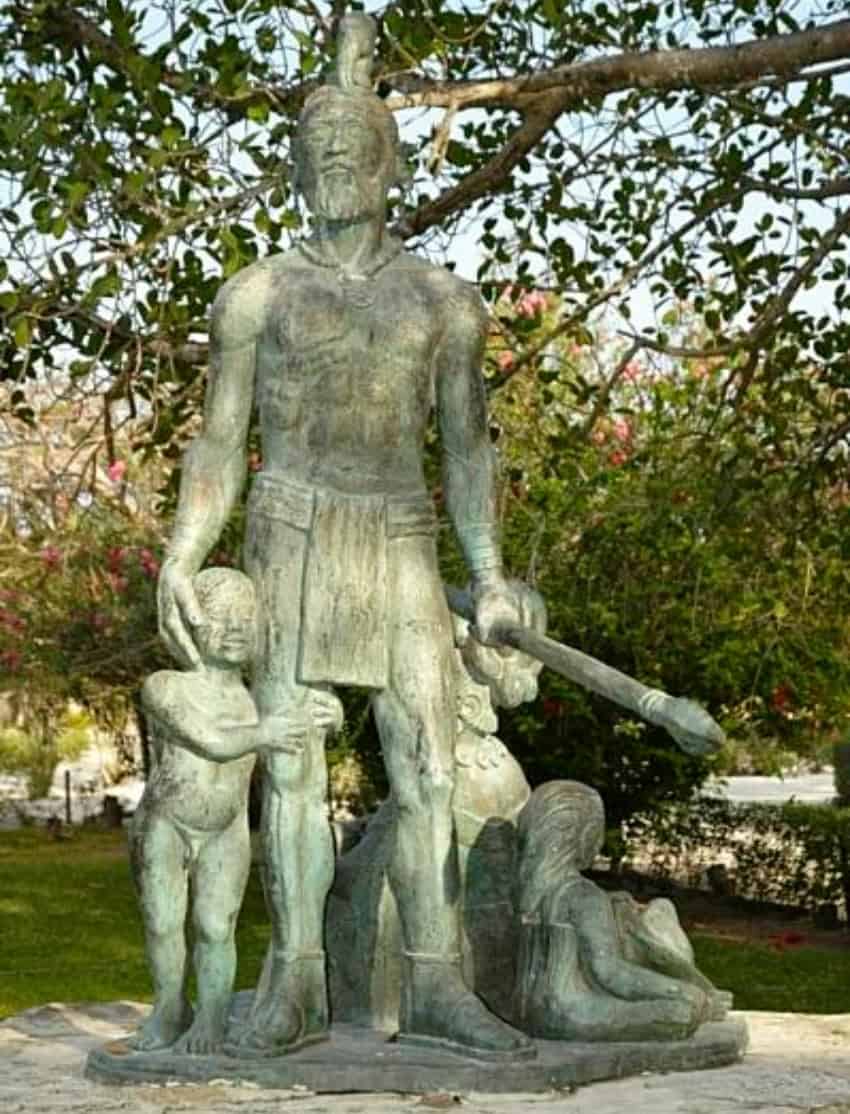
Oviedo wrote of Guerrero as a traitor, but that viewpoint has changed over the years. Today Guerrero is celebrated as a freedom fighter and father of the mestizo population. He has been the hero of historical novels, most notably Eugenio Aguirre’s bestseller “Gonzalo Guerrero,” and there is an impressive bronze statue of him and his family in the Yucatán resort town of Akumal. Whether a hero of the Maya or a traitor to the Spanish, he certainly appears to have been a brave and honorable man.
Bob Pateman lived in Mexico for six years. He is a librarian and teacher with a Master’s Degree in History.
KioskNews shows a cleaned-up reading view extracted from the publisher’s page — the original always lives on their site, not ours.