‘Once-in-a-lifetime chance’: Japan launches historic mission to collect rocks from Mars’s moon Phobos

Japan has successfully launched a spacecraft on an unprecedented mission to bring back samples from one of Mars’s moons that scientists hope will shed light on the origins of the solar system and life on Earth.
The Martian Moons Exploration (MMX) spacecraft, propelled by Japan’s flagship H3 rocket, lifted off before dawn from Tanegashima island in the country’s far south-west, the Japan Aerospace Exploration Agency (Jaxa) said.
The spacecraft is expected to reach Mars’s orbit in August next year and collect at least 10g of soil and rock from the surface of Phobos, one of two small, potato-shaped moons orbiting the planet. It is scheduled to return in 2031, Jaxa said.
The pock-marked moon, which has a diameter measuring 14 miles (22.5km), orbits Mars three times a day about 6,000km above its surface.
The flagship H3 rocket carrying the unmanned probe blasted off into a pitch black sky from Tanegashima Space Centre at 4:41am, witnessed by thousands of people who had woken up early to follow a livestream.
An hour later, Jaxa scientists declared the launch a success when the spacecraft separated from the rocket’s upper stage, prompting scenes of celebration in the flight control room.
Nasa has landed nine spacecraft on Mars over the past half a century, while China landed on the Martian surface in 2021, but this is the first time anyone has attempted to land on Phobos or the planet’s smaller moon, Deimos.
“There’s a lot of adrenaline and a lot of excitement and a lot of wow,” said Nasa astrophysicist Tom Statler, who is involved in the Japan-led project to collect samples.
Five space agencies are collaborating on the five-year mission, which will attempt to land a robotic prospector and a rover on Phobos, the larger and closer of the two moons.
The $578m mission features a five-tonne spacecraft that will sync with Phobos’ tight orbit around Mars when it arrives next summer. It will then eject a small French-German rover, named Idefix after the white terrier in the Asterix comics.
If all goes according to plan, the four-wheeled rover will bounce (due to gravity on Phobos being 1/1,000th as strong as Earth) for several minutes on Mars’s surface before coming to a halt. It will spend 100 days surveying the planet’s surface to find safe landing and sampling sites ahead of the arrival of the main craft, a four-legged stationary lander that will gather the samples.
The lander will spend only two hours on Phobos drilling and vacuuming up material, before launching back into space. Officials said it would observe Deimos during several flybys before leaving Mars’s orbit in November 2030.
“It is a once-in-a-lifetime chance. We are part of the first sample return mission from the Martian system,” said the Germany Space Agency’s rover chief Markus Grebenstein.
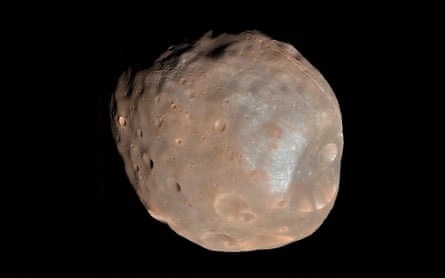
Scientists hope the samples will help them establish how Phobos and Deimos were formed and even offer clues about the origins of life. MMX’s findings will also help shape future Mars missions, including crewed expeditions, Nasa said.
According to one theory – the “giant impact” hypothesis – the two moons formed after a celestial body collided with Mars. A second proposition, known as the “capture” hypothesis, suggests that the moons are asteroids pulled in by Mars’s gravity.
Determining which theory is correct will help reveal “how a habitable environment for life might have arisen on the terrestrial planets”, Jaxa said, referring to the four planets closest to the sun: Mercury, Venus, Earth and Mars.
The US and China are in a race to be the first to return rock samples from the surface of Mars. Nasa’s Perseverance rover, which has been roaming across Mars since 2021, has already collected samples, but its return to Earth was halted by the Trump administration after a congressional vote in January this year.
China’s Tianwen-3 spacecraft is scheduled to launch around 2028 and could bring back Mars samples as early as 2031, potentially before the Japanese moon mission’s return.
KioskNews shows a cleaned-up reading view extracted from the publisher’s page — the original always lives on their site, not ours.